
Ultimate Checklist for AC Tips for Central Coast Homeowners
Article content and related resources
Master essential AC tips for Central Coast homeowners with proven passive cooling, maintenance, and smart thermostat strategies for lasting coastal comfort.
Why AC Tips for Central Coast Homeowners Are Different from the Rest of California
The best ac tips for central coast homeowners start with understanding that your coastal environment is genuinely different from the rest of the state — and what works inland often falls short here.
Here are the most important ac tips for central coast homeowners at a glance:
- Set your thermostat to 78°F when home — each degree lower adds roughly 10% to your running costs.
- Clean or replace filters every 30–60 days — salt air and coastal humidity accelerate buildup faster than inland areas.
- Use ceiling fans counterclockwise in summer — this creates a wind-chill effect and lets you raise the thermostat without losing comfort.
- Close blinds on sun-facing windows during peak heat — heavy block-out curtains can cut indoor heat gain by up to 33%.
- Open windows in the evening — the Central Coast marine layer and evening sea breezes are free cooling you should use.
- Schedule a professional tune-up before summer — ideally between March and May, before demand peaks.
- Choose a system with anti-corrosion coatings — standard units degrade faster in salt air without protective treatment.
- Use a smart thermostat — automated scheduling reduces energy waste when no one is home.
Heating and cooling can account for 40–50% of total energy use in the average Australian and American home, and that figure hits especially hard here on the California Central Coast, where nearly half of homeowners say they can't afford to run their air conditioning as much as they'd like. The challenge isn't just the summer heat — it's the salt air rolling in off the Pacific, the marine layer that keeps morning temperatures deceptively mild, and the afternoon warmth that catches unprepared systems off guard. Getting cooling right on the Central Coast means thinking about your AC system, your home's envelope, and the unique coastal conditions all at once.
I'm Matthew Palmieri, founder of Homepatible, and with a background spanning HVAC installation and repair, smart home technology, and contractor operations across Santa Barbara and San Luis Obispo Counties, I've seen how the right ac tips for central coast homeowners can mean the difference between a system that lasts 20 years and one that fails in half that time. In the sections below, I'll walk you through everything you need to keep your home cool, efficient, and protected from the conditions that make coastal HVAC a category of its own.
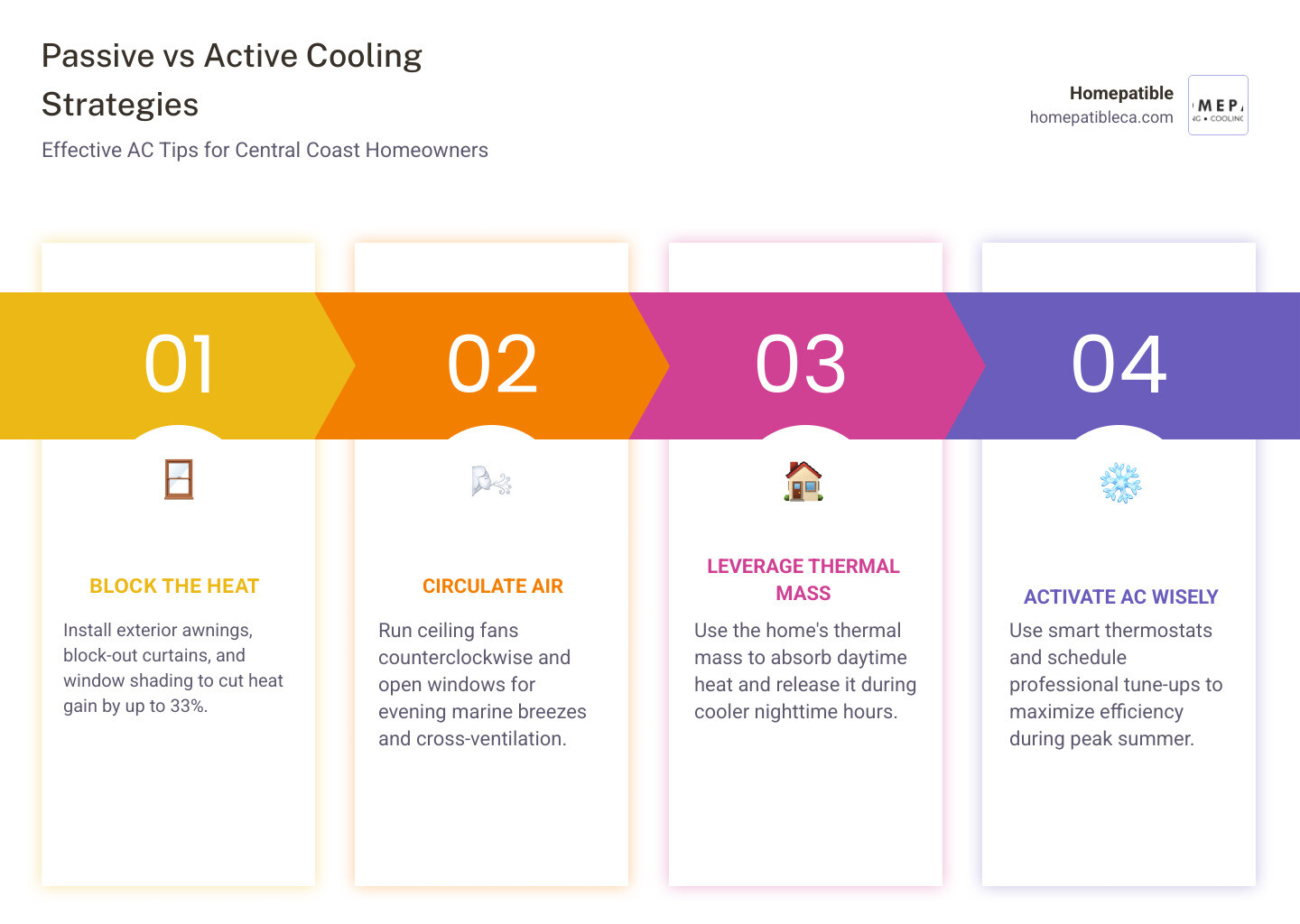
Mastering Passive Cooling and Ventilation Strategies
Before we even flip the switch on the air conditioner, we always recommend looking at your home as a "thermal envelope." In May 2026, energy efficiency isn't just a buzzword; it's a necessity for managing utility bills. Passive cooling is your first line of defense. By stopping heat from entering your home in the first place, you reduce the workload on your AC unit, extending its lifespan and saving you money.
Windows are often the biggest culprits for heat gain, impacting your energy use by as much as 30 percent. Installing heavy, block-out curtains or external shading can reduce heat gain by up to 33% simply by blocking the sun's rays before they penetrate the glass. If you're wondering How to Keep Your Cool When the Central Coast Sizzles, the answer starts with keeping those blinds closed on the sun-facing sides of your house (usually the south and west) during the hottest parts of the day.
Thermal insulation is another critical factor. A well-insulated ceiling can block up to 45% of summer heat gain. If your home in Goleta or Santa Maria feels like an oven by 3:00 PM, it might be time to check your attic insulation.

Using Fans and Shading as AC Tips for Central Coast Homeowners
One of the most effective ac tips for central coast homeowners involves the humble ceiling fan. When set to rotate counterclockwise in the summer, the fan blades push a breeze downward, creating a "wind-chill effect." While fans don't actually lower the room temperature, they make you feel up to 4°F cooler. This allows you to raise your thermostat setting without sacrificing comfort.
External shading, such as awnings or shutters, is even more effective than internal blinds because it stops the heat before it even touches the windowpane. When Teaching an Old House New Cool Tricks: HVAC Options Compared, we often find that combining these low-tech solutions with a modern AC system provides the most balanced comfort.
Strategic Nighttime Ventilation
Living on the Central Coast gives us a secret weapon: the marine layer. In places like Arroyo Grande or Carpinteria, the temperature often drops significantly once the sun goes down.
Strategic ventilation involves opening windows and doors during the cooler evening and early morning hours to flush out the day's heat. This "night flushing" cools down the thermal mass of your home — the walls, floors, and furniture — so it takes longer to heat up the next day. Just remember to seal the house back up as soon as the sun starts to warm things up in the morning. For more localized advice, check out Don't Sweat It: A Local's Guide to Getting New AC in Arroyo Grande.
Essential Maintenance for Coastal AC Longevity
The coastal air that makes our region beautiful is also a "slow-motion wrecking ball" for mechanical equipment. Salt air is highly corrosive, and if left unchecked, it can eat through the metal components of your air conditioner. This is why Coastal AC Care 101: Keeping Your Unit Cool for Years is such a vital resource for our community.
Regular maintenance isn't just about preventing breakdowns; it's about efficiency. A poorly maintained system can consume 15-25% more electricity. We recommend Central Coast homeowners follow a strict 30-to-90-day filter replacement interval, depending on whether you have pets or live near open hillsides where dust is common. For those inland in the North County, our A Complete Guide to AC System Servicing for Paso Robles Homeowners offers specific insights into managing the dust and heat of the valley.
DIY vs. Professional Maintenance Tasks
| Task | Frequency | DIY or Pro? |
|---|---|---|
| Replace Air Filters | Every 30-90 Days | DIY |
| Clear Debris from Outdoor Unit | Monthly | DIY |
| Flush Condensate Drain Line | Every 6 Months | DIY/Pro |
| Check Refrigerant Levels | Annually | Pro |
| Clean Evaporator & Condenser Coils | Annually | Pro |
| Electrical Component Inspection | Annually | Pro |
Protecting Your System from Salt Air and Humidity
To combat the corrosive effects of salt air, we look for units with factory-applied epoxy or "blue fin" protective coatings. These coatings act as a barrier between the salt and the delicate aluminum fins of your condenser.
If you live within a few miles of the ocean, one of the best ac tips for central coast homeowners is to gently rinse your outdoor unit with a garden hose (not a pressure washer!) once or twice a year to wash away salt deposits. This simple act can add years to your system's life. Additionally, using "Dry" or dehumidification modes on your AC can help manage the heavy coastal humidity without over-cooling the home. We cover these nuances in The Hidden Benefits of Regular AC Maintenance in Mild Climates. For professional help, visit our AC Maintenance Tune Up San Luis Obispo page.
Air Filter Best Practices and AC Tips for Central Coast Homeowners
Filter choice matters. We generally recommend MERV 8 to 11 filters for standard residential use. However, during wildfire season — which has become a reality for us on the Central Coast — upgrading to a MERV 13 filter can help catch fine smoke particles and PM2.5.
Be careful not to use a filter that is too restrictive, as it can reduce airflow and put undue strain on your blower motor. If you're in Lompoc, you can find more specific guidance in our Don't Sweat It: Your Lompoc AC Installation Roadmap.
Optimizing Your Thermostat for Coastal Comfort
The Department of Energy and Energy Star both recommend a baseline setting of 78°F when you are home and awake. While this might sound high to some, you can save about 3 percent on your utility bill for every degree you raise the set temperature.
On the Central Coast, where the humidity can make 75°F feel sweltering, managing the moisture in the air is just as important as the temperature. A modern thermostat can help you strike that balance. We often discuss these strategies in our Benefits of an AC Service Agreement for Savvy Homeowners.
Smart Thermostat Benefits and AC Tips for Central Coast Homeowners
As licensed Nest Pro Elite technicians, we’ve seen how smart thermostats like Google Nest can revolutionize home comfort. These devices learn your schedule and automatically adjust the temperature when you leave, ensuring you aren't cooling an empty house in Buellton or Solvang.
Key benefits include:
- Remote Access: Turn on the AC from your phone while you're driving home from the beach.
- Occupancy Sensors: Only cool the rooms you are actually using.
- Energy Reports: Track your usage and find new ways to save.
- Integration: Pairs perfectly with other smart home systems for a seamless experience.
If you're looking for AC Installation in Buellton: Chill Out with the Best HVAC Solutions, a smart thermostat is often the first upgrade we suggest.
Choosing the Right System and Professional Installation
If your system is more than 15–20 years old, it might be time to consider a replacement. Modern ENERGY STAR certified models can use up to 30% less electricity than older units. But choosing the right system isn't just about the brand; it's about the sizing.
We perform "Manual J" load calculations to ensure your system is perfectly sized for your home's square footage, insulation levels, and window orientation. An oversized unit will "short-cycle," turning on and off too quickly to properly dehumidify the air, leaving your home feeling cold and clammy. An undersized unit will run constantly, wearing itself out and driving up your bills. Our Don't Sweat It: A Complete Guide to Your New AC Setup goes into the technical details of this process.
Split Systems, Ducted Units, and Mini-Splits
- Central AC (Ducted): Best for homes with existing ductwork.
- Ductless Mini-Splits: Ideal for older homes in Santa Barbara or historic cottages where installing ducts is impossible. They offer incredible zone control.
- Heat Pumps: A highly efficient option for the Central Coast's mild climate, providing both heating and cooling.
Check out The Ultimate Decision Guide When Mini Splits Outshine Central AC to see which is right for you.
Signs You Need Professional Service or Replacement
How do you know when it's time to call us? Watch for these red flags:
- Rising Utility Bills: If your bills are climbing but your habits haven't changed, your system is losing efficiency.
- Inconsistent Cooling: Some rooms are freezing while others are sweltering.
- Strange Noises: Grinding, squealing, or banging sounds are never a good sign.
- Leaky Ducts: You can waste up to 30% of your conditioned air before it ever reaches your living room.
For a deeper dive into troubleshooting, read The Central Coast Homeowners Guide to Spotting AC Trouble Early. If you need immediate help, our AC Repair Service San Luis Obispo and Everything You Need to Know About AC Installation in San Luis Obispo pages are great starting points.
Frequently Asked Questions about AC Tips for Central Coast Homeowners
What is the best thermostat setting for Central Coast summers?
Energy Star suggests 78°F as the ideal baseline when you're home. When you're away, try setting it to 85°F, and when sleeping, 82°F. While this might feel warm initially, using ceiling fans can make these temperatures very comfortable. For more on localized installation benefits, see 5 Reasons Why You Will Love AC Install in Paso Robles.
How often should I clean my AC filters in a coastal environment?
Check them monthly. The combination of salt air, coastal fog, and seasonal dust can clog filters faster than you'd expect. Clean filters can cut AC energy use by up to 15%. This is a key part of why you should care about 5 Reasons You Should Care About Best AC Installation in SLO.
Does salt air really damage my air conditioner?
Yes, absolutely. Salt air acts like a corrosive abrasive, leading to coil leaks and significantly shorter equipment lifespans. Using protective coatings and scheduling regular professional rinsing is essential. If your system has already suffered from corrosion, you may need to look into AC Installation Replacement San Luis Obispo.
Conclusion
At Homepatible, we believe that staying cool on the Central Coast shouldn't be a struggle or a financial burden. By combining smart passive cooling strategies with professional maintenance and modern technology like Google Nest, you can create a home that is both comfortable and efficient.
Whether you're in Santa Barbara, San Luis Obispo, or any of the 40+ communities we serve, our licensed technicians are ready to help you optimize your home's climate. From 24/7 emergency repairs to precision installations, we are your local experts in making homes smarter and safer.
Ready to take the next step?
Our certified technicians are ready to help with all your home service needs. Schedule a service today.
Schedule My ServiceRecent Posts
Related Articles
Ready to Get Started?
Whether you need a repair, maintenance, or a new system, our expert team is here to help.