
The Ultimate Decision Guide: When Mini Splits Outshine Central AC
Article content and related resources
Discover when is a mini split better than central AC for energy efficiency, zoned comfort, older homes & Central Coast additions. Expert guide!
When Is a Mini Split Better Than Central AC? (Quick Answer for Central Coast Homeowners)
When is a mini split better than central AC is one of the most common questions homeowners across Santa Barbara and San Luis Obispo County are asking in 2026 — and for good reason. The answer isn't one-size-fits-all, but in many situations, a ductless mini split system is the clear winner.
Here are the most common scenarios where a mini split outperforms central AC:
- No existing ductwork - Older homes, slab foundations, or historic properties where adding ducts would be costly or disruptive
- Home additions and conversions - Garages, sunrooms, attic rooms, or finished basements that aren't connected to your central system
- Zoned comfort needs - When different family members need different temperatures in different rooms
- Energy efficiency is a priority - Mini splits can reach up to 42 SEER, compared to central AC's typical ceiling of around 26 SEER, and eliminate the 20-30% energy loss that ductwork causes
- Targeted cooling or heating - Only conditioning the rooms you actually use, rather than the whole house
- Quieter operation - Mini split indoor units run as quietly as 19 decibels, far below most central air handlers
- Heating and cooling in one unit - Most mini splits work as heat pumps, so you get year-round comfort from a single system
Central AC still makes sense when you have well-maintained existing ductwork and need consistent whole-home cooling across a large floor plan. But for many Central Coast homes — especially older properties or those with unique layouts — a mini split is simply the smarter, more efficient choice.
Read on for a deeper breakdown of each scenario so you can make the right call for your home.
When is a mini split better than central AC for energy efficiency?
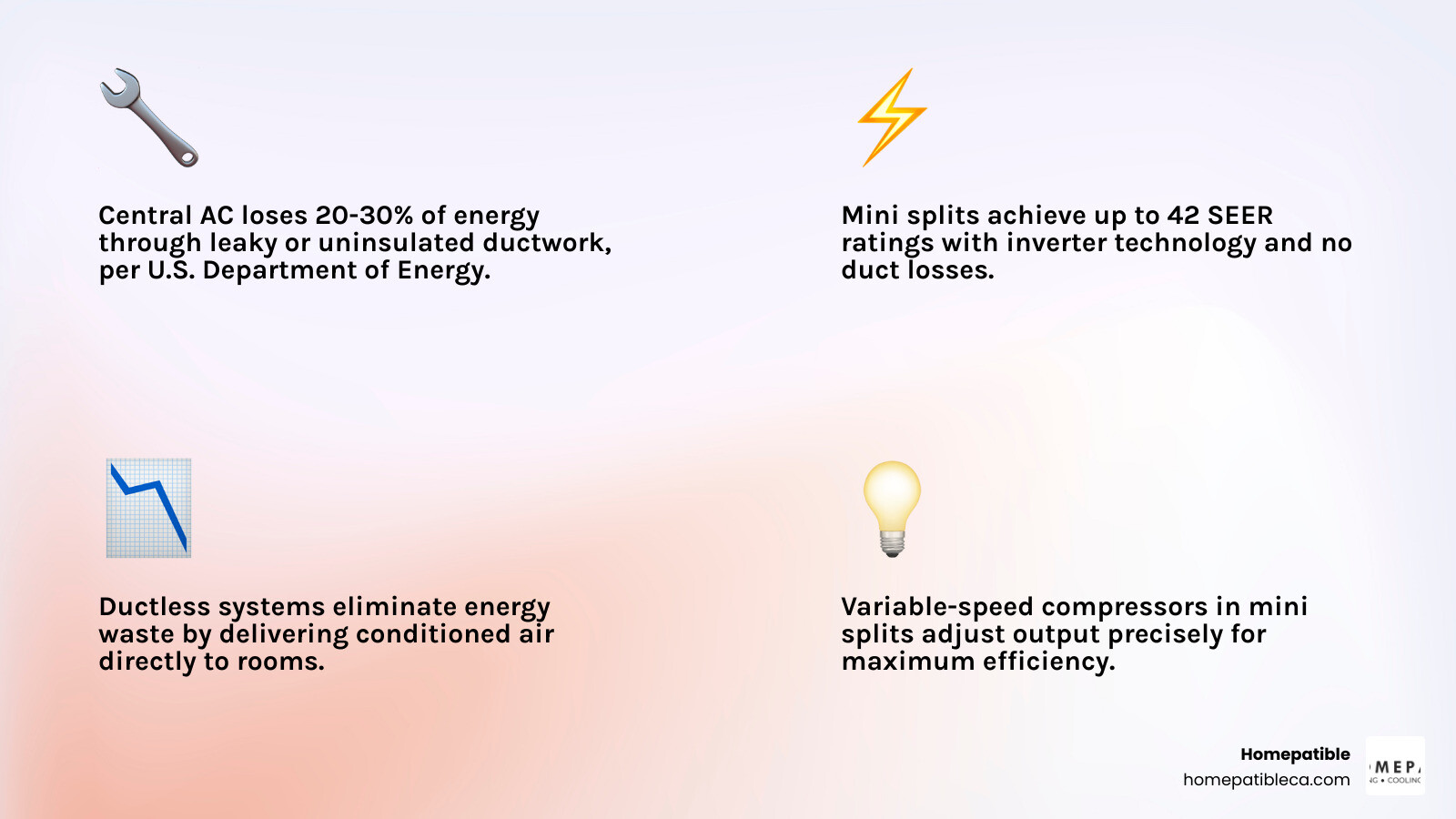
If your goal is to lower your monthly utility bills in 2026, the efficiency gap between these two systems is one of the most important factors to consider. Mini splits are inherently more efficient because they deliver conditioned air directly into the room, bypassing the "middleman" of ductwork.
According to the U.S. Department of Energy, typical central air systems can lose up to 30% of their energy through leaky or poorly insulated ducts. This means nearly a third of the air you pay to cool never actually reaches your living space. By going ductless, you eliminate this waste entirely.
| Feature | Central AC | Ductless Mini Split |
|---|---|---|
| Max Efficiency (SEER2) | Up to 26 SEER2 | Up to 42 SEER2 |
| Ductwork Energy Loss | 20% to 30% | 0% (Ductless) |
| Compressor Technology | Often Single or Two-Stage | Variable-Speed Inverter |
| Electricity Usage | Standard | 15% to 50% Less in AC Mode |
The secret to this efficiency lies in inverter technology. While many traditional central units operate like a light switch—either 100% on or completely off—mini splits use variable-speed compressors. These act more like a dimmer switch, adjusting their output precisely to match the cooling demand of the room. This prevents the energy-heavy "starts and stops" associated with older HVAC technology. To learn more about how these compact powerhouses work, check out our guide on Ductless AC Installation in San Luis Obispo: Small Units, Big Chill.
Strategic Scenarios for Ductless Technology
Beyond raw efficiency numbers, when is a mini split better than central AC often comes down to the specific layout and usage of your home. We often see homeowners in Santa Ynez or Pismo Beach struggling with "problem rooms"—that one bedroom over the garage that never gets cool, or a sunroom that feels like an oven in July.
Mini splits offer zoned temperature control, meaning each indoor unit has its own thermostat. This allows you to:
- Cool the master bedroom to 68 degrees while leaving the guest room at 75.
- Turn off the air in the living room entirely while you sleep.
- Provide dedicated comfort to guest suites or finished basements without overtaxing your main system.
For residents in the Santa Ynez Valley, where temperatures can fluctuate significantly between day and night, this flexibility is a game-changer. You can find more details on our Santa Ynez CA Ductless service page.
When is a mini split better than central AC for home additions in Santa Barbara?
If you are adding a new room, converting an attic, or finishing a basement, extending your existing central AC ductwork can be a logistical nightmare. It often requires cutting into walls, dropping ceilings, and—most importantly—it may require you to replace your entire central unit because the original wasn't sized to handle the extra square footage.
In these "unconditioned spaces," a mini split is almost always the superior choice. It provides a dedicated solution for the new space without putting any extra strain on your primary system. Whether it's a new sunroom in Ballard or a home office in Goleta, a single-zone mini split can be installed in as little as one day. For a roadmap on how these installations work in our local climate, see AC Installation in Ballard CA: Your Ticket to a Breeze-Easy Summer.
When is a mini split better than central AC for older homes in San Luis Obispo?
San Luis Obispo is home to beautiful historic architecture, but many of these older homes were built long before central air was a standard feature. These houses often feature:
- Slab foundations with no room for under-floor ducts.
- Plaster walls that are difficult and expensive to renovate.
- Limited closet space where an air handler would traditionally sit.
Installing a full central AC system in a home that lacks ductwork can add upwards of $18,000 to your project cost just for the ducts alone. A mini split bypasses this destruction. We simply need a small three-inch hole in the wall to connect the indoor unit to the outdoor compressor. This preserves the historic integrity of your home while providing 2026-level comfort. Discover how we handle these delicate projects on our Paso Robles CA Ductless Services page.
Comparing Installation and Long-Term Maintenance
When comparing the two, many homeowners focus solely on the "box" and forget about the long-term care. Central AC maintenance involves changing filters every 30 to 90 days and, eventually, paying for professional duct cleaning to remove dust, pet dander, and allergens that accumulate over the years.
Mini splits require a different approach. Most units feature washable air filters that you can simply rinse in the sink every few weeks. This is a significant advantage for indoor air quality, as the air isn't traveling through dusty hidden passages before it reaches your lungs. However, mini splits do require "deep cleans" of the indoor blower wheels every 6 to 12 months to prevent mold growth, especially in our humid coastal areas like Carpinteria or Pismo Beach.
We recommend a professional tune-up at least once a year for either system to ensure the refrigerant levels are correct and the electrical components are safe. For residents in the northern part of our service area, our A Complete Guide to AC System Servicing for Paso Robles Homeowners and Templeton CA Ductless Maintenance Tune-Up resources offer specialized advice for our local weather patterns.
Performance and Heating Capabilities in the Central Coast Climate
It is a common misconception that mini splits are "just for cooling." In reality, most modern mini splits are high-performance heat pumps. They don't create heat; they move it. Even in the relatively mild winters of Santa Barbara and San Luis Obispo Counties, a heat pump is significantly more efficient than a traditional gas furnace.
In 2026, "Hyper-Heat" technology allows these systems to provide reliable warmth even if temperatures were to drop below freezing—though that's a rarity for us! More importantly for our coastal neighbors in Summerland or Montecito, mini splits are excellent at managing coastal humidity. Because they run on variable speeds, they can stay on at a low level for longer periods, which pulls more moisture out of the air than a central system that cycles on and off rapidly.
If your current heating system is struggling, you might consider a Heat Pump Installation Replacement or check out our Heat Pumps Repair Service if your existing unit isn't keeping you cozy.
Frequently Asked Questions about Mini Splits vs. Central Air
Can a mini split system cool an entire house effectively?
Yes, absolutely. While many people think of mini splits as "single-room units," we frequently install multi-zone configurations. A single outdoor compressor can power up to eight indoor units (heads). By performing a proper Manual J load calculation, our technicians ensure the system is perfectly sized for your entire square footage. This is a popular option for homes on Vandenberg Space Force Base CA Ductless Installation Replacement projects where whole-home efficiency is a priority.
Do ductless systems increase home resale value in 2026?
In today's market, energy-conscious buyers are looking for two things: lower utility bills and personalized comfort. A high-efficiency mini split system checks both boxes. While central AC used to be the "gold standard" for resale, modern buyers appreciate the ability to control temperatures room-by-room. In areas like Pismo Beach, where "green" home features are highly coveted, a premium ductless system can offer a return on investment of 55% to 80% of its cost. Explore your options at Pismo Beach CA AC Installation Replacement.
Are mini splits quieter than traditional central air conditioners?
Yes, by a wide margin. In a central AC system, you often hear the "whoosh" of air moving through ducts and the loud "clunk" of the air handler turning on. Mini split indoor units are designed for "whisper mode," often operating between 19 and 26 decibels—roughly the sound of a library or rustling leaves. The outdoor units are also significantly quieter, making them better for close-neighbor situations in Santa Maria or San Luis Obispo. For more on quiet cooling, visit our San Luis Obispo CA Air Conditioning page.
Conclusion
So, when is a mini split better than central AC? If you live in an older home without ducts, are building an addition, or simply want the highest energy efficiency and most precise comfort control available in 2026, the mini split is the winner. If you have a large, open-concept home with existing, high-quality ductwork, central AC remains a strong contender.
At Homepatible, we don't believe in "cookie-cutter" HVAC. Our licensed Nest Pro Elite technicians serve the entire Central Coast, from the hills of Montecito to the suburbs of San Luis Obispo. We specialize in integrating these high-efficiency systems with smart home technology to give you total control over your environment.
Whether you need a 24/7 emergency repair or a consultation for a brand-new whole-home system, we are here to help. Contact our team for comprehensive home comfort services today and let's find the perfect fit for your Central Coast home.
Ready to take the next step?
Our certified technicians are ready to help with all your home service needs. Schedule a service today.
Schedule My ServiceRecent Posts
Related Articles
Ready to Get Started?
Whether you need a repair, maintenance, or a new system, our expert team is here to help.