
Step-by-Step Guide to Two-Stage and Variable Speed Systems
Article content and related resources
Discover if two-stage and variable-speed systems are worth the extra cost for Central Coast homes with this step-by-step comfort and efficiency guide.
Are Two-Stage and Variable-Speed Systems Worth the Extra Cost on the Central Coast?
Are two-stage and variable-speed systems worth the extra cost? For most Central Coast homeowners in Santa Barbara and San Luis Obispo Counties, the answer depends on three things: how long you plan to stay, how much your climate demands from your cooling system, and how much indoor comfort matters to your daily life.
Here is a quick breakdown to answer the core question directly:
| System Type | Best For | Worth the Upgrade? |
|---|---|---|
| Single-Stage | Short-term ownership, mild use, tight budget | Not always — solid baseline option |
| Two-Stage | Most homeowners, humid or warm climates | Yes — strong comfort and value balance |
| Variable-Speed | Long-term owners, hot/humid climates, comfort-focused | Yes — highest efficiency and comfort over time |
Key facts at a glance:
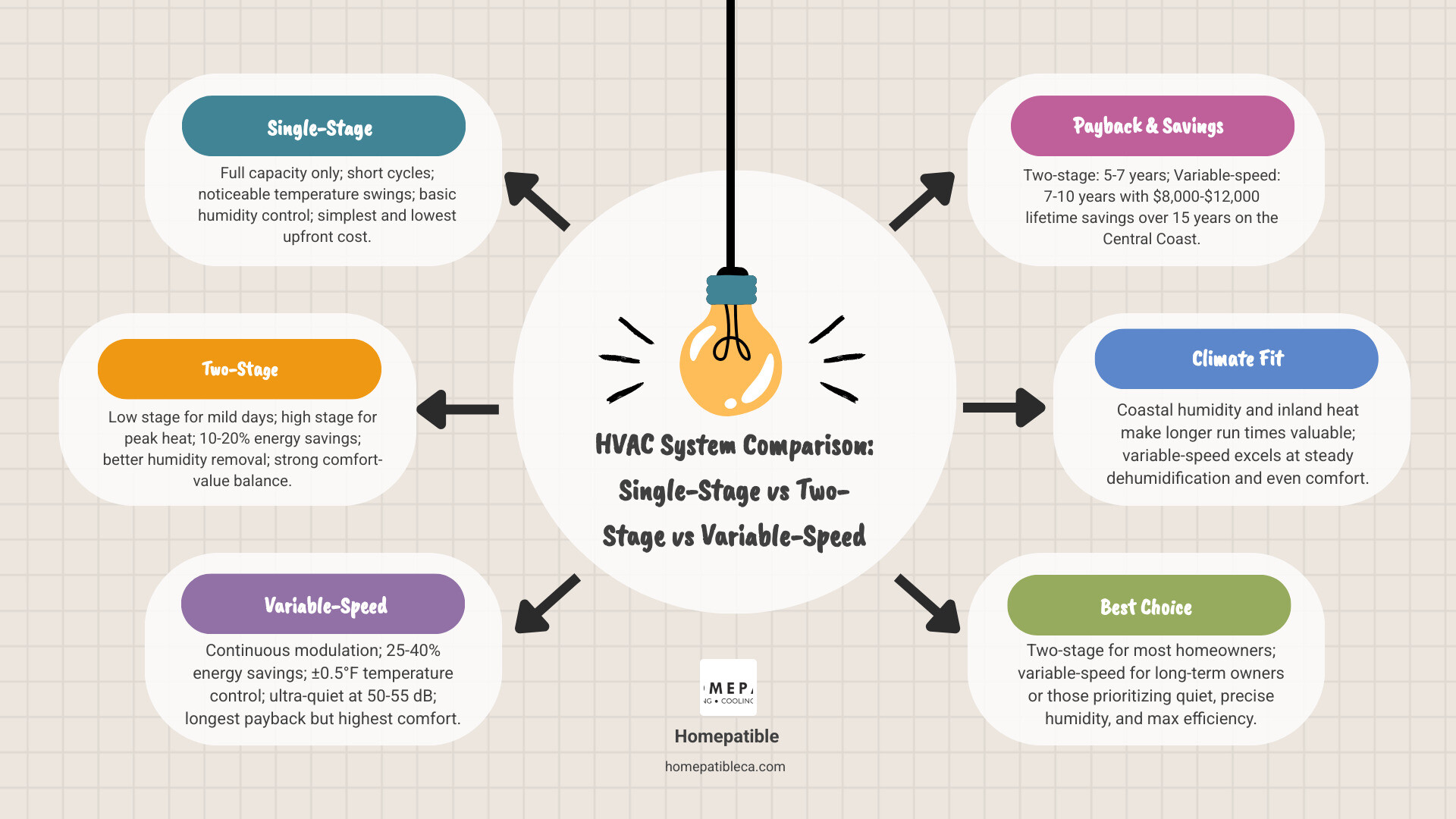
- Two-stage systems can reduce energy use by 10–20% over single-stage
- Variable-speed systems can cut energy consumption by 25–40%
- Variable-speed systems can save $40–$80 per month compared to single-stage
- Two-stage systems typically pay back their premium in 5–7 years
- Variable-speed systems typically pay back in 7–10 years, with potential lifetime savings of $8,000–$12,000 over 15 years
- Variable-speed systems maintain temperatures within 0.5°F of your setting vs. 3–4°F swings with single-stage
- Variable-speed systems operate as quietly as 50–55 decibels vs. 70–75 decibels for single-stage units
The Central Coast's mix of coastal humidity, inland heat, and mild shoulder seasons means your system choice has real consequences for daily comfort — not just your energy bill. Whether you are cooling a ranch home in Goleta or a two-story in Arroyo Grande, understanding what each system actually does (and doesn't do) helps you make a smarter investment.
I'm Matthew Palmieri, founder of Homepatible, and with a background spanning HVAC systems, smart home technology, and contractor operations across the Central Coast, I've helped hundreds of homeowners work through exactly this question of are two-stage and variable-speed systems worth the extra cost for their specific home and climate. In this guide, I'll walk you through every factor you need to weigh — from how each system works, to comfort differences you'll actually feel, to the incentives that can close the cost gap.
Step 1: Understand How Single-Stage, Two-Stage, and Variable-Speed Systems Work
To evaluate whether a premium heating and cooling upgrade makes financial sense, we first have to look under the hood. The core difference between these systems lies in how the compressor—the heart of your outdoor unit—and the indoor blower motor handle airflow and cooling cycles.
Traditional systems operate on a binary principle, while modern systems utilize advanced modulation to match your home's heat load in real-time. Let's look at how these technologies compare side-by-side:
| Performance Feature | Single-Stage Systems | Two-Stage Systems | Variable-Speed Systems |
|---|---|---|---|
| Compressor Speeds | 1 (Fixed at 100%) | 2 (Low ~65-70% / High 100%) | Infinite (Modulates 30% to 100%) |
| Average SEER2 Rating | 14 – 15 SEER2 | 15 – 17 SEER2 | 18 – 22+ SEER2 |
| Temperature Variance | ± 3°F to 4°F swings | ± 1°F to 2°F swings | ± 0.5°F (Near-constant) |
| Humidity Removal | Standard | Enhanced | Maximum (Up to 400% more moisture) |
| Average Sound Level | 70 – 75 dB | 60 – 68 dB | 50 – 55 dB |
| Relative Upfront Premium | Baseline | Moderate (15% to 30% higher) | High (50% to 70% higher) |
Single-Stage Systems: Simple On-or-Off Cooling
A single-stage system is the traditional standard for residential air conditioning. It operates like a basic light switch: it is either 100% on or completely off. When your thermostat detects that the indoor temperature has risen above your setpoint, it signals the compressor to start up at maximum capacity.
Because it only runs at full blast, a single-stage system cools the home quickly and then shuts off. This rapid cycle—known as short-cycling—creates noticeable temperature swings and limits the system's ability to pull moisture out of the air. It is a simple, time-tested approach, but it is the least efficient way to manage indoor comfort.
Two-Stage Systems: Low Stage Most Days, High Stage When Needed
Think of a two-stage system like a ceiling fan with low and high settings. Instead of running at full capacity all the time, a two-stage compressor can operate at a lower capacity (typically around 65% to 70% of its maximum output) on mild days.
When the outdoor temperature climbs during a warm afternoon in Solvang or Santa Ynez, the system automatically steps up to 100% capacity. Because the low stage is sufficient to handle about 80% of your daily cooling needs, a two-stage system runs for longer, gentler cycles. This reduces the energy-intensive start-and-stop sequence and provides much steadier cooling.
Variable-Speed Systems: Continuous Adjustment for Precise Comfort
Variable-speed systems represent the pinnacle of modern HVAC technology. Instead of fixed steps, they use inverter-driven compressors that continuously modulate their output in tiny 1% increments, typically ranging from 30% to 100% capacity.
This operation is highly comparable to a car's cruise control. Rather than floor the gas pedal and slam on the brakes (like a single-stage unit), a variable-speed system adjusts its speed continuously to maintain a perfectly steady temperature. Running "low and slow" allows the system to operate almost continuously at a highly efficient whisper, providing unmatched humidity removal, superior air filtration, and incredibly quiet performance.
Step 2: Decide If Are Two Stage and Variable Speed Systems Worth the Extra Cost for Your Home
Determining if are two stage and variable speed systems worth the extra cost requires looking past the initial installation and analyzing the total cost of ownership. The right decision depends heavily on your long-term plans, your local microclimate, and your household comfort priorities.
Are Two Stage and Variable Speed Systems Worth the Extra Cost If You Plan to Stay Long-Term?
If you plan to live in your Central Coast home for the next 7 to 10 years or longer, upgrading to a premium system is almost always a wise financial move. Because variable-speed systems can reduce cooling-related energy consumption by 25% to 40%, the monthly utility savings accumulate significantly over time. Over a typical 15-year equipment lifespan, a variable-speed system can save thousands of dollars in operational costs compared to a standard single-stage unit.
Furthermore, premium systems experience less physical strain because they avoid the constant hard starts associated with single-stage equipment. When integrated with high-quality smart thermostats, these systems can learn your home's thermal profile over time, maximizing your return on investment.
Are Two Stage and Variable Speed Systems Worth the Extra Cost in Hot or Humid Climates?
While our region is famous for its Mediterranean climate, local geography creates distinct microclimates. Coastal communities like Carpinteria, Montecito, and Goleta often deal with heavy marine layers and high outdoor humidity. Meanwhile, inland areas like Buellton, Los Alamos, and parts of Santa Maria experience intense summer heat.
In humid coastal areas, a single-stage system can easily leave your home feeling sticky. Because it cools the air too quickly, it shuts off before it has run long enough to pull moisture out of the air. A variable-speed system, on the other hand, runs longer at lower speeds, removing up to 400% more moisture than a standard system under challenging conditions. If you want to eliminate that heavy, "swamp-like" feeling indoors, upgrading to a modulating system is absolutely worth the investment. For more details on high-efficiency equipment, read about The Pros and Cons of Upgrading to High Efficiency AC Systems.
When a Single-Stage System May Still Make Sense
Upgrading is not always the right move for every situation. A single-stage system remains a highly practical and reliable choice if:
- You plan to sell the home soon: If you expect to move within the next 3 to 5 years, you likely won't stay long enough to reach the payback point through utility savings.
- You live in an exceptionally mild pocket: If you reside in an area where you only turn on the air conditioner a handful of times per year, the energy savings won't be substantial enough to justify the upfront premium.
- You are working with a strict upfront budget: A high-quality single-stage system installed by a professional is still a fantastic, reliable option that will keep your home safe and cool.
Step 3: Compare Real Comfort Differences You’ll Actually Feel
While energy savings are a major part of the math, the day-to-day comfort improvements are often what homeowners appreciate the most. Premium HVAC systems completely transform how your indoor environment feels.
Temperature Consistency: From Wide Swings to Near-Steady Comfort
With a single-stage system, you often experience a "sweat-chill" cycle. The system blasts cold air until the thermostat is satisfied, making you feel chilly. Once it shuts off, the indoor air remains stagnant, and the temperature slowly climbs three to four degrees until the system blasts on again.
Two-stage and variable-speed systems eliminate these dramatic spikes. By modulating their output, variable-speed systems keep your indoor temperature within 0.5°F of your thermostat setting. This steady, gentle movement of air prevents hot and cold spots, ensuring that your upstairs bedrooms and open-concept living areas maintain the exact same level of comfort.
Humidity Control: Why Longer Run Times Matter
High indoor humidity makes the air feel significantly warmer than it actually is, often forcing you to lower your thermostat setting just to feel comfortable. Air conditioning systems naturally remove moisture as warm air passes over the cold evaporator coil, causing water vapor to condense and drain away.
Because single-stage systems run in short, aggressive bursts, the coil doesn't stay cold long enough to remove significant moisture. Two-stage and variable-speed systems run for much longer, continuous cycles at lower speeds. This steady contact with the cold coil allows a variable-speed unit to remove up to 30% more humidity than a two-stage system, keeping your home's relative humidity within the ideal 30% to 50% range. This is especially beneficial for coastal properties prone to mold and indoor air quality concerns.
Noise Levels: Which Systems Run Quieter?
If you have ever had to pause a movie or raise your voice because the outdoor AC unit kicked on right outside your window, you know how intrusive a loud system can be. Single-stage systems operate at roughly 70 to 75 decibels—comparable to a loud vacuum cleaner.
Because variable-speed systems spend the vast majority of their time running at lower, highly efficient capacities, they operate at a whisper-quiet 50 to 55 decibels. This is about the volume of a quiet conversation or a gentle rainfall. The indoor blower motor also ramps up and down gradually, eliminating the loud "whoosh" of air that often startles pets and wakes light sleepers during the night.
Step 4: Factor in Installation Quality, Ductwork, and Smart Controls
No matter how advanced an HVAC system is, its real-world performance is entirely dependent on the quality of its installation and the design of the surrounding system. This is particularly true for premium, modulating equipment.
Why Proper Sizing Matters More Than the Equipment Label
One of the most common mistakes in our industry is sizing a system based on guesswork or simple square footage rules of thumb. Over 60% of homes in the U.S. suffer from HVAC sizing errors. If a variable-speed system is oversized, it will short-cycle just like a single-stage unit, completely wiping out its efficiency and humidity-control benefits.
Before any installation, we perform a detailed Manual J load calculation. This scientific assessment factors in your home's insulation, window orientation, local climate, and layout to determine the exact heating and cooling capacity required. If you are preparing for a new system in Ballard, check out our guide on AC Installation in Ballard CA: Your Ticket to a Breeze Easy Summer.
Why Ductwork Can Make or Break Variable-Speed Performance
Your ductwork is the highway system for your home's conditioned air. If your ducts are leaky, undersized, or poorly designed, you can lose up to 25% to 40% of your system's total airflow.
Variable-speed systems rely on precise static pressure to modulate airflow correctly. If you connect a highly advanced variable-speed unit to restrictive, uninsulated, or leaky ducts, the system will struggle to perform, and you may even experience moisture issues in your attic or crawlspace. Ensuring your duct system is sealed, insulated, and properly sized is a critical first step. For homeowners in the northern part of our service area, planning a professional installation is key; learn more about AC Installation Replacement Paso Robles CA.
Smart Thermostats and Communicating Controls
A standard thermostat cannot communicate the complex data required to run a true variable-speed system. To unlock the full potential of continuous modulation, these systems require proprietary communicating thermostats or advanced smart home integration.
As licensed Nest Pro Elite technicians, we specialize in bridging the gap between traditional mechanical systems and modern home automation. A properly integrated smart thermostat can monitor indoor humidity, track outdoor weather changes, and manage complex staging logic to keep your energy bills as low as possible. To learn more about how smart technology optimizes your system, read The Science of Savings: Improving Efficiency via Smart Integration.
Step 5: Weigh Lifespan, Maintenance, Repairs, and Incentives
Investing in a premium system requires a clear understanding of what to expect over the next 15 years regarding equipment longevity, ongoing maintenance, and the financial incentives available to help offset the initial purchase.
Do Two-Stage or Variable-Speed Systems Last Longer?
With proper professional installation and routine maintenance, all three system types can realistically last 15+ years. However, two-stage and variable-speed systems often have a slight edge in longevity.
The primary cause of wear and tear on an HVAC compressor is the startup sequence. Starting up requires a massive surge of electrical current and places significant physical stress on internal bearings. Because variable-speed systems run continuously at low capacities and avoid constant cycling, they experience fewer hard starts, reducing thermal and mechanical stress on vital components.
Maintenance and Repair Differences Over Time
While premium systems run more efficiently, they are highly sophisticated machines containing complex inverter boards, electronic expansion valves, and communicating sensors.
- Maintenance: Every system requires annual professional maintenance to keep coils clean, clear condensate drains, and verify electrical connections. If you want to keep your system running at peak performance, check out the Benefits of an AC Service Agreement for Savvy Homeowners.
- Repairs: Because premium systems use advanced, proprietary parts, repairs can be more complex and costly once the manufacturer's warranty expires. This makes routine preventive maintenance incredibly important. If you live in Santa Maria, you can easily schedule your annual service through our AC Maintenance Tune Up Santa Maria CA page. If you are experiencing system issues further south, we also offer rapid AC Repair Service Arroyo Grande CA.
Rebates, Incentives, and Financing That May Improve Upgrade Value
The upfront cost of upgrading to a two-stage or variable-speed system can be significantly reduced by taking advantage of modern financial incentives:
- Federal Tax Credits (Section 25C): Under the Energy Efficient Home Improvement Credit, qualifying high-efficiency central air conditioners and heat pumps can qualify for tax credits of up to $600 for AC units and up to $2,000 for heat pumps.
- Utility Rebates: Many local utility companies on the Central Coast offer rebates for installing high-efficiency, ENERGY STAR certified equipment.
- Flexible Financing: We offer excellent financing options, including qualifying projects with 0% APR for up to 60 months, allowing you to pay for the system over time as you enjoy lower monthly energy bills. To explore more ways to save energy in California, check out our guide on How to Make Your California Home Energy Efficient Without Breaking the Bank.
Frequently Asked Questions About Two-Stage and Variable-Speed HVAC Systems
How much can homeowners realistically save on monthly energy use?
In real-world conditions on the Central Coast, homeowners upgrading from an old, single-stage system to a variable-speed system typically see a 25% to 40% reduction in their cooling-related electricity costs. For a home that runs its air conditioning frequently during the summer, this translates to monthly savings of $40 to $80, resulting in thousands of dollars saved over the life of the system.
Is two-stage good enough, or should I choose variable-speed?
For many homeowners, a two-stage system is the "sweet spot" of home comfort. It provides about 80% of the comfort and humidity-control benefits of a variable-speed system at a more accessible upfront cost. However, if you are highly sensitive to noise, struggle with severe indoor humidity, have a multi-story home with hot spots, or plan to stay in your home for the long term, the whisper-quiet operation and perfect temperature control of a variable-speed system are well worth the extra investment.
Can I add variable-speed cooling to my existing HVAC system?
No, you cannot simply swap your outdoor unit for a variable-speed model. True variable-speed operation requires a fully matched, communicating system. This means your outdoor compressor, your indoor air handler or furnace blower motor, and your thermostat must all be compatible and designed to communicate with one another. It is almost always necessary to perform a complete system replacement to get the full benefits of variable-speed technology.
Conclusion
Deciding if are two stage and variable speed systems worth the extra cost ultimately comes down to aligning your home's unique needs with your personal comfort and financial goals. For many families on the Central Coast, the whisper-quiet operation, consistent temperatures, and superior humidity control turn an ordinary house into a true sanctuary.
At Homepatible, we serve homeowners throughout Santa Barbara and San Luis Obispo Counties with transparent pricing, expert craftsmanship, and 24/7 emergency support. Whether you are ready to design a modern smart home system or simply want an honest, professional assessment of your current equipment, we are here to help.
Ready to explore your home comfort options? Request air conditioning service guidance from our team today, or give us a call to speak with one of our licensed technicians!
Ready to take the next step?
Our certified technicians are ready to help with all your home service needs. Schedule a service today.
Schedule My ServiceRecent Posts
Related Articles
Ready to Get Started?
Whether you need a repair, maintenance, or a new system, our expert team is here to help.