
The Science of Savings: Improving Efficiency via Smart Integration
Article content and related resources
Discover how smart home technology improves home efficiency with thermostats, lighting, HVAC, and water systems for 10-30% energy savings.
Why How Smart Home Technology Improves Home Efficiency Matters for Central Coast Homeowners
How smart home technology improves home efficiency comes down to one core idea: your home's systems — heating, cooling, lighting, appliances, and water — work together automatically to use only the energy they actually need.
Here's a quick breakdown of how it works:
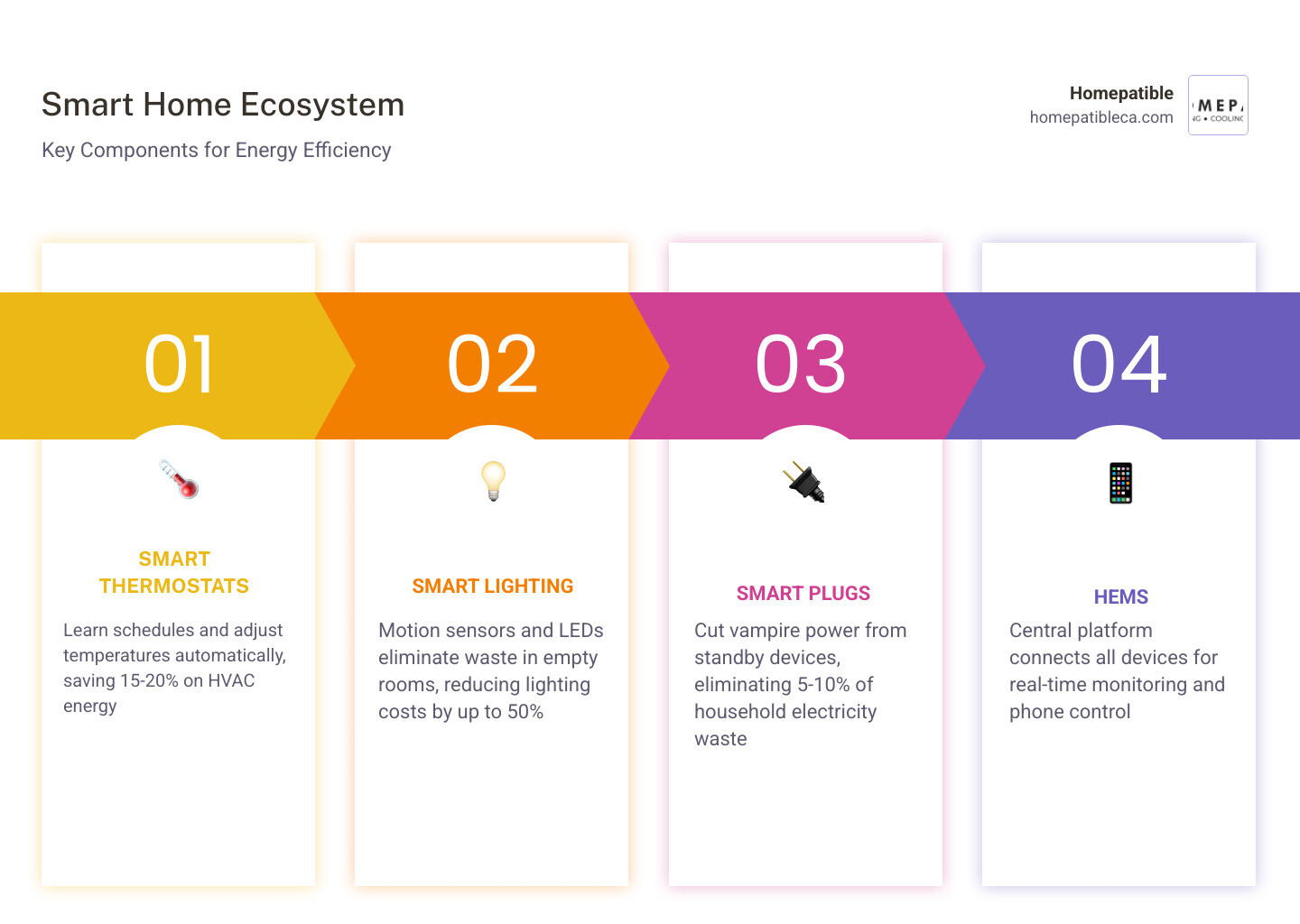
- Smart thermostats learn your schedule and adjust temperatures automatically, saving up to 15–20% on heating and cooling
- Smart lighting uses motion sensors and LED bulbs to eliminate wasted energy in empty rooms
- Smart plugs cut "vampire power" from devices left on standby — which accounts for 5–10% of household electricity
- Smart appliances shift high-energy tasks like laundry to off-peak hours when electricity is cheaper
- Home Energy Management Systems (HEMS) connect all of these devices into one platform you can monitor and control from your phone
- Real-time energy monitoring shows you exactly where energy is being wasted so you can fix it
Taken together, research shows these systems can reduce total home energy use by 10–30%, with some data-driven automation approaches achieving up to 25% reductions in consumption.
For busy homeowners across Santa Barbara and San Luis Obispo Counties, rising energy bills aren't just a number on a page — they're a monthly frustration. Between keeping your home comfortable during warm Central Coast summers and managing a dozen different systems, it's easy to feel like energy waste is just unavoidable. Smart home technology changes that equation. Instead of manually adjusting your thermostat, remembering to turn off lights, or guessing when your appliances are drawing unnecessary power, a connected home handles those decisions automatically — and gets smarter over time.
The concept isn't as complicated as it sounds. At its core, a smart home is simply a network of internet-connected devices that communicate with each other through your home's WiFi and a central hub. You can control everything from a single app, set automations based on your schedule or occupancy, and even receive real-time alerts when something is using more energy than expected. According to ENERGY STAR, homeowners who adopt these efficiency technologies can realistically expect to save $200 to $400 per year on energy bills — and that's before factoring in the environmental benefits of reducing your household's carbon footprint.
This guide walks you through exactly how to make it happen, room by room and system by system.
How Smart Home Technology Improves Home Efficiency Through Climate Control
Heating and cooling represent the single largest energy expense for most households, often accounting for 40% to 50% of total energy use. This is where how smart home technology improves home efficiency makes the most dramatic financial impact. Unlike traditional programmable thermostats that require manual input and often end up ignored, smart thermostats use adaptive learning algorithms to study your family’s habits.
Over the first few weeks of April 2026, a smart thermostat "watches" when you leave for work in Santa Maria or head to the beach in Carpinteria. It uses geofencing—tracking your smartphone’s location—to know when the house is empty and automatically shifts into "Eco Mode." Occupancy sensors further refine this by detecting movement in specific rooms, ensuring you aren't cooling an empty guest wing in Montecito while everyone is gathered in the kitchen.
To keep these high-tech brains working with the "brawn" of your HVAC system, regular maintenance is essential. We recommend a Heat Pumps Maintenance Tune-Up to ensure your system’s reversing valve and refrigerant levels are optimized for the coastal climate. By integrating smart controls with a well-maintained system, you can achieve multi-zone HVAC performance, allowing you to set different temperatures for upstairs and downstairs, significantly reducing the load on your unit.
Don't forget the seasonal transitions. Whether you need a Furnace Maintenance Tune-Up before a chilly Los Olivos winter or an AC Maintenance Tune-Up ahead of a summer heatwave, smart technology provides the data to tell you exactly when your system is struggling.
Maximizing HVAC performance with how smart home technology improves home efficiency
A smart home system provides more than just remote control; it offers predictive maintenance. Real-time monitoring can alert us to a failing capacitor or a clogged filter before the system breaks down entirely. One often overlooked factor in efficiency is airflow. If your ducts are choked with Central Coast dust, your smart thermostat will work overtime to compensate. Scheduling professional Duct Cleaning ensures that the conditioned air actually reaches your living spaces efficiently.
By choosing ENERGY STAR-rated appliances and pairing them with thermal sensors, you can optimize airflow based on the actual temperature in each room rather than a single reading from a hallway. This data-driven approach ensures your HVAC system operates at peak efficiency, extending its lifespan and lowering your monthly costs.
Strategic automation for seasonal energy savings
Smart home technology isn't limited to mechanical systems. Your windows play a massive role in thermal efficiency. Smart shades and automated blinds can be programmed to respond to solar heat gain. In the summer, your home can automatically close the blinds on west-facing windows in Goleta during the hottest part of the afternoon. In the winter, they can stay open to provide "passive heating" from the sun.
Weather-responsive adjustments allow your home to "check" the forecast. If a Santa Ana wind event is predicted to spike temperatures, your home can pre-cool during the early morning hours when electricity rates are lower, keeping you comfortable without a massive spike in peak-hour demand.
Automating Lighting and Appliances for Maximum Energy Reduction
Lighting accounts for roughly 10% to 20% of home electrical use. Transitioning to smart LED bulbs is the "low-hanging fruit" of energy efficiency. These bulbs use 75% to 80% less energy than traditional incandescents and last 25 times longer.
However, the real magic happens with automation. By using motion sensors, dimmers, and timers, you ensure that lights are only on when someone is in the room. No more driving halfway to Solvang and wondering if you left the kitchen lights on—you can check and turn them off from your phone.
| Feature | Traditional Incandescent | Smart LED Bulb |
|---|---|---|
| Energy Use | 60 Watts | 8-10 Watts |
| Lifespan | 1,000 Hours | 25,000+ Hours |
| Annual Cost | ~$7.00 per bulb | ~$1.00 per bulb |
| Automation | None (Manual) | App, Voice, Motion |
Beyond bulbs, smart plugs are essential for eliminating "vampire power." Many electronics, like coffee makers and gaming consoles, draw standby power even when turned off. Smart plugs can be programmed to completely cut power to these devices during the night or while you’re at work, saving an average of $20 to $60 per year.
Reducing daily waste: how smart home technology improves home efficiency in the kitchen and laundry
Modern smart appliances are designed with load-shifting in mind. Instead of running the dishwasher immediately after dinner when grid demand is high, you can schedule it for off-peak hours (usually after midnight). Energy dashboards provide real-time usage alerts, showing you which appliance is the "energy hog" in your home.
Machine learning optimization takes this further. Some smart washing machines can detect the weight and fabric type of a load to use the minimum amount of water and heat required. By analyzing your usage patterns, these systems help you adopt more mindful habits without sacrificing convenience.
Integrating Water Management and Air Quality Systems
Water heating is typically the second-largest energy expense in a home. Upgrading to tankless water heaters can be up to 30% more efficient than traditional gas heaters because they only heat water on demand. When paired with smart leak detection sensors, you protect your home from catastrophic water damage while monitoring exactly how much hot water your household consumes.
Outdoor efficiency is just as vital in our Mediterranean climate. Smart irrigation systems use local weather data and soil moisture sensors to ensure you aren't watering the lawn during a rainstorm in Orcutt. On average, these systems save 15,000 gallons of water annually.
Indoor health is the final piece of the puzzle. Smart Air Filtration Systems and Indoor Air Quality monitors can track pollutants and allergens in real-time. If levels spike, the system can automatically trigger Air Purifier Installation units or UV Light Installation systems to scrub the air, ensuring your home is both efficient and healthy.
Transitioning to a Sustainable Smart Home in the Central Coast
As we look toward the future of the Central Coast in 2026, sustainability and resilience are top of mind. A truly efficient home integrates renewable energy sources. Solar panel integration with smart inverters allows you to prioritize "self-consumption"—using the power you generate during the day to run high-draw appliances or charge your EV.
A Home Energy Management System (HEMS) acts as the "brain" of this ecosystem. It coordinates between your solar panels, battery storage, and the utility grid. With the new Matter standard, interoperability is better than ever, meaning devices from different brands can finally "talk" to each other seamlessly. This reduces the "piecemeal trap" where homeowners end up with a dozen different apps that don't coordinate.
The long-term ROI of these investments is clear. Beyond the immediate monthly savings, homes with integrated smart technology often see a boost in property value. Buyers today expect a home that is future-proofed and environmentally responsible.
Frequently Asked Questions about Smart Home Efficiency
What are the realistic energy savings from smart technology?
Most homeowners see a total energy bill reduction of 10% to 30%. Specifically, smart thermostats can save about 12% to 15% on heating and cooling costs. The biggest savings come from visibility—once you see your energy usage on a dashboard, you naturally begin to change wasteful behaviors, like leaving the AC on with the windows open.
How long is the payback period for smart home investments?
The payback period varies by device. Smart thermostats often pay for themselves in 1 to 2 years through direct energy savings. Lighting upgrades can have a payback of under a year if you’re replacing high-use incandescent bulbs. Larger systems, like HEMS or smart appliances, take longer but offer significant long-term property value and maintenance savings.
Can smart homes work with renewable energy like solar?
Absolutely. In fact, smart technology is the best way to maximize a solar investment. Smart systems can "time-shift" consumption, meaning they wait to run the dryer or charge the car until your solar panels are producing peak power. This reduces your reliance on the grid and ensures you get the most out of every ray of California sunshine.
Conclusion
At Homepatible, we believe that a comfortable home shouldn't come at the cost of high energy bills or environmental impact. Our team of licensed Nest Pro Elite technicians specializes in bringing these technologies to life across Santa Barbara and San Luis Obispo Counties. Whether you need a simple thermostat upgrade in Buellton or a fully integrated smart home ecosystem in Pismo Beach, we provide the expertise to make your home smarter, safer, and significantly more efficient.
With 24/7 emergency service and transparent pricing, we are your local partners in Central Coast resilience. Ready to start your journey toward a more efficient home? Explore our full range of smart home and efficiency services today and let us help you unlock the science of savings.
Ready to take the next step?
Our certified technicians are ready to help with all your home service needs. Schedule a service today.
Schedule My ServiceRecent Posts
Related Articles
Ready to Get Started?
Whether you need a repair, maintenance, or a new system, our expert team is here to help.