
The Pros and Cons of Upgrading to High Efficiency AC Systems
Article content and related resources
Discover if a high SEER2 AC is worth the extra cost: ROI, tax credits, comfort benefits & Central Coast savings analyzed.
Is a High SEER2 AC Worth the Extra Cost? Here's What Central Coast Homeowners Need to Know
Is a high SEER2 AC worth the extra cost? For most homeowners in Santa Barbara and San Luis Obispo Counties, the honest answer is: it depends — but often, yes.
Here's a quick breakdown to help you decide:
| Your Situation | High SEER2 Worth It? |
|---|---|
| You run AC heavily (hot inland climate, long seasons) | Yes — faster payback, bigger savings |
| You're in a mild coastal area with low cooling loads | Maybe — mid-range SEER2 may be enough |
| You plan to stay in your home 10+ years | Yes — long-term savings add up |
| You're selling or moving within 5 years | Probably not — payback period too long |
| You qualify for tax credits or utility rebates | Yes — incentives change the math significantly |
| Your ductwork is in poor condition | Not yet — fix ducts first |
The short version: a higher SEER2 rating means your AC uses less electricity to cool your home. But whether that translates into real savings depends on how much you run your system, where you live, and how well it's installed.
For Central Coast homeowners, the climate picture is mixed. Coastal neighborhoods in Santa Barbara and Goleta stay relatively mild, while inland areas like Orcutt, Santa Maria, and parts of SLO County can see serious summer heat spikes. That difference matters a lot when you're crunching the numbers on efficiency upgrades.
Beyond the utility bill, higher SEER2 systems — especially those with variable-speed compressors — often deliver noticeably better comfort, quieter operation, and improved humidity control. Those benefits are real, even if they don't show up on a spreadsheet.
This guide walks through everything you need to know: what SEER2 actually means, what the research says about payback periods, which incentives are available in 2026, and what the true "sweet spot" is for most homeowners on the Central Coast.
Understanding SEER2 and Modern Efficiency Standards
When we talk about air conditioning today, the "2" in SEER2 is the most important part of the conversation. SEER stands for Seasonal Energy Efficiency Ratio. Think of it like a car’s MPG (miles per gallon) rating. It measures how much cooling you get for every watt of electricity you use over an entire season.
However, the Department of Energy (DOE) realized that the old testing methods didn't accurately reflect how units performed when they were actually hooked up to a home's ductwork. In 2023, they introduced the M1 testing procedure. This new standard increases the "external static pressure" during testing by a factor of five. In plain English: they tested the units under much harder, more realistic conditions.
This change means a 15 SEER unit under the old rules might only be rated as a 14.3 SEER2 today. When you're looking at AC Installation & Replacement Services, it’s crucial to use these updated numbers to get an honest look at your potential savings.
Regional climate factors: Is a high SEER2 AC worth the extra cost?
On the Central Coast, our geography dictates our utility bills. If you live in Gaviota or Summerland, you might only turn your AC on during a few "Santa Ana" wind events each year. In these cases, the answer to is a high seer2 ac worth the extra cost might be a "no" from a purely financial standpoint.
However, if you are in Santa Maria, Buellton, or Los Olivos, your cooling load is significantly higher. Inland heat spikes can keep units running for hours on end during the summer months. In these warmer pockets of Santa Barbara and San Luis Obispo Counties, a higher efficiency system pays for itself much faster because the "run time" is high enough to generate substantial monthly savings.
Federal minimums for California homeowners
California falls under the Southwest region standards. As of 2026, the federal minimum for split-system air conditioners in our area is 14.3 SEER2. Anything lower than that cannot be legally installed.
While 14.3 is the baseline, many homeowners choose to aim higher. To earn the "Energy Star" label, a system generally needs to reach at least 15.2 SEER2. Choosing a system that meets these higher standards isn't just about being "green"; it's about ensuring your home is equipped with modern technology that won't be obsolete in a few years. For a deeper dive into why these standards matter locally, check out 5 Reasons You Should Care About Best AC Installation in SLO.
Evaluating the ROI: Is a high SEER2 AC worth the extra cost?
The Return on Investment (ROI) of a high-efficiency AC is a math problem with a few variables: the upfront premium, your local electricity rates, and how often you use the system.
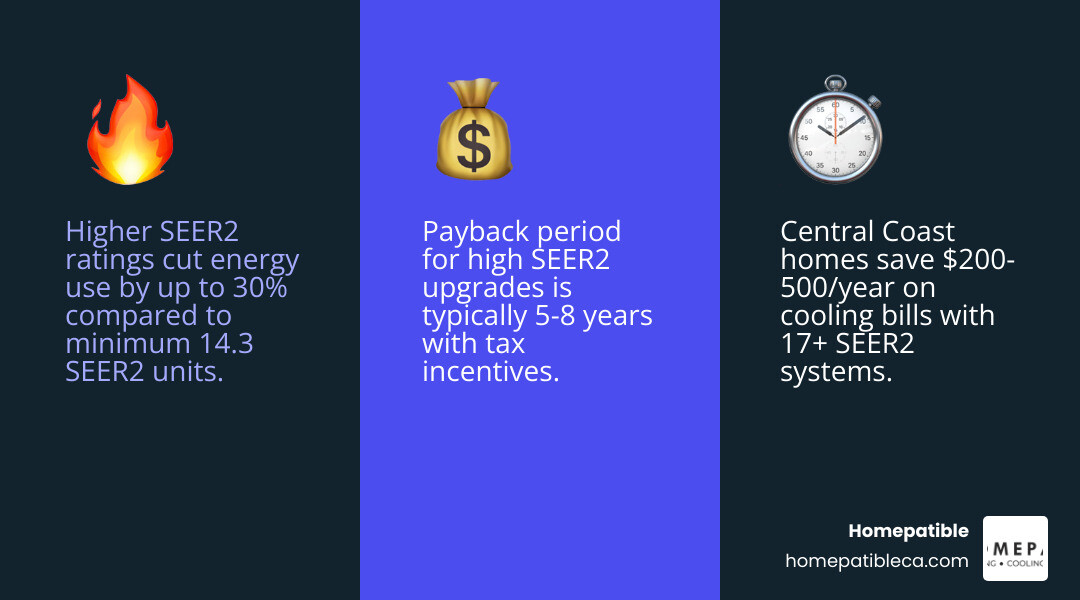
Data shows that upgrading from an old 10 SEER unit (common in many older homes in Lompoc or Orcutt) to a modern 16 SEER2 system can reduce your cooling costs by 30% to 40% annually. To put that in perspective, if your summer cooling bills are typically high, that could mean hundreds of dollars back in your pocket every year.
| SEER2 Rating | Efficiency Gain vs. 14.3 Baseline | Estimated Monthly Savings |
|---|---|---|
| 14.3 SEER2 | Baseline | $0 |
| 16 SEER2 | ~12% More Efficient | Moderate |
| 18 SEER2 | ~20% More Efficient | High |
| 20+ SEER2 | ~43% More Efficient | Very High |
While the monthly savings are great, the "break-even point" is what most of our clients ask about. In hotter regions or homes with high usage, the payback period for a mid-to-high SEER2 system often lands between 7 and 10 years. If you plan on staying in your home in Solvang or Ballard for the long haul, the system will eventually pay for its own upgrade cost and then continue to save you money for the rest of its 15-to-20-year lifespan.
Financial incentives and tax credits in 2026
One of the biggest reasons is a high seer2 ac worth the extra cost right now is the availability of federal incentives. Under the Inflation Reduction Act, homeowners can qualify for significant tax credits.
For qualifying high-efficiency central air conditioners, you may be eligible for a credit of up to $600. If you opt for a high-efficiency heat pump—which provides both heating and cooling—that credit can jump up to $2,000. When you stack these federal credits with local utility rebates, the "extra cost" of a high-efficiency unit often shrinks by half or more. You can find more details on these programs in our guide on Tax Credits for Heat Pumps and EV Chargers Explained.
Long-term home value and is a high SEER2 AC worth the extra cost
We also have to consider resale value. In a competitive real estate market like Santa Barbara or San Luis Obispo, an "Energy Star" certified home is a major selling point. Prospective buyers in 2026 are highly sensitive to energy costs. Showing a history of lower utility bills and a high-end, efficient HVAC system can increase your home's appeal and potentially its closing price.
Furthermore, high-efficiency systems are often built with more durable components, such as all-aluminum coils and advanced compressors, which can lead to better system longevity compared to entry-level models. For those in Callender or Nipomo, knowing your system is built to last provides peace of mind. Read more about local installation standards in What Every Callender Resident Should Know About Central Air Installation.
Beyond the Numbers: Comfort and Performance Benefits
Efficiency isn't just about the bill; it's about how the air feels inside your home. Entry-level 14.3 SEER2 systems are usually "single-stage," meaning they are either 100% on or 100% off. This often leads to the "ice-box then sauna" effect, where the house gets very cold, then warms up significantly before the unit kicks back on.
High-efficiency systems usually feature two-stage or variable-speed compressors. A variable-speed system can ramp up or down in tiny increments, much like a dimmer switch for a light. This allows it to maintain a rock-steady temperature within half a degree of your setting.

Enhanced humidity control and air quality
While the Central Coast isn't the Tropics, we do deal with coastal "May Gray" and "June Gloom" that brings plenty of moisture. High-efficiency variable-speed units are masters of humidity control. Because they can run for longer periods at lower speeds, they spend more time pulling moisture out of the air without over-cooling the house.
Lower humidity doesn't just make you feel cooler at higher temperatures; it also improves indoor air quality by reducing the risk of mold and dust mites. For more tips on keeping your system running at peak performance, see our post on Stop the Sizzle with These Spring AC Maintenance Tips.
Noise reduction and quiet operation
If your AC unit is located right outside a bedroom window or near your patio in Arroyo Grande, noise is a major factor. Standard units can be quite loud, often reaching 72-76 decibels—about the level of a vacuum cleaner.
In contrast, high-efficiency units often feature sound blankets and variable-speed fans that allow them to run as quietly as 55 decibels. That’s the difference between a loud conversation and a quiet whisper. If you value your backyard peace and quiet, the answer to is a high seer2 ac worth the extra cost might be found in the decibel rating alone. Regular upkeep helps keep things quiet, too; check out Tune Up to Chill Out with San Luis Obispo AC Maintenance for more.
Critical Factors for Realizing High-Efficiency Savings
Buying a 20 SEER2 air conditioner doesn't guarantee you'll see 20 SEER2 savings. The "delivered efficiency" depends entirely on the quality of the installation.
The most important step is a Manual J load calculation. This is a scientific way to determine exactly how much cooling your home needs based on square footage, insulation, window types, and even the direction your house faces in Santa Maria or Goleta. An oversized unit will "short-cycle" (turn on and off too quickly), which ruins efficiency and leaves your home humid. An undersized unit will run forever and never get you comfortable.
The impact of ductwork and installation quality
Your ductwork is the "veins and arteries" of your HVAC system. If your ducts are leaky, uninsulated, or too small, a high-efficiency AC will struggle. In fact, research shows that leaky ducts can reduce system efficiency by as much as 20% to 40%.
Before we install a high-SEER2 unit, we often perform static pressure tests to ensure your ducts can handle the airflow. If you're investing in a top-tier unit, it’s often worth it to seal or repair the ductwork at the same time to ensure you actually get the savings you're paying for. For more on the importance of professional setup, read Everything You Need to Know About AC Installation in San Luis Obispo.
Maintenance and repair considerations
It is worth noting that higher-efficiency systems are more complex. They use inverter boards and specialized sensors to achieve those high ratings. While these parts are generally very reliable, they can be more expensive to replace once the warranty expires.
This is why we emphasize regular maintenance and proper surge protection for high-end systems. Protecting the "brains" of your AC from power spikes is a small investment that protects a very large one. If you're in business, efficiency is even more critical; see our guide to Mastering the Chill: A Guide to Commercial HVAC Installation in Arroyo Grande, CA.
Frequently Asked Questions about SEER2 Ratings
What is the "sweet spot" SEER2 rating for most homes?
For the majority of homeowners in Santa Barbara and San Luis Obispo Counties, the "sweet spot" is typically between 15.2 and 17 SEER2. This range offers a great balance of significantly lower utility bills, eligibility for most rebates and tax credits, and a much more reasonable upfront cost than the ultra-premium 20+ SEER2 units. Beyond 18 SEER2, you often see "diminishing returns," where the extra energy savings are so small it takes 15+ years to pay back the higher purchase price.
Does a higher SEER2 always mean better cooling?
Not necessarily. SEER2 measures efficiency (how much power it uses), not capacity (how much cold air it makes). A 3-ton 14.3 SEER2 unit and a 3-ton 20 SEER2 unit both provide the same amount of "cooling power." The 20 SEER2 unit just does it while using much less electricity. However, because high-SEER2 units usually have variable-speed technology, they often provide more consistent cooling and better dehumidification, which feels "better" to most people.
How long is the typical payback period for a high-efficiency upgrade?
In our experience on the Central Coast, the payback period usually falls within a 5 to 10-year window. If you are in a hotter area like Santa Ynez or Mission Hills and use your AC frequently, you’ll likely hit that break-even point closer to year 5 or 6. If you're on the coast and use it sparingly, it might take 10 or 12 years.
Conclusion
So, is a high SEER2 AC worth the extra cost? If you value lower monthly bills, a smaller carbon footprint, and a home that stays perfectly comfortable regardless of the temperature in Santa Maria or Goleta, then yes—the upgrade is a smart investment.
At Homepatible, we specialize in helping Central Coast homeowners find the right balance between upfront cost and long-term value. Our licensed Nest Pro Elite technicians serve everyone from Carpinteria to San Luis Obispo, ensuring every system we install is perfectly sized and tuned for our unique California climate. Whether you need a 24/7 emergency repair or a brand-new high-efficiency installation, we’re here to help with transparent pricing and expert service.
Ready to see how much you could save? Explore our AC Installation & Replacement Services today or give us a call to schedule a consultation. We’ll help you crunch the numbers and find the perfect "sweet spot" for your home and your budget.
Ready to take the next step?
Our certified technicians are ready to help with all your home service needs. Schedule a service today.
Schedule My ServiceRecent Posts
Related Articles
Ready to Get Started?
Whether you need a repair, maintenance, or a new system, our expert team is here to help.