
Tax Credits for Heat Pumps and EV Chargers Explained
Article content and related resources
Claim federal tax credits for heat pump and EV charger upgrades: up to 30% off! Maximize savings with Energy Star tech in CA. Learn eligibility now.
What Are the Federal Tax Credits for Heat Pump and EV Charger Upgrades?
Federal tax credits for heat pump and EV charger upgrades can put real money back in your pocket — but the windows to claim them are closing fast.
Here's a quick summary of what's available right now:
| Upgrade | Credit Amount | Annual Cap | Deadline |
|---|---|---|---|
| Air-source heat pump | 30% of cost including installation | $2,000/year | Dec 31, 2025 |
| Heat pump water heater | 30% of cost including installation | $2,000/year (combined) | Dec 31, 2025 |
| EV charger (home) | 30% of cost including installation | $1,000/port | Jun 30, 2026 |
| Geothermal heat pump | 30% of cost | No annual limit | Dec 31, 2032 |
| Other efficiency upgrades (insulation, windows, panels, etc.) | 30% of cost | $1,200/year | Dec 31, 2025 |
| Total possible annual credit | Up to $3,200/year |
These credits come from two federal programs created by the Inflation Reduction Act of 2022:
- Energy Efficient Home Improvement Credit (Section 25C) — covers heat pumps, insulation, windows, doors, panel upgrades, and home energy audits
- Residential Clean Energy Credit (Section 25D) — covers geothermal heat pumps, solar panels, battery storage, and wind energy with no dollar cap
A few important things to know upfront:
- Both credits are nonrefundable — they reduce your tax bill but won't generate a refund if they exceed what you owe (the Residential Clean Energy Credit can be carried forward, however)
- The equipment must be installed — not just purchased — by the deadline
- Starting in 2025, heat pump manufacturers must provide a QM code (PIN number) that you'll need to include on your tax return
- The EV charger credit has a location requirement — your home must be in a low-income or non-urban census tract
For Central Coast homeowners in Santa Barbara and San Luis Obispo Counties, many of these upgrades make strong financial sense beyond just the tax savings — heating and cooling account for more energy use than anything else in the home, and modern heat pumps can dramatically cut those bills year-round.
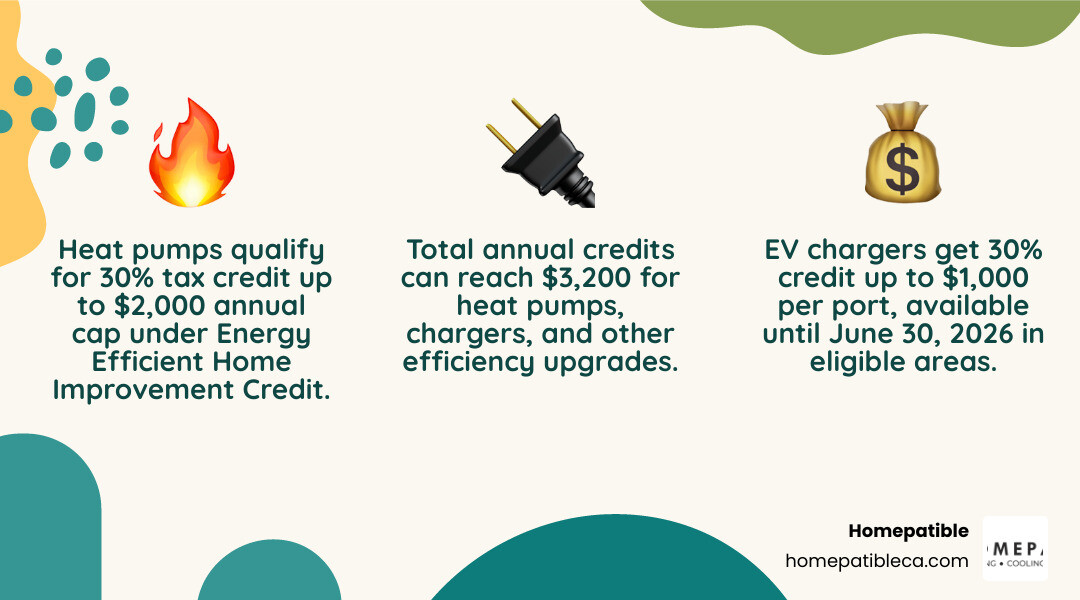
Maximizing Federal Tax Credits for Heat Pump and EV Charger Upgrades
Navigating federal incentives doesn't have to be a headache. At Homepatible, we’ve seen how homeowners across the Central Coast can strategically stack these benefits to save thousands. The primary mechanism for these savings is a 30% tax credit. However, it’s important to understand the "buckets" these credits fall into.
The Energy Efficient Home Improvement Credit (Section 25C) has an annual aggregate limit of $3,200. This is split into two parts: a $2,000 limit specifically for heat pumps and heat pump water heaters, and a $1,200 limit for other upgrades like insulation, windows, and doors. By planning your upgrades over multiple years, you can actually claim the maximum credit each year through the end of 2025. For example, you might focus on a heat pump installation or replacement in Los Olivos, CA this year, and tackle windows and doors the next.
For those living in Santa Barbara and San Luis Obispo Counties, starting with a home energy audit is a smart move. Not only does it help you identify where your home is losing energy, but the federal government offers a 30% credit (up to $150) to help cover the cost of that audit.
Qualifying for Federal Tax Credits for Heat Pump and EV Charger Upgrades
To ensure you actually see that money back on your tax return, the equipment must meet strict Energy Star criteria. As we move through the 2025 tax year, the standards have become more rigorous. For heat pumps, the unit must meet the "Energy Star Most Efficient" criteria to qualify.
When it comes to your electric vehicle, the rules are slightly different. The tax credit for EV charger installation in Los Olivos, CA falls under Section 30C. This credit is available for property placed in service through June 30, 2026.
It is vital to remember that these are non-refundable credits. This means if you owe $1,000 in taxes but have a $2,000 credit, your tax bill drops to zero, but Uncle Sam won't send you a check for the remaining $1,000. However, the Residential Clean Energy Credit (Section 25D)—which covers geothermal and solar—is unique because it allows for "carry-forward" rules, meaning you can apply the leftover credit to future tax years.
Eligible Equipment for Federal Tax Credits for Heat Pump and EV Charger Upgrades
What exactly can you install to trigger these savings?
- Air-source heat pumps: These provide both heating and cooling and are the most common choice for our local climate.
- Heat pump water heaters: These can be up to three times more efficient than conventional models.
- Level 2 EV Chargers: The 30% credit applies to the charger itself and the labor to install it.
- Battery Storage: Systems with a capacity of 3 kWh or greater qualify for a 30% credit under Section 25D.
- Electrical Panel Upgrades: If you need to upgrade your panel to support a new heat pump or EV charger, you can claim 30% of the cost (up to $600) as long as the panel has a capacity of at least 200 amps.
Regular maintenance is also key to keeping these high-efficiency systems running. Scheduling a heat pump maintenance tune-up in San Luis Obispo, CA ensures your system stays within the efficiency parameters required for long-term performance.
Efficiency Standards for Heat Pump Technology
Efficiency standards aren't just technical jargon; they are the gatekeepers of your tax credit. Since January 1, 2025, the IRS has required that heat pumps meet the Energy Star Most Efficient criteria. This includes specific SEER2 (Seasonal Energy Efficiency Ratio) and HSPF2 (Heating Seasonal Performance Factor) ratings.
In California, we generally follow the "Southern Tier" requirements, which focus more on cooling efficiency, but the specific ratings can change based on whether you are installing a ducted or ductless system. For instance, ductless systems often require a SEER2 rating higher than 16 and an EER2 higher than 12. If you're looking for a heat pump maintenance tune-up in Edna, CA, our technicians can help you identify if your existing unit met these standards at the time of installation.
A significant change for 2025 is the requirement for a manufacturer QM code. This is a unique PIN number that manufacturers must provide for every eligible product. You must include this code on your tax return to successfully claim the credit. Without this PIN, the IRS may reject your claim for the Energy Efficient Home Improvement Credit.
Heat Pump Water Heaters and Biomass Stoves
Heat pump water heaters are often the "unsung heroes" of energy efficiency. They qualify for the same $2,000 separate annual limit as air-source heat pumps. This means you could potentially install a new HVAC heat pump and a heat pump water heater in the same year, but you would still be capped at a total of $2,000 for that specific category.
When calculating your credit, don't forget that labor costs and installation expenses are included for "residential energy property" like water heaters and heat pumps. This is a huge benefit compared to building envelope components (like insulation or windows), where only the material costs qualify. Whether you are getting a heat pump maintenance tune-up in Carpinteria, CA or a full replacement, keeping detailed records of the labor involved is essential for your tax preparer.
Geographic Rules for EV Charger Tax Credits
The EV charger tax credit (Section 30C) is fantastic, but it comes with a "geographic catch." Unlike the heat pump credit, which is available to almost any homeowner, the EV charger credit is restricted by location.
To qualify for the 30% credit (up to $1,000 per port), your residence must be located in a low-income census tract or a non-urban (rural) census tract. While this might sound restrictive, approximately two-thirds of Americans live in eligible areas. This includes many parts of our service area, such as EV charger installation in Vandenberg Space Force Base, CA.
The IRS provides mapping tools where you can enter your address to find your 11-digit GEOID. If that ID matches the IRS's list of eligible tracts, you're in the clear to claim the credit. Just remember the deadline for this specific credit is June 30, 2026.
Documentation and Filing Requirements
When tax season rolls around, you’ll need more than just a "good feeling" about your upgrades. You will need to file specific forms:
- IRS Form 5695: Used for residential energy credits (heat pumps, solar, etc.).
- IRS Form 8911: Used for the alternative fuel vehicle refueling property credit (EV chargers).
If you’ve recently had a heat pump repair service in See Canyon, CA, keep that receipt too, as it helps document the ongoing "placed in service" status of your equipment. You must keep all receipts, manufacturer certification statements, and, if you had one, your home energy auditor’s report. For EV chargers, ensure you have documented your 11-digit GEOID from the census mapping tool to prove your location's eligibility.
Frequently Asked Questions
Can renters claim federal tax credits for energy upgrades?
Yes! If you are a renter and you pay for the installation of qualifying equipment in your principal residence, you can claim the credit. However, you should always get written consent from your landlord before making permanent changes to the property. If you need a heat pump repair service in Hope Ranch, CA for a unit you installed as a tenant, those records remain yours for tax purposes.
Do these tax credits apply to second homes or vacation rentals?
It depends on the credit. The Energy Efficient Home Improvement Credit (Section 25C) generally requires the home to be your principal residence for things like windows and doors. However, for "residential energy property" like heat pumps and central AC, you can claim it for a second home that you use as a residence (and do not rent out). The Residential Clean Energy Credit (Section 25D) also allows for second homes, but not for fuel cell property. Landlords who do not live in the property cannot claim these credits for rental units.
What happens if the tax credit exceeds what I owe?
As mentioned, these are non-refundable. If your tax liability is $0, you won't get money back. However, the Residential Clean Energy Property Credit (Section 25D) is the "gift that keeps on giving" because you can carry forward the unused portion to the next year. The 25C credit (for heat pumps and insulation) does not have this carry-forward provision, so it’s best to time those upgrades for years when you have a higher tax liability.
Conclusion
Upgrading your home’s efficiency is a win-win for your comfort and your wallet, especially with the current federal incentives. At Homepatible, our licensed technicians and Nest Pro Elite experts are here to help homeowners throughout Santa Barbara and San Luis Obispo Counties make the most of these opportunities. Whether you need a new heat pump, an EV charger, or a smart home integration to manage it all, we provide the expertise and transparent pricing you deserve. More info about home energy services is just a click away—let’s make your home smarter and more efficient today.
Ready to take the next step?
Our certified technicians are ready to help with all your home service needs. Schedule a service today.
Schedule My ServiceRecent Posts
Related Articles
Ready to Get Started?
Whether you need a repair, maintenance, or a new system, our expert team is here to help.