
Cheat Sheet to How Proper AC Sizing Affects Comfort and Efficiency
Article content and related resources
Discover how proper AC sizing affects comfort and efficiency with the right Manual J load calculation for Central Coast homes.
Why How Proper AC Sizing Affects Comfort and Efficiency Is the Most Important Decision for Your Home
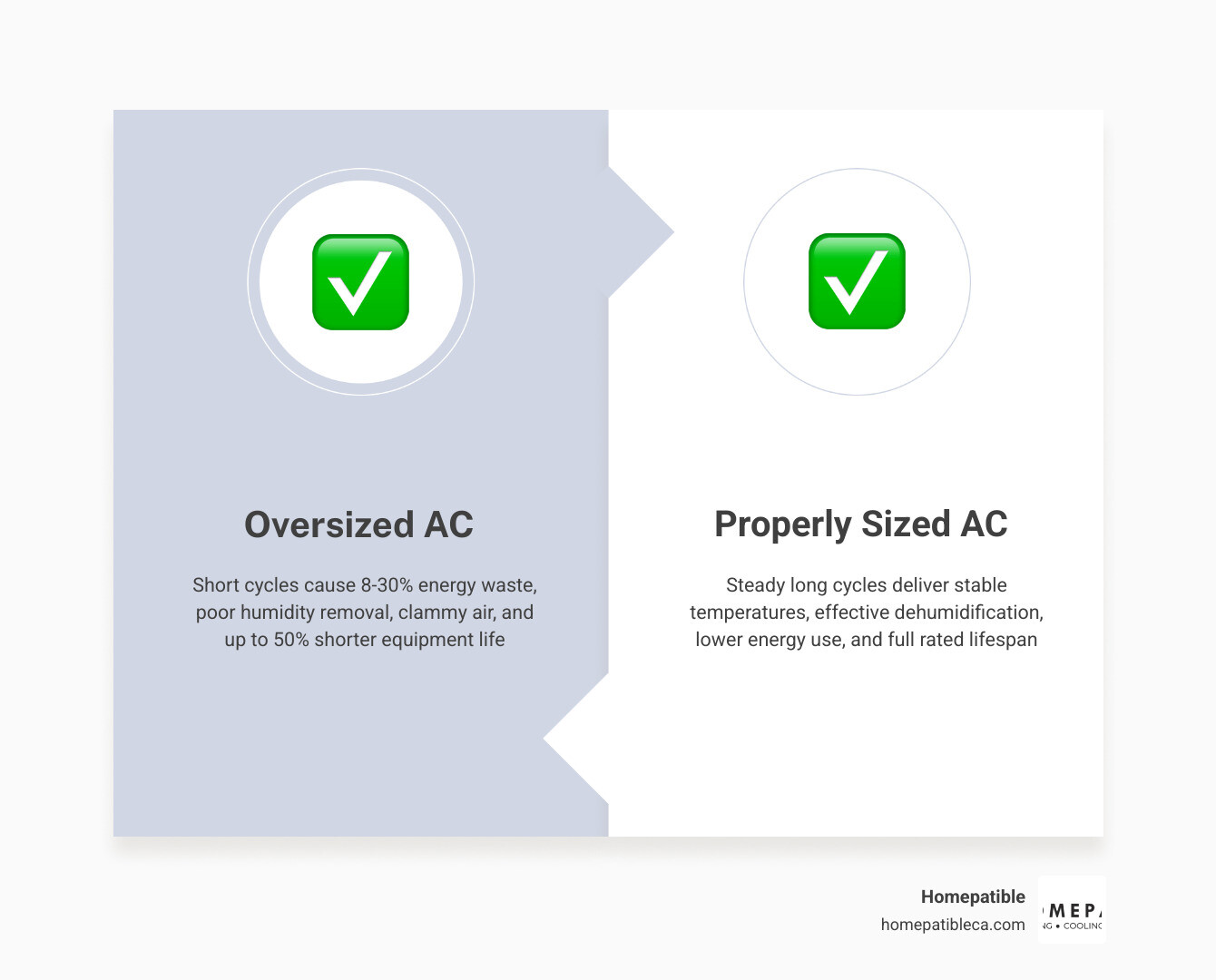
How proper AC sizing affects comfort and efficiency is straightforward: a system matched to your home's actual cooling load runs in steady, efficient cycles that control both temperature and humidity — while a mismatched system wastes energy, wears out faster, and leaves you uncomfortable no matter how low you set the thermostat.
Here is what that means in practice:
| Factor | Properly Sized AC | Oversized AC | Undersized AC |
|---|---|---|---|
| Temperature swings | Minimal, stable | 3–5°F between cycles | Up to 10°F between rooms |
| Humidity control | Effective dehumidification | Clammy air, poor moisture removal | Struggles to keep up |
| Energy use | Efficient long cycles | Short cycling wastes 8–30% more energy | Constant running, high bills |
| Equipment lifespan | Full rated lifespan | Up to 50% shorter | Premature compressor wear |
| Comfort | Consistent throughout home | Uneven, drafty, humid | Never quite cool enough |
Despite how much this matters, studies estimate that 30 to 50% of residential AC systems are improperly sized — and the majority are too big, not too small. More than half of U.S. homes are living with this problem right now.
For homeowners on the Central Coast of California — from Santa Barbara to San Luis Obispo — the stakes are even higher. Marine layer humidity, microclimates that shift block to block, and mild but variable temperatures mean a system sized for a generic "average home" will routinely miss the mark. A home in Goleta behaves very differently from one in Nipomo, even if they share the same square footage.
The fix is not simply buying a bigger unit or a shinier brand. It starts with understanding what sizing actually means — and demanding that your installer does the math correctly.
I'm Matthew Palmieri, founder of Homepatible, and my background spans HVAC installation, smart home technology, and contractor operations across the Central Coast — giving me a close-up view of exactly how proper AC sizing affects comfort and efficiency in real homes, not just in textbooks. In the sections ahead, I'll walk you through everything you need to know to make a confident, informed decision about your home's cooling system.
Understanding HVAC Sizing: BTUs, Tonnage, and Capacity
When we talk about the "size" of an air conditioner, we are not talking about its physical dimensions. You could have two outdoor condenser units of similar physical size, yet one might have twice the cooling capacity of the other. In the HVAC world, sizing refers strictly to a system's ability to extract heat from a space over a specific period.
Selecting a system with the correct cooling capacity is the single most critical step in any installation. If you are planning an upgrade, reading up on Everything You Need to Know About AC Installation in San Luis Obispo can help you understand how local conditions dictate these capacity requirements.
What is a BTU and Tonnage?
To understand capacity, we must look at two primary units of measurement: BTUs (British Thermal Units) and tonnage.
- BTU (British Thermal Unit): This is the basic unit of heat energy. One BTU is defined as the amount of heat required to raise the temperature of one pound of water by one degree Fahrenheit. In air conditioning, BTU ratings indicate how much heat energy the system can remove from your home per hour. Residential systems typically range from 18,000 to 60,000 BTUs per hour.
- Tonnage: This is simply a larger unit of measurement used to simplify HVAC discussions. One ton of cooling capacity is equal to 12,000 BTUs per hour.
The term "ton" has a fascinating historical origin. Before mechanical refrigeration, ice was harvested and used for cooling. One ton of cooling capacity represents the amount of heat energy required to melt one ton (2,000 pounds) of ice over a 24-hour period. Therefore, if your home requires a 3-ton air conditioner, it needs a system that can extract 36,000 BTUs of heat per hour—the equivalent cooling power of melting three tons of ice daily.
Why Sizing Matters More Than SEER Ratings
When shopping for a new air conditioner in May 2026, it is easy to get caught up in high SEER2 (Seasonal Energy Efficiency Ratio) ratings. Manufacturers heavily market these ratings, promising massive utility savings. However, a high SEER2 rating is practically meaningless if the system is sized incorrectly.
SEER2 measures how efficiently a system operates under ideal, continuous laboratory conditions. In the real world, an oversized system will cycle on and off rapidly. Because an air conditioner uses the most electricity during its startup phase, a 20 SEER2 system that is constantly starting and stopping will actually consume far more energy than a perfectly sized 14.3 SEER2 system that runs in steady, efficient cycles. Sizing is the foundation of efficiency; the SEER2 rating is simply the polish on top.
How Proper AC Sizing Affects Comfort and Efficiency
Achieving a comfortable indoor climate requires a delicate balance of temperature reduction, air circulation, and moisture removal. A perfectly sized air conditioning system acts like a seasoned marathon runner, maintaining a steady, efficient pace to keep your home in a state of thermal equilibrium.
To find the right professionals who understand this balance, consult Don't Sweat the Heat: A Guide to Air Conditioner Installers Near San Luis Obispo to ensure your system is installed by certified experts.
To illustrate the stark differences in performance, let's examine how oversized and undersized systems compare to a properly sized unit:
| Performance Metric | Oversized System | Undersized System | Properly Sized System |
|---|---|---|---|
| Cycle Length | Short, frequent bursts (5–10 mins) | Runs continuously without stopping | Smooth, steady cycles (20–30 mins) |
| Indoor Humidity | High, clammy, sticky air | Uneven, humid in far rooms | Balanced (30% to 50% relative humidity) |
| Energy Consumption | High due to constant startup surges | High due to non-stop operation | Optimized, minimal energy draw |
| Component Wear | Severe strain on compressor/motors | Accelerated wear from constant running | Minimal, scheduled wear |
| Room-to-Room Variance | Hot and cold spots throughout home | Massive temperature swings | Consistent, even cooling |
How proper ac sizing affects comfort and efficiency by preventing short cycling
Short cycling is the primary symptom of an oversized air conditioner. When a system has too much cooling capacity, it floods your home with cold air, satisfying the thermostat in a matter of minutes. While this might sound like a good thing, it is incredibly damaging to both your comfort and your wallet.
An air conditioner's startup cycle is its most demanding phase. It requires a massive surge of electrical current to get the compressor and fan motors running. When a system short cycles—turning on and off four or more times per hour—it remains trapped in this high-energy startup phase. This not only inflates your monthly utility bills by 8% to 30%, but it also inflicts severe mechanical wear, potentially cutting the lifespan of your compressor in half.
For a deeper look into how proper installation prevents these cycling issues in neighboring coastal zones, check out the 5 Reasons Why You Will Love AC Install in Paso Robles.
How proper ac sizing affects comfort and efficiency through humidity control
True indoor comfort involves managing two types of heat: sensible heat (the actual temperature you read on a thermometer) and latent heat (the moisture suspended in the air).
Your air conditioner cools your home by blowing warm indoor air across a freezing evaporator coil. As this air cools, the moisture within it condenses onto the coil and drains away. A properly sized air conditioner needs to run continuously for at least 15 to 20 minutes to lower the coil temperature sufficiently and pull significant moisture out of the air. On a humid day, a correctly sized system can extract up to 25 gallons of water from your indoor air.
When an oversized system short cycles, it shuts off long before this dehumidification process can take place. The result is a home that feels cold and clammy. You might find yourself lowering the thermostat to 68°F just to escape the stickiness, when a properly dehumidified home would feel incredibly comfortable at 73°F.
Keeping your system maintained is key to preserving this dehumidification capacity; you can learn more about this by reading about AC Maintenance in Hope Ranch: Everything You Need to Know.
The Science of Right-Sizing: Manual J Load Calculations
The only accurate way to determine the heating and cooling load of a home is through a scientific calculation known as a Manual J load calculation. Developed by the Air Conditioning Contractors of America (ACCA), this protocol is the gold standard for residential system sizing.
For historic and modern estates alike, such as those in Montecito, getting this calculation right is essential to preserving architectural integrity and indoor comfort. To see how this is applied locally, explore our dedicated page on AC Installation Replacement Montecito CA.
A Manual J calculation evaluates your home as a complete thermal envelope. It doesn't just look at the floor plan; it measures how heat moves into and out of your home. A professional load calculation considers:
- Insulation Levels: The R-value of your attic, wall, and floor insulation.
- Window Specifications: The size, framing material, glazing, and Solar Heat Gain Coefficient (SHGC) of every window.
- Home Orientation: Which direction your windows face, which dictates how much solar radiation enters the home throughout the day.
- Air Infiltration: How tightly sealed the home is against outdoor air leaks.
- Internal Heat Gains: The number of regular occupants (each human body adds roughly 350 to 600 BTUs of heat) and heat-generating appliances.
- Local Climate Data: The outdoor "design temperatures" for your specific zip code, representing the extreme weather conditions your system must be able to handle.
Why Rules of Thumb Fail Central Coast Homeowners
Historically, many contractors relied on "rules of thumb," such as allocating one ton of cooling capacity for every 500 or 600 square feet of living space. This practice is a primary reason why more than half of U.S. homes have improperly sized HVAC systems.
Relying on square footage alone is a massive gamble. Consider two identical 2,000-square-foot homes. The first is a 1920s bungalow with single-pane windows, minimal attic insulation, and high plaster ceilings. The second is a modern, tightly sealed home built in 2026 with radiant barrier insulation, double-pane Low-E windows, and energy-efficient LED lighting.
The older home might require a 4-ton system to stay cool, while the modern home might only need a 2.5-ton system. If a contractor installs a 4-ton system in the modern home based on square footage, that system will short cycle constantly, destroying its efficiency.
Furthermore, the Central Coast is famous for its distinct microclimates. A home in Lompoc, which benefits from consistent marine layers and cooler coastal winds, has vastly different cooling demands than a home in Solvang or Santa Ynez, where summer temperatures regularly climb into the 90s.
To explore how these regional factors influence your choice of equipment, read our guide on Central Air vs Mini Split for Central Coast Homes Explained.
Advanced Sizing: Variable-Speed Systems and Zoning
Modern HVAC technology has introduced highly flexible options that change how we approach system sizing. Traditional single-stage air conditioners are either 100% "on" or 100% "off." This rigid operation makes precise sizing absolutely critical.
However, modern variable-speed (inverter-driven) compressors can modulate their output anywhere from 25% to 100% capacity. This allows the system to scale its cooling power up or down depending on real-time demands. On a mild, foggy morning in Goleta, a variable-speed system might run continuously at just 30% capacity, consuming a fraction of the power while keeping indoor humidity perfectly balanced. On a hot afternoon, it can ramp up to 100% to keep you cool.
These variable-capacity systems, when combined with zoning (dividing your home into separate, independently controlled thermal zones), provide a forgiving "cushion" for sizing. They are particularly effective when using ductless mini-splits.
To learn more about when these advanced systems are the ideal choice for your home, review The Ultimate Decision Guide When Mini Splits Outshine Central AC.
Frequently Asked Questions About AC Sizing
How do I know if my current AC is the wrong size?
If your existing air conditioner is struggling, it may be the wrong size for your home. Keep an eye out for these common warning signs:
- Your system runs in short bursts: If your AC turns on, blasts freezing air for 5 to 10 minutes, and then shuts off, it is likely oversized.
- The air feels cold but sticky: An oversized system that doesn't run long enough will fail to dehumidify, leaving your home feeling damp and clammy.
- The system never turns off on hot days: An undersized system will run continuously without ever reaching your thermostat's setpoint.
- Massive room-to-room temperature swings: If your living room is freezing but your upstairs bedrooms remain hot and stagnant, your system's capacity and ductwork are likely mismatched.
- Noisy operation: An oversized unit trying to push too much air through undersized ductwork will often whistle, rattle, or sound incredibly loud when running.
If you suspect your system is the wrong size, scheduling a professional assessment is the best next step. Homeowners can read A Complete Guide to AC System Servicing for Paso Robles Homeowners to understand how professional diagnostic testing can pinpoint these sizing and operational issues.
What happens if my air conditioner is undersized?
While an oversized system is the most common issue, an undersized system presents its own set of frustrating problems.
When an air conditioner is too small, it lacks the necessary BTUs to offset the heat entering your home on hot summer days. The system will run continuously, consuming massive amounts of electricity as it tries in vain to reach your desired temperature. This non-stop operation places extreme thermal and mechanical stress on the compressor and outdoor fan motor, leading to frequent breakdowns and a drastically shortened equipment lifespan.
What should I ask an installer to ensure correct sizing?
To protect your investment and ensure you get a perfectly sized system, always ask prospective contractors the following questions:
- "Will you perform a Manual J load calculation before recommending a system size?" If they say they size systems based on square footage or "by looking at the old unit," thank them for their time and find another contractor. Fewer than 20% of contractors actually perform this vital step.
- "Can I see the printed or digital copy of the load calculation report?" A reputable contractor will be happy to share this data with you and explain how they arrived at their recommendation.
- "Does my existing ductwork support the airflow requirements of this new system?" Installing a new, properly sized AC on old, leaky, or undersized ductwork will choke the system, leading to high static pressure, noisy operation, and premature component failure.
For those planning an upgrade in the San Luis Obispo area, exploring our page on AC Installation Replacement San Luis Obispo CA will help you connect with qualified professionals who prioritize these scientific sizing protocols.
Conclusion
At Homepatible, we believe that your home comfort should never be a guessing game. Sizing an air conditioning system is a science, and taking shortcuts always leads to higher utility bills, frequent mechanical failures, and a home that never feels quite right.
Whether you are dealing with the heavy marine layers of Carpinteria, the warm summer afternoons of Solvang, or the variable microclimates of Lompoc and Santa Maria, our team of licensed Nest Pro Elite technicians is here to help. We combine rigorous Manual J load calculations with advanced smart home integration to ensure your cooling system is a perfect fit for your home's unique thermal fingerprint.
Ready to experience the difference that a perfectly sized, highly efficient cooling system can make for your home? Contact us today to schedule your professional load calculation and system assessment, or visit our Homepatible Air Conditioning page to explore our comprehensive cooling solutions. Let us help you find your home's perfect climate balance.
Ready to take the next step?
Our certified technicians are ready to help with all your home service needs. Schedule a service today.
Schedule My ServiceRecent Posts
Related Articles
Ready to Get Started?
Whether you need a repair, maintenance, or a new system, our expert team is here to help.