
Central Air vs Mini Split for Central Coast Homes Explained
Article content and related resources
Discover central air vs mini split for central coast homes: efficiency, costs, and best picks for Shell Beach, SLO properties. Find your ideal system!
The Real Difference Between Central Air and Mini Splits for Central Coast Homes
Central air vs mini split for Central Coast homes is one of the most common questions homeowners in Santa Barbara and San Luis Obispo Counties face when upgrading or replacing their cooling systems — and the answer isn't the same for every house.
The Central Coast has a climate unlike most of California. Coastal fog, mild summers, and cool ocean breezes mean your system won't run as hard as one in Fresno or Phoenix. But when heat does hit — especially inland in areas like Santa Maria or Nipomo — you still need reliable, efficient cooling. The wrong system choice can mean higher energy bills, uneven comfort, or an expensive installation you didn't plan for.
Here's a quick breakdown to help you decide:
| Factor | Central Air | Ductless Mini Split |
|---|---|---|
| Best for | Homes with existing ductwork | Homes without ducts, additions, or specific zones |
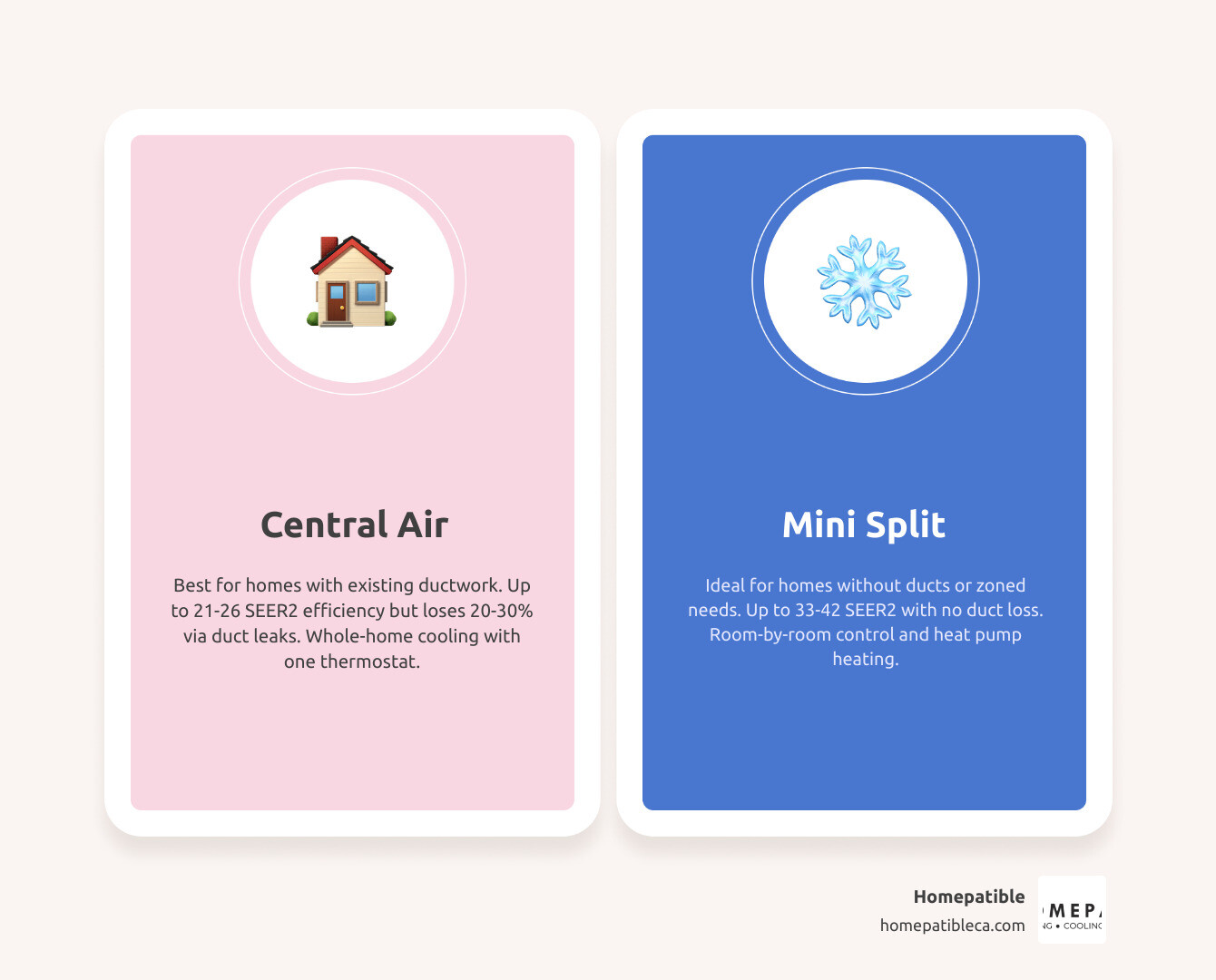
| Efficiency | Up to 21-26 SEER2 (loses 20-30% via duct leaks) | Up to 33-42 SEER2, no duct loss |
| Upfront cost | Lower if ducts already exist | Higher per zone, but no ductwork needed |
| Zoned control | Limited without upgrades | Built-in, room by room |
| Heating | Requires separate furnace | Most units are heat pumps (heat + cool) |
| Installation disruption | High if new ducts needed | Minimal — just a 3-inch wall penetration |
| Aesthetics | Hidden vents, no visible units | Wall-mounted indoor units visible in each room |
| Ideal Central Coast use case | Newer homes, whole-home uniform cooling | Older homes, room additions, coastal bungalows |
Bottom line: If your home already has solid, well-sealed ductwork, central air is often the more cost-effective choice for whole-home cooling. If you're working with an older home, a new addition, or a space without existing ducts, a ductless mini split is almost always the smarter move — and it doubles as an efficient heater for Central Coast winters.
Both systems can last 15 to 20 years with proper maintenance. The right choice depends on your home's layout, your existing infrastructure, and how you actually use your space.
How Central Air and Mini-Splits Operate in Central Coast Climates
To make an informed choice, it helps to understand the "magic" behind the curtain. Both systems rely on the same fundamental science: the refrigerant cycle. They don't actually "create" cold; instead, they act like a high-tech sponge, soaking up heat from inside your home and squeezing it out into the Pacific breeze.
In a General Air Conditioning San Luis Obispo CA setup, you have a large outdoor condenser unit and an indoor evaporator coil, usually tucked away in a closet or attic. A powerful fan pushes air through a network of ducts to every room. It’s a "whole-home" approach—one thermostat tells the entire house to reach a certain temperature.
On the flip side, General Ductless Shell Beach CA systems (mini-splits) skip the ducts entirely. They use an outdoor compressor connected to individual indoor air handlers via small refrigerant lines. These lines only require a tiny, three-inch hole in your wall. Because each indoor unit has its own thermostat, you can cool the kitchen while leaving the guest room off, saving energy and wear on the system.
I'm comparing central air vs mini split for Central Coast homes; which is better for my Shell Beach property?
If you live in Shell Beach, Gaviota, or any of our beautiful coastal spots, your cooling needs are unique. You might go weeks without needing the AC, only to have a sudden heatwave make your upstairs unbearable.
For many homeowners, AC Installation Replacement Shell Beach CA often leans toward mini-splits if the home is a classic beach bungalow. These homes often lack the attic space for bulky ductwork. However, if you have a modern, multi-level home with existing ducts, central air remains the champion of uniform, "set-it-and-forget-it" comfort. The "better" system is the one that fits your home's bones without requiring you to tear out your ceilings.
Energy Efficiency: Central Air vs Mini Split for Central Coast Homes
Efficiency is the name of the game in April 2026. With electricity rates being what they are, choosing a system that sips power instead of gulping it is vital.
When we talk about efficiency, we look at SEER2 ratings (Seasonal Energy Efficiency Ratio). Modern central AC units are impressive, typically ranging from 21 to 26 SEER2. However, they have a "hidden enemy": duct leakage. Research shows that central systems can lose 20% to 30% of their cooled air through leaky or poorly insulated ducts. This means a high-efficiency unit might only be delivering 70% of its potential to your living room.
Ductless systems are the efficiency kings. They can achieve SEER2 ratings as high as 33 to 42. Because there are no ducts, there is zero air loss. Furthermore, mini-splits use inverter technology. While older systems are either "100% on" or "completely off" (like flooring your car's gas pedal and then slamming the brakes), inverters allow the compressor to speed up or slow down precisely to meet the demand.
As we discuss in our guide to Ductless AC Installation in San Luis Obispo: Small Units, Big Chill, this part-load operation is perfect for our mild climate, where you often just need a "gentle nudge" to stay comfortable rather than a full blast of arctic air.
Maximizing Efficiency with Zoned Cooling in Nipomo
In areas like Nipomo or Santa Maria, where the sun can be a bit more intense than right on the water, zoned cooling is a game-changer. If your current system is struggling, you might not need a total overhaul—sometimes an AC Repair Service Nipomo CA can identify that your central system is fine, but your ductwork is failing.
Mini-splits offer built-in zoning, which provides several efficiency benefits:
- No Cooling Empty Rooms: Why pay to cool the guest room or the formal dining room at 2:00 PM?
- Personalized Comfort: One person can have their home office at 68°F while someone else keeps the living room at 74°F.
- Variable-Speed Savings: The system only works as hard as the specific active zones require.
Choosing the Right System for Your Home Layout and Infrastructure
Your home’s architecture is often the deciding factor in the central air vs mini split for central coast homes debate.
If your home was built in the last 30 years, it likely has a duct system designed for central air. In this case, Mastering Your Climate with Central Air Service in San Luis Obispo is usually the most straightforward path. Replacing an old central unit with a new, high-efficiency model is less invasive and usually more affordable upfront than installing a multi-zone mini-split system.
However, if your ducts are old, undersized, or full of holes, the cost to repair or replace them can be staggering—sometimes adding significant thousands to the project. We serve a wide range of Service Areas San Luis Obispo CA, and we’ve seen homes where the structural integrity simply wouldn't allow for new ductwork without a massive, messy renovation.
I'm looking for a cooling solution for an older home; when to choose a mini split for Central Coast homes?
Older homes, like those in historic parts of Santa Barbara or the Victorian-style houses in the valley, are the perfect candidates for ductless technology. Preserving original plaster walls and intricate crown molding is a priority for many of our clients.
A Ductless Installation Replacement Gaviota CA is the "problem solver" for:
- Room Additions: If you’ve added a sunroom or a "Frog" (Finished Room Over Garage), your central AC likely wasn't sized to handle the extra space. A mini-split is the perfect standalone fix.
- Garage Conversions: Turning the garage into a home gym or ADU? A ductless unit provides professional-grade climate control without needing to tap into the main house system.
- Targeted Cooling: Do you have that "one room" that stays ten degrees hotter than the rest of the house? A single-zone mini-split can fix that specific problem forever.
Maintenance, Air Quality, and Year-Round Comfort Requirements
Both systems require regular love to reach their 20-year potential, but the "chores" look a little different.
Central air systems rely on a single, large filter. For most homes, we recommend a MERV 8 to 13 filter, replaced every 1 to 3 months. This is excellent for whole-home air quality because it constantly cycles and cleans the air from every room.
Mini-splits, however, require a more hands-on approach. Each indoor unit has a washable mesh filter. If you need a Ductless Repair Service San Luis Obispo CA, the most common culprit we find is a clogged filter. These should be rinsed in the sink every 2 to 4 weeks during heavy use. While they are great at catching dust and pet hair, they don't typically offer the same level of advanced HEPA filtration as a dedicated central system.
Don't forget about winter! Most modern mini-splits are actually "heat pumps." They can reverse their cycle to pull heat from the outside air and bring it inside. Even when it’s 40°F in Lompoc, a mini-split can keep you toasty without needing a gas furnace. This "all-electric" lifestyle is becoming increasingly popular on the Central Coast as we move toward greener energy solutions.
Decision Checklist and 2026 Financial Incentives
Choosing between central air vs mini split for central coast homes often comes down to the numbers. As of April 2026, there are significant incentives to help you choose the high-efficiency route.
The Inflation Reduction Act continues to offer federal tax credits of up to $2,000 for qualifying high-efficiency heat pumps (both ducted and ductless). When you combine this with local utility rebates available in our Service Areas, the "efficiency premium" of a better system often pays for itself in just 3 to 5 years through lower monthly bills.
| Feature | Central Air | Mini Split |
|---|---|---|
| Noise (Indoor) | 30-40 Decibels (Air rushing through vents) | 19-26 Decibels (Softer than a whisper) |
| Noise (Outdoor) | 55-75 Decibels | 50-60 Decibels |
| Air Filtration | Whole-home MERV/HEPA options | Individual washable mesh filters |
| Lifespan | 15-20 Years | 15-20 Years |
| Control | Single Thermostat (or costly zoning) | Remote/App control for every room |
Frequently Asked Questions about Coastal Cooling
Can a mini-split effectively heat my home during Central Coast winters?
Absolutely. In fact, for our mild winters in places like Santa Ynez or Solvang, a mini-split is often more efficient than a traditional gas furnace. Because it moves heat rather than generating it through combustion, it can provide consistent warmth while using a fraction of the energy.
How do noise levels compare between central AC and ductless units?
If you value peace and quiet, the mini-split is the clear winner. Indoor units often operate at 19-26 decibels—for context, a rustling leaf is about 20 decibels. Central AC isn't exactly "loud," but you will definitely hear the "whoosh" of air every time the system kicks on.
Which system offers better air filtration for allergy sufferers?
Central AC generally takes the trophy here. Because it circulates air from the entire home through a high-grade central filter, it’s better at removing fine pollen, smoke particles, and pet dander. While mini-splits do filter the air, their filters are primarily designed to protect the internal components rather than purify the room's air to a medical grade.
Conclusion
Whether you are looking for the whole-home power of central air or the surgical precision of a ductless mini-split, the "right" answer depends on your specific goals. Are you looking for the lowest upfront cost, or the lowest long-term energy bill? Are you cooling a brand-new build in Orcutt or a 1920s cottage in Montecito?
At Homepatible, our licensed Nest Pro Elite technicians are experts at navigating the central air vs mini split for central coast homes debate. We serve Santa Barbara County, San Luis Obispo County, and the entire surrounding region with transparent pricing and a commitment to your comfort. We don't just install boxes; we design climate solutions that make your home smarter, safer, and much more comfortable.
Ready to find your perfect fit? More info about our professional home services is just a click away, or give us a call to schedule your home comfort assessment today.
Ready to take the next step?
Our certified technicians are ready to help with all your home service needs. Schedule a service today.
Schedule My ServiceRecent Posts
Related Articles
Ready to Get Started?
Whether you need a repair, maintenance, or a new system, our expert team is here to help.