
A Practical Guide to Coastal Climate and AC Equipment Lifespan
Article content and related resources
Discover how coastal climate affects AC equipment lifespan with proven strategies to fight salt air corrosion and extend your system's life on the Central Coast.
The Science of Salt: How Coastal Climate Affects AC Equipment Lifespan
How coastal climate affects AC equipment lifespan is one of the most important things Central Coast homeowners need to understand — because the ocean air that makes Santa Barbara and San Luis Obispo County such desirable places to live is quietly working against your air conditioning system every single day.
Here is a quick summary of how coastal conditions shorten AC lifespan:
| Factor | Coastal Impact |
|---|---|
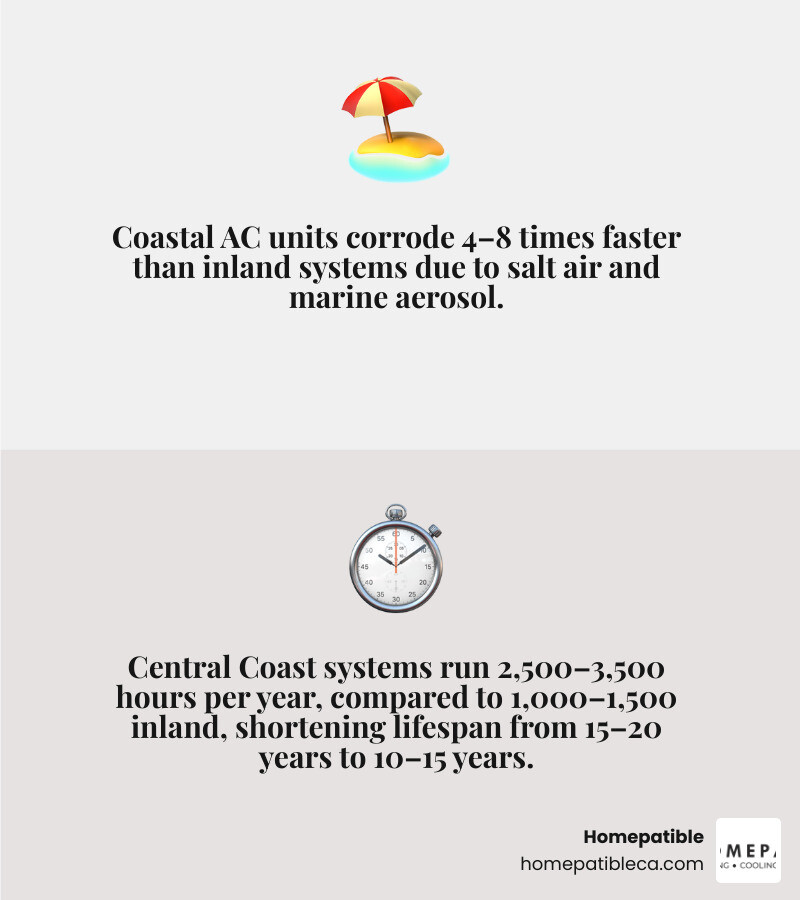
| Salt air corrosion | Damages metal components 4–8x faster than inland environments |
| Annual runtime | 2,500–3,500 hours vs. 1,000–1,500 hours in drier climates |
| Average system lifespan | 10–15 years coastal vs. 15–20 years inland |
| Oceanfront lifespan | As little as 8–12 years, or 5–7 years without maintenance |
| Primary components affected | Condenser coils, fins, fan motors, electrical terminals, fasteners |
| Key drivers of damage | Salt corrosion, high humidity, marine layer, wind-blown sand |
Salt particles carried by onshore breezes settle on your outdoor condenser unit and combine with moisture to trigger a slow but relentless electrochemical reaction. Aluminum fins pit and crumble. Copper refrigerant lines develop pinhole leaks. Electrical connections corrode and fail. And because the Central Coast's mild climate means your AC runs far more hours per year than systems in most parts of the country, every one of these processes is accelerated.
The result? Systems that might last 15 to 20 years in a dry inland climate routinely need replacement in 10 to 15 years here — and sometimes far sooner, especially for homes within a mile of the water.
This guide walks you through the science behind coastal AC wear, what it means for your specific situation on the Central Coast, and what you can do to protect your investment.
I'm Matthew Palmieri, founder of Homepatible, and my background spanning HVAC operations, contractor services, and home systems maintenance has given me a front-row seat to how coastal climate affects AC equipment lifespan — particularly for homeowners along California's Central Coast who face some of the most corrosive conditions in the country. Everything in this guide is built on real-world field experience and the latest industry data, so you can make confident, informed decisions about your home's cooling system.
To understand why your air conditioner struggles in places like Hope Ranch or Pismo Beach, we have to look at the chemistry of the air. The "salt air" we love is actually a suspension of microscopic salt particles and moisture known as marine aerosol. When these particles land on your AC unit, they don't just sit there; they trigger a process known as electrolytic corrosion.
This is essentially a "slow-motion battery" effect. Salt acts as an electrolyte, facilitating a galvanic reaction between the different metals in your system. Most AC condensers use copper tubing with aluminum fins. In the presence of salt and moisture, the aluminum becomes a "sacrificial" metal, corroding rapidly to protect the copper. This is why you might see the delicate fins on your outdoor unit turning into a white, powdery substance or simply crumbling away when touched.
As the aluminum fins degrade, the copper tubing is eventually left exposed. This leads to pinhole leaks in the refrigerant lines, causing the system to lose its cooling capacity and eventually leading to total compressor failure. Learning Coastal Living: How to Keep Your Home from Getting Salty This Spring is the first step in recognizing that your HVAC system isn't just fighting the heat; it's fighting a chemical battle.
Proximity to the Shoreline and Corrosion Rates
The closer you are to the Pacific, the more intense the battle becomes. Homes within the "one-mile zone" of the shoreline experience the most aggressive exposure. Onshore winds carry heavy concentrations of salt spray directly onto outdoor equipment. According to ASTM B117 salt spray testing standards, components in these environments can deteriorate 4 to 8 times faster than those located just a few miles inland.
However, don't assume you're safe if you live in the hills of San Luis Obispo or the Santa Ynez Valley. Onshore breezes and fog patterns can carry microscopic salt particles several miles inland, meaning that even homes in places like Arroyo Grande or Orcutt are still affected by coastal wear. Following A Professional AC Tune-Up Checklist for Coastal Living is essential regardless of exactly how many blocks you are from the sand.
Environmental Stressors: Marine Layers and Wind-Blown Sand
It isn't just the salt. The Central Coast's famous marine layer brings persistent high humidity and fog, which keeps the metal surfaces of your AC unit damp for longer periods, providing the perfect environment for corrosion to thrive.
Additionally, wind-blown sand and debris act like sandpaper, physically pitting the protective paint on the cabinet and clogging the spaces between the condenser fins. This sand infiltration creates an airflow restriction that forces the fan motor to work harder, leading to motor strain and overheating. Understanding How to Keep Your Cool When the Central Coast Sizzles means acknowledging that humidity and sand are just as much of a threat as the temperature itself.
Comparing Lifespan: Coastal vs. Inland HVAC Performance
The gap in equipment longevity between coastal and inland areas is significant. While a central AC system in a dry, inland climate might easily reach the 20-year mark, the reality for Central Coast residents is often much shorter.
| Metric | Coastal California (Central Coast) | Inland California / National Average |
|---|---|---|
| Central AC Lifespan | 10–15 Years | 15–20 Years |
| Heat Pump Lifespan | 10–15 Years | 15–20 Years |
| Ductless Mini-Split | 15–18 Years (with care) | 20+ Years |
| Annual Runtime | 2,500–3,500 Hours | 1,000–1,500 Hours |
| Corrosion Risk | Extreme | Low to Moderate |
The primary reason for this discrepancy is the combination of accelerated component wear and much higher usage. We often overlook The Hidden Benefits of Regular AC Maintenance in Mild Climates, assuming that because it doesn't get "desert hot" here, our systems aren't working hard. In reality, they are working longer and in harsher conditions.
How Coastal Climate Affects AC Equipment Lifespan and Runtime
While we enjoy temperate weather, our AC systems often log 2,500 to 3,500 hours of runtime annually. This is because the "latent load"—the energy required to remove moisture from the air—is incredibly high on the coast. In places like Santa Barbara, humidity levels often hover between 70% and 85%.
Your air conditioner has to work twice as hard: first to dehumidify the air, and then to cool it. This increased compressor workload leads to higher energy consumption and faster wear on mechanical parts. If you want to Beat the Heat Without Breaking the Bank This Summer, you must ensure the system is operating at peak efficiency, as even a small amount of coil corrosion can cause energy bills to skyrocket.
High Humidity and Component Fatigue
High humidity doesn't just make the system run longer; it also creates a breeding ground for biological growth. Moisture accumulation inside the air handler can lead to mold and mildew in the ductwork, which affects indoor air quality.
Furthermore, the damp, salty air is brutal on electrical components. We frequently see electrical terminal corrosion, which leads to intermittent failures, and capacitor failure due to the constant stress of long run times. It is vital to Don't Ignore These Commercial HVAC Warning Signs, as residential systems often exhibit the same symptoms of fan motor stress and "flash rust" on internal components.
Warning Signs of Accelerated Coastal Wear

How do you know if the ocean air is winning the battle against your AC? There are several visual and performance-based red flags to watch for:
- Crumbling Fins: If the aluminum fins on your outdoor unit look like they are "shedding" or turn to dust when you touch them, the corrosion is advanced.
- White Crusty Deposits: This is salt buildup and the byproduct of aluminum oxidation. It acts as an insulator, trapping heat inside the coils.
- Pitting and Flaking Paint: Small bubbles or "pitting" on the metal cabinet indicate that salt has gotten under the protective coating.
- Unusual Noises: Rattling or grinding sounds often mean the fan motor bearings are failing due to salt or sand infiltration.
- Lukewarm Airflow: If your vents are blowing air that isn't quite cold, you may have a refrigerant leak caused by pinhole corrosion in the coils.
- Rising Energy Bills: A system caked in salt and rust has to run longer to achieve the same cooling effect, leading to a steady climb in your monthly costs.
For homeowners in the northern part of our service area, A Complete Guide to AC System Servicing for Paso Robles Homeowners provides a deeper look at how to spot these signs before they lead to a total system breakdown.
Proven Strategies to Extend Your System’s Life
While the coastal climate is harsh, a premature 5-to-7-year failure is not inevitable. With the right strategies, you can push your system toward the 15-year mark or beyond.
- Fresh-Water Rinses: This is the simplest DIY task. Use a garden hose with a gentle spray (never a pressure washer!) to rinse the salt off your outdoor unit once a month.
- Protective Coil Coatings: Specialized epoxy or phenolic coatings (often called E-coatings) can be applied to the coils. These create a barrier that prevents salt from ever touching the metal.
- Sacrificial Anodes: Similar to those used on boats, these magnesium rods can be installed to draw the corrosion away from your expensive AC components.
- Strategic Placement: If you are installing a new unit, try to place it on the side of the house shielded from prevailing ocean winds.
- Windbreaks: Using fences or landscaping (maintained at least 2 feet away for airflow) can help block direct salt spray and wind-blown sand.
Don't wait for summer to start these habits. Stop the Sizzle with These Spring AC Maintenance Tips to ensure your system is ready for the high-humidity months ahead.
Maintenance Steps to Mitigate How Coastal Climate Affects AC Equipment Lifespan
Inland homes might get away with annual service, but for the Central Coast, bi-annual (twice a year) professional maintenance is the gold standard. A professional tune-up should include:
- Deep Coil Cleaning: Using specialized, non-acidic cleaners to remove salt crystals that a garden hose can't reach.
- Electrical Inspection: Checking for "flash rust" on terminals and tightening connections to prevent shorts.
- Drainage Clearing: High humidity means more condensate; we clear the lines to prevent algae buildup and indoor flooding.
- Filter Changes: We recommend changing filters every 30-60 days in coastal areas to keep airflow high and strain low.
For residents in specialized communities, our guide on AC Maintenance in Hope Ranch: Everything You Need to Know offers localized advice for high-exposure properties.
Coastal-Rated Equipment and Protective Features
If you are in the market for a new system, look for "coastal-rated" or "marine-grade" units. These systems are specifically engineered for our environment and often include:
- Epoxy-Coated Coils: Factory-applied coatings that cover every inch of the heat exchanger.
- Stainless Steel Hardware: Screws and fasteners that won't rust into place, making future repairs possible.
- Double-Powder-Coated Cabinets: Extra layers of protection for the exterior housing.
- Triple-Phase Protection: Enhanced electrical shielding against moisture.
Sometimes, a traditional system isn't the best fit. Check out The Ultimate Decision Guide When Mini Splits Outshine Central AC to see if a ductless system—which has fewer exposed metal components—might be a more durable choice for your beach home.
Repair vs. Replacement: Making the Right Choice in May 2026
As of May 2026, the landscape for AC replacement has changed. Stricter SEER2 efficiency standards and California's Title 24 regulations mean that modern systems are significantly more efficient than those installed just a decade ago.
When deciding whether to keep repairing a corroded unit or replace it, we recommend the "5,000 Rule." Multiply the age of your unit by the cost of the repair. If the total exceeds $5,000, it is usually more cost-effective to replace the system.
Additionally, if your system still uses the phased-out R-22 refrigerant, any major leak caused by coastal corrosion will be incredibly expensive to fix. In many cases, upgrading to a modern, coastal-hardened system can pay for itself through energy savings and the peace of mind that comes with a new warranty. Plus, there are often Don't Sweat the Cost: California Incentive Programs for Cooling Upgrades that can help offset the initial investment.
If you're planning to move, How to Sell Your Home Faster with a Brand New Air Conditioner is a proven strategy, as savvy Central Coast buyers always look at the condition of the HVAC system first.
Frequently Asked Questions about Coastal AC Lifespan
How often should I rinse my outdoor unit if I live near the beach?
If you are within one mile of the ocean, we recommend a gentle fresh-water rinse of the outdoor condenser coils once a month. This helps remove salt crystals before they can bond to the metal and trigger the corrosion process. Always turn the power off at the thermostat before rinsing, and never use a pressure washer, which can flatten the delicate aluminum fins.
Does a standard manufacturer warranty cover salt air corrosion?
Generally, no. Most manufacturers consider salt air corrosion to be "environmental damage" or an "act of nature," similar to a flood or storm. This is why proactive maintenance and choosing coastal-rated equipment with specialized coatings is so vital. Without these, you could be facing a total system loss that isn't covered by your warranty.
Are there specific AC units designed for coastal environments?
Yes! Many top manufacturers offer coastal-rated units that feature factory-applied epoxy coatings on the coils, stainless steel hardware, and extra-thick powder coating on the cabinets. These units are specifically designed to withstand the "slow-motion battery" effect of salt air. For some homes, Ductless AC Installation in San Luis Obispo: Small Units, Big Chill is an excellent alternative, as these systems are often more resilient to coastal conditions.
Conclusion
Understanding how coastal climate affects AC equipment lifespan is the key to protecting one of your home's most expensive systems. While the salt, humidity, and wind of the Central Coast are relentless, they don't have to mean a decade of high energy bills and frequent breakdowns.
By choosing the right equipment, staying on top of monthly rinsing, and partnering with a team that understands the unique demands of Santa Barbara and San Luis Obispo Counties, you can enjoy the ocean breeze without sacrificing your home comfort.
At Homepatible, our licensed Nest Pro Elite technicians are experts in coastal HVAC challenges. Whether you need a "rescue mission" for a corroded unit or a new, marine-grade installation, we are here to help. Contact us today for expert Air Conditioning Services tailored to the beautiful—but salty—Central Coast.
Ready to take the next step?
Our certified technicians are ready to help with all your home service needs. Schedule a service today.
Schedule My ServiceRecent Posts
Related Articles
Ready to Get Started?
Whether you need a repair, maintenance, or a new system, our expert team is here to help.