
Don't Ignore These Commercial HVAC Warning Signs
Article content and related resources
Spot signs your commercial HVAC needs attention: inconsistent temps, noises, energy spikes & more. Act now for safety & efficiency!
Why Knowing the Signs Your Commercial HVAC Needs Attention Can Save Your Business
The signs your commercial HVAC needs attention are often subtle at first — a slightly higher energy bill, a faint musty smell, or one room that never quite reaches the right temperature. Easy to dismiss. Easy to delay.
But commercial HVAC systems rarely fail without warning. The problem is that most facility managers and business owners don't recognize the early signals until a minor issue becomes a full system breakdown — one that forces closures, disrupts operations, and leads to costly emergency repairs.
Here's a quick look at the most common warning signs to watch for:
Top Signs Your Commercial HVAC Needs Attention:
- Unusual noises — grinding, squealing, banging, or hissing from vents or equipment
- Inconsistent temperatures — hot spots, cold zones, or rooms that won't stabilize
- Spiking energy bills — unexplained increases without changes in usage
- Short cycling — system turns on and off too frequently
- Weak or uneven airflow — low output from supply vents
- Strange odors — musty, burning, or chemical smells from vents
- Poor indoor air quality — increased dust, humidity complaints, or allergy symptoms
- Visible water pooling or leaks — around indoor or outdoor units
- Thermostat malfunctions — unresponsive controls or inaccurate readings
- Frequent repairs — recurring breakdowns or aging equipment past its service life
According to industry data, HVAC systems account for an average of 39% of a facility's total energy use. When something goes wrong, it doesn't just affect comfort — it hits your bottom line, your occupants' health, and your operational continuity. Businesses that skip routine maintenance face repair costs that are, on average, 30% higher than those that stay proactive.
Whether you manage an office complex, retail space, or commercial facility on California's Central Coast, catching these problems early is the difference between a quick service call and a full system replacement.
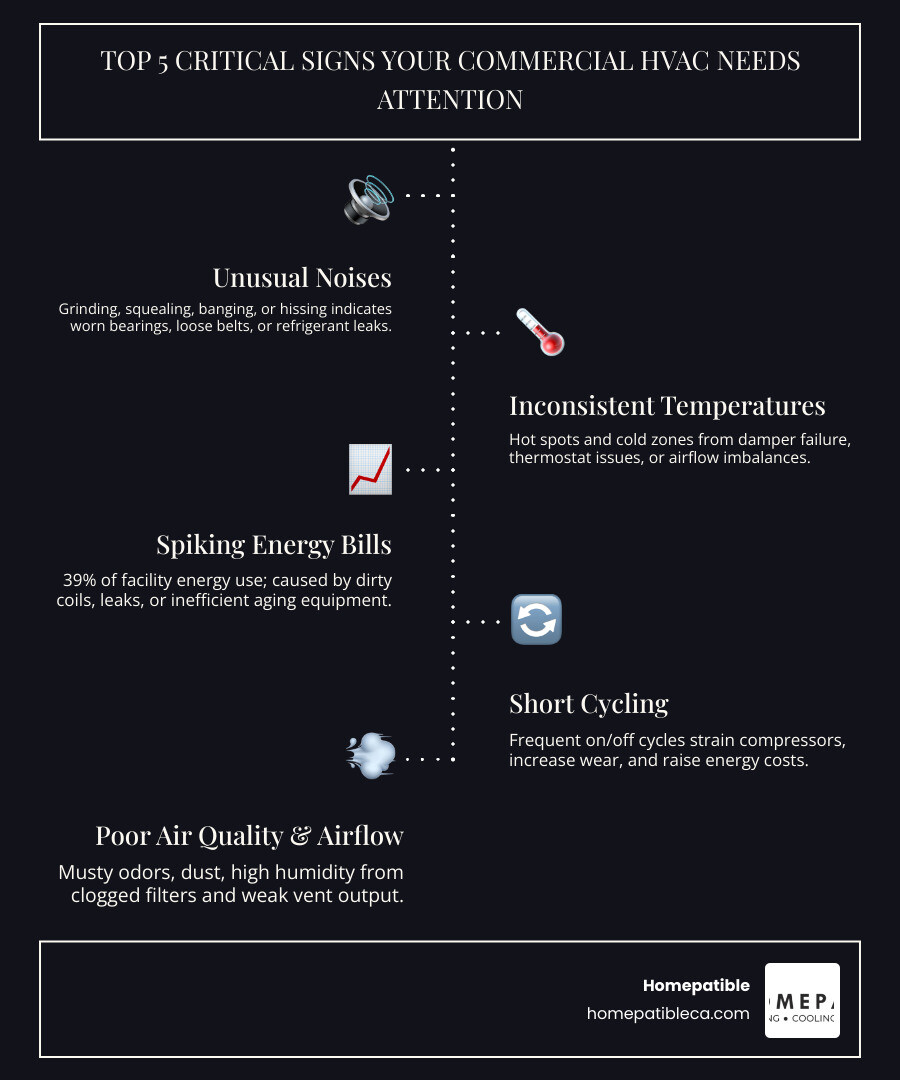
5 Critical Signs Your Commercial HVAC Needs Attention
As we move through April 2026, many business owners in Santa Barbara and San Luis Obispo Counties are realizing that their climate control systems are the silent workhorses of their operations. However, even the most robust systems reach a breaking point. One of the most obvious signs your commercial HVAC needs attention is the sheer age of the equipment. Most commercial systems have a typical lifespan of 15 to 25 years. If your unit is approaching the two-decade mark, it likely uses outdated technology that consumes 20-40% more energy than modern high-efficiency replacements.
Beyond age, keep a sharp eye out for physical deterioration. Visible corrosion on the outer casing or internal components isn't just an aesthetic issue; it’s a sign of chemical wear or moisture damage that can lead to structural failure. Similarly, water pooling around your indoor air handlers or outdoor rooftop units is a major red flag. This often stems from clogged condensate drain lines or cracked pans, which can quickly lead to mold growth and structural water damage if not addressed by a Santa Margarita CA Commercial HVAC Repair Service.
If you find yourself calling for repairs more than twice a year, you are likely dealing with a "cascading failure" scenario. This is when one worn-out part puts undue stress on another, leading to a never-ending cycle of breakdowns. In these cases, a Nipomo CA Commercial HVAC Installation Replacement might actually be the more cost-effective long-term solution compared to constant "band-aid" fixes.
Why Inconsistent Temperatures are Signs Your Commercial HVAC Needs Attention
Have you noticed "hot spots" in the conference room while the lobby feels like a meat locker? These temperature imbalances are classic signs your commercial HVAC needs attention. In large commercial buildings, maintaining a consistent 72 degrees across multiple zones is a complex task. When certain areas refuse to cool down or heat up, it often points to a damper failure within the ductwork. Dampers are the "traffic cops" of your airflow; if they get stuck, air can't reach its intended destination.
In places like the Central Coast, where coastal breezes meet inland heat, Orcutt CA Commercial Air Conditioning systems must be perfectly calibrated. Inconsistent temperatures can also be caused by:
- Thermostat Calibration Issues: If the sensor is off by just 3-4 degrees, the entire zone will feel uncomfortable.
- Airflow Imbalances: Blocked vents or leaking ductwork prevent conditioned air from reaching the far corners of your facility.
- Failing Compressors: If the heart of the AC is struggling, it may not produce enough "cool" to satisfy the entire building's demand.
Unusual Noises: Clear Signs Your Commercial HVAC Needs Attention
A healthy commercial HVAC system should provide a steady, low-level hum that fades into the background. When it starts "talking" to you, it’s usually screaming for help. Different sounds indicate very specific mechanical failures:
- Grinding: This is almost always a sign of worn-out bearings in the blower motor or the compressor. If left unaddressed, the friction will eventually cause the motor to burn out entirely.
- Squealing: Usually related to a belt that has become loose, frayed, or misaligned. This is a common issue for San Luis Obispo CA Commercial Air Conditioning units that run high hours during our warmer months.
- Banging or Clanking: This suggests a loose component, like a fan blade or a connecting rod, that is hitting the housing. This is a high-priority repair to prevent catastrophic internal damage.
- Hissing: This often signals a refrigerant leak. Since refrigerant is a closed-loop system, any hissing sound means the gas is escaping, which kills efficiency and can freeze up your coils.
- Rattling: Often just loose panels or hardware, but persistent rattling can lead to electrical connections vibrating loose over time.
Efficiency Red Flags: Energy Spikes and Short Cycling
In April 2026, managing overhead is more important than ever for Central Coast businesses. Since HVAC systems consume an average of 39% of a facility’s energy, a sudden spike in your utility bill is one of the most reliable signs your commercial HVAC needs attention. If your bill jumps by 15-30% without a corresponding increase in production or a massive heatwave, your system is likely working overtime to compensate for a hidden failure.
One of the biggest culprits of energy waste is "short cycling." This occurs when the HVAC system turns on and off in rapid succession—often running for less than 10 minutes at a time. This is incredibly damaging because the startup sequence is the most energy-intensive part of the cycle. Short cycling is often caused by oversized equipment, clogged air filters, or malfunctioning thermostats. For facilities like those at Vandenberg Space Force Base CA Commercial HVAC Maintenance Tune Up, keeping these cycles healthy is critical for both budget and equipment longevity.
| Feature | Healthy Operational Cycle | Short Cycling (Red Flag) |
|---|---|---|
| Run Time | 15–20 minutes per cycle | Under 10 minutes |
| Energy Use | Steady, predictable | High spikes during frequent starts |
| Wear & Tear | Normal component aging | Accelerated motor and compressor wear |
| Humidity Control | Effective dehumidification | "Clammy" air (too short to remove moisture) |
| Temperature | Consistent across zones | Significant fluctuations |
Addressing Poor Indoor Air Quality and Weak Airflow
Indoor air quality (IAQ) has become a top priority for facility managers. Poor IAQ can lead to "Sick Building Syndrome," causing employees to report headaches, fatigue, and sneezing—all of which lead to a 10-20% drop in productivity. Commercial buildings should ideally stay between 30–50% relative humidity. Anything higher is a red flag that your HVAC system is failing to dehumidify the air properly.
If you notice musty odors, it’s a strong sign of mold or mildew growth within the ductwork or on the evaporator coils. This is often a result of poor drainage or neglected Santa Barbara CA Commercial Indoor Air Quality maintenance. Weak airflow is another common complaint; if you can barely feel air coming out of the supply vents, your blower motor might be failing, or your ducts could be severely obstructed.
Dust accumulation around vents is more than just a cleaning chore—it’s a sign that your filtration system is bypassed or overwhelmed. Proper Goleta CA Commercial Indoor Air Quality starts with high-efficiency filters and clean ductwork, ensuring that the air your team breathes is fresh and allergen-free.
When to Schedule Professional Commercial HVAC Maintenance
Waiting for a total breakdown is the most expensive way to manage a building. To prevent the signs your commercial HVAC needs attention from becoming a total disaster, we recommend a twice-yearly service schedule.
- Spring Cooling Checks: Before the summer heat hits the Central Coast, ensure your refrigerant levels are topped off and your condenser coils are scrubbed clean.
- Fall Heating Tune-ups: Before the chilly Pacific nights set in, have your heat exchanger and electrical connections inspected for safety and efficiency.
Regular Grover Beach CA Commercial HVAC Maintenance Tune Up visits can extend the life of your system by up to 40%. For older units that are starting to show their age, a proactive Oceano CA Commercial HVAC Installation Replacement plan allows you to budget for the upgrade rather than facing an emergency capital expense during your busiest season. Preventive maintenance agreements are the best way to ensure these checks never fall through the cracks, providing priority service and peace of mind.
Frequently Asked Questions about Commercial HVAC Issues
What causes a sudden spike in commercial energy bills?
Sudden spikes are usually caused by the system losing efficiency. Common culprits include dirty evaporator coils (which can cause a 15-25% efficiency loss), failing blower motors that draw too much amperage, or significant leaks in the ductwork. Malfunctioning sensors can also cause the system to run much longer than necessary, driving up costs without improving comfort.
How does short cycling damage a commercial system?
Short cycling is a "system killer." Because the compressor experiences the most strain during the first few seconds of startup, turning on and off 10 times an hour instead of 3 times an hour triples the wear on internal components. It also prevents the system from reaching a steady state of dehumidification, leaving your building feeling "sticky" and humid.
What do burning smells from HVAC vents signify?
A burning smell is an "urgent safety alert." It typically signifies electrical malfunctions, such as a seized motor that is overheating or wiring that has begun to melt due to a short circuit. If you smell anything like burning plastic or ozone, you should perform an immediate shutdown of the system and call a professional to prevent a potential fire hazard.
Conclusion
Proactive care is the cornerstone of a successful business facility. As we look toward the efficiency goals of 2026, recognizing the signs your commercial HVAC needs attention is your first line of defense against operational downtime. From the coastal fog of Carpinteria to the valley heat of Santa Ynez, your HVAC system is vital to your business's success.
At Homepatible, we pride ourselves on Central Coast reliability. Whether you need a simple thermostat calibration or a complex rooftop unit replacement, our licensed technicians are ready to help. Don't wait for the "meat locker" or the "sauna" effect to take hold of your office. Schedule your professional commercial system assessment today and keep your business running at peak performance.
Ready to take the next step?
Our certified technicians are ready to help with all your home service needs. Schedule a service today.
Schedule My ServiceRecent Posts
Related Articles
Ready to Get Started?
Whether you need a repair, maintenance, or a new system, our expert team is here to help.