
Detailed Guide to Summer AC Efficiency for Coastal California Homes
Article content and related resources
Discover summer AC efficiency tips for coastal California homes to cut energy bills and protect your system from salt air and humidity.
Why Summer AC Efficiency in Coastal California Is More Complicated Than You Think
If you're looking for summer AC efficiency tips for coastal California homes, here's a quick overview of what actually moves the needle:
- Set your thermostat to 78°F when you're home and awake — each degree higher saves 3–5% on cooling costs
- Run ceiling fans counterclockwise to feel up to 6 degrees cooler without lowering the thermostat
- Rinse your outdoor condenser unit with fresh water every 2–3 weeks to remove salt buildup
- Change or clean your air filter every 30–60 days — coastal air loads filters faster than inland conditions
- Close window coverings during peak sun hours to reduce heat gain
- Schedule professional AC maintenance at least once a year, ideally before summer peaks — twice a year is better near the coast
- Use a smart or programmable thermostat to avoid cooling an empty home
- Choose marine-grade or coated equipment when replacing your system to extend its lifespan near the ocean
Living on the Central Coast of California comes with an enviable lifestyle — mild temperatures, ocean breezes, and that iconic morning marine layer rolling in off the Pacific. But that same coastal environment is quietly working against your air conditioning system every single day. The salt-laden air accelerates corrosion on outdoor components, the persistent humidity forces your AC to work harder to remove moisture from the air (not just cool it), and the fog and temperature swings unique to places like Santa Barbara and San Luis Obispo create cooling demands that standard inland HVAC advice simply doesn't address. As energy costs rise heading into summer 2026, getting your coastal AC system dialed in isn't just about comfort — it's about protecting a significant home investment.
I'm Matthew Palmieri, founder of Homepatible, and my background spans HVAC systems, smart home technology, and home services operations across the Central Coast — giving me insight into exactly why summer AC efficiency tips for coastal California homes require a different playbook than what works in drier inland climates. In the sections ahead, I'll walk you through everything from daily habits and thermostat settings to salt corrosion protection and system upgrades built for life near the Pacific.
The Marine Layer and Coastal Humidity: How Ocean Air Impacts AC Performance
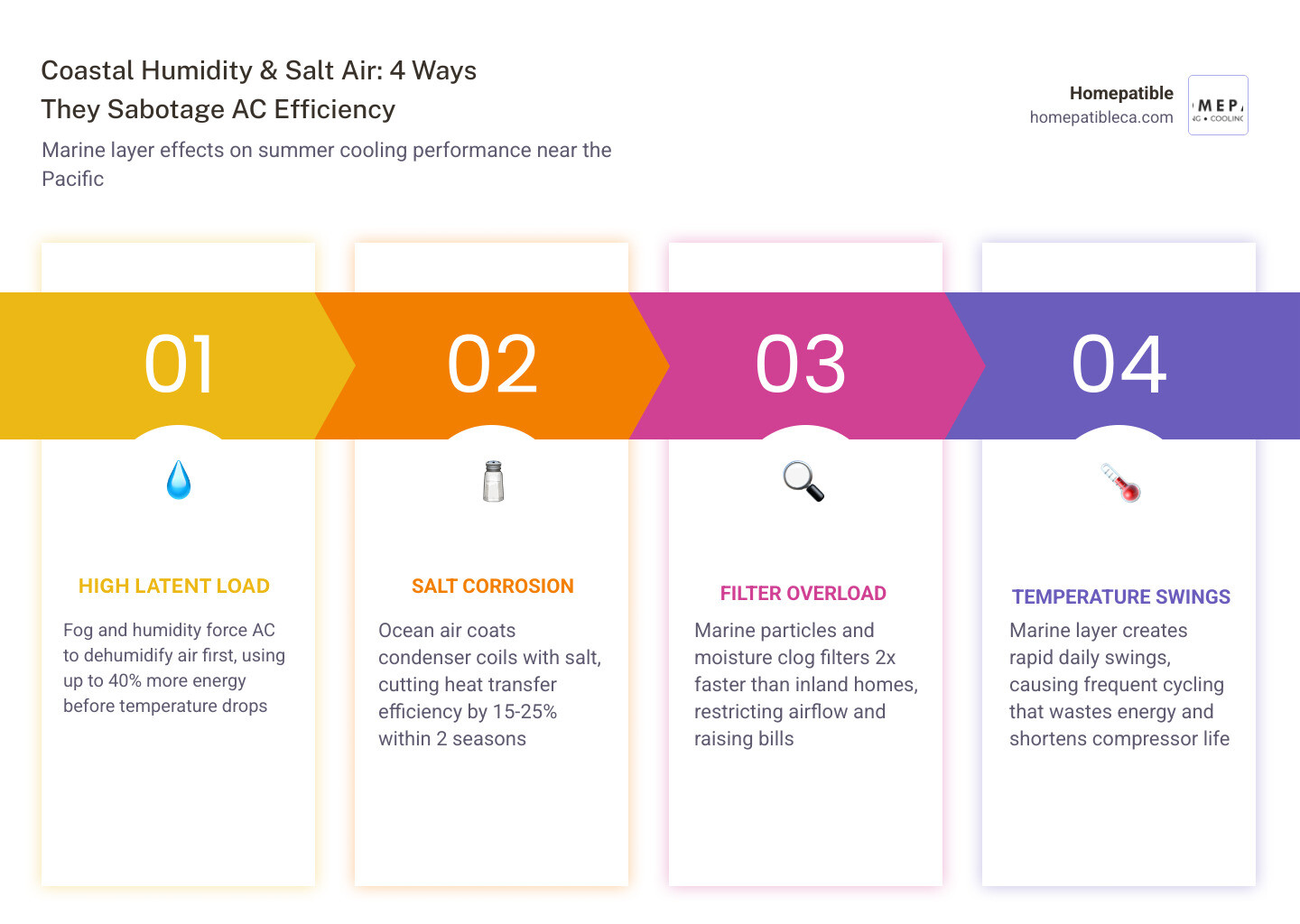
To understand why standard air conditioning advice doesn't quite fit our beautiful slice of California, we have to look at the science of coastal air. When the marine layer rolls into Goleta, Carpinteria, or Montecito, it brings more than just picturesque fog; it brings an incredibly high "latent load."
In HVAC terms, the total cooling load of your home is split into two categories:
- Sensible Load: This is the actual temperature of the air that you read on a standard thermometer.
- Latent Load: This is the amount of moisture (humidity) suspended in the air.
Standard air conditioners are designed to address sensible heat first and latent heat second. However, in our coastal microclimates, morning relative humidity regularly exceeds 80%. This means your air conditioner must spend up to 40% of its energy simply condensing moisture out of the air before it can effectively lower the indoor temperature.
When your evaporator coils are constantly working overtime to squeeze gallons of water out of the humid coastal breeze, the system runs longer cycles. This extra run time doesn't just bump up your electric bill; it also accelerates wear on critical electrical and mechanical components. If you want to dive deeper into how this damp, salty air quietly degrades your system, check out our detailed guide on How Salt Air and Fog Are Secretly Sabotaging Your AC Equipment.
Why Summer AC Efficiency Tips for Coastal California Homes Matter in 2026
As we navigate the summer of 2026, climate patterns along the Central Coast are showing more frequent diurnal temperature swings and unexpected heat waves, even in traditionally cooler coastal pockets like Summerland and Hope Ranch. Combine these shifting weather patterns with rising California utility rates, and running an inefficient cooling system becomes a major financial drain.
Many homeowners in mild areas assume that because they don't experience the triple-digit heat of the Central Valley, they don't need to worry about air conditioning efficiency. This is a common misconception. In mild climates, an inefficient or neglected AC unit actually works harder over time because it rarely runs long enough to dehumidify the home properly, leading to short-cycling, musty indoor odors, and accelerated wear. For a closer look at why mild-climate systems deserve just as much attention as their desert counterparts, read about The Hidden Benefits of Regular AC Maintenance in Mild Climates.
Summer AC Efficiency Tips for Coastal California Homes
Maximizing your summer cooling efficiency doesn't require sacrificing your comfort. By combining smart daily habits with minor environmental adjustments, you can keep your home perfectly chilled while keeping your energy bills under control.
Here are the most effective summer AC efficiency tips for coastal California homes that you can start using today:
- Embrace the 78°F Rule: The U.S. Department of Energy recommends setting your thermostat to 78°F when you are home and active. While this might sound warm to some, each degree you raise your thermostat can save you roughly 3% to 5% on your cooling costs.
- Leverage the Wind-Chill of Ceiling Fans: Running a ceiling fan in an occupied room can make the space feel up to six degrees cooler than the actual ambient temperature. This allows you to set your thermostat higher without feeling the difference. Just make sure your fans are rotating counterclockwise in the summer to push cool air straight down, and remember to turn them off when you leave the room—fans cool people, not empty spaces!
- Manage Solar Heat Gain with Window Treatments: The afternoon sun beating down on west-facing windows in Santa Barbara or Goleta can quickly turn your living room into a greenhouse. Installing light-blocking insulated curtains, blinds, or low-E window tints can block out a massive amount of solar heat, taking a huge load off your AC unit.
- Open Windows Mindfully: One of the greatest perks of coastal living is the natural evening cool-down. When the outdoor temperature drops below your indoor temperature in the late afternoon or evening, shut off the AC and open your windows to let the cool Pacific breeze do the work for you. Just be sure to close them in the morning before the day warms up and the marine humidity rolls back in.
- Keep Up with Filter Changes: Coastal air is filled with moisture, salt, and fine particles. This causes air filters to clog much faster than they would inland. Change your pleated MERV 11 or MERV 13 filters every 30 to 60 days to maintain optimal airflow and prevent your system from straining.
For a comprehensive roadmap on getting your home ready before the peak summer heat hits, consult our California Spring Maintenance Guide to Beat the Heat Early.
To help you build a daily routine, here is a quick checklist of habits to keep your home cool naturally:
- Morning (before 9:00 AM): Close all windows, blinds, and drapes to seal in the morning cool air and block early solar heat.
- Midday: Avoid using heat-producing appliances like ovens or clothes dryers. Opt for a microwave, slow cooker, or outdoor grill instead.
- Afternoon: Turn on ceiling fans in occupied rooms to create a comfortable breeze.
- Evening (after sunset): If the outdoor air is cool and dry, open windows on opposite sides of the house to create cross-ventilation.
Implementing Summer AC Efficiency Tips for Coastal California Homes Daily
To truly optimize your home's energy consumption, you need to transition from manual adjustments to automated smart home technology. This is where programmable and smart thermostats shine.
Instead of leaving your AC running at 72°F all day while you are working in Santa Maria or enjoying a day at the beach in Carpinteria, a smart thermostat can automatically adjust the temperature to 85°F when the house is empty. You can program it to begin pre-cooling your home about 30 to 45 minutes before you return, ensuring you walk into a comfortable space without wasting energy all day.
Furthermore, advanced smart thermostats (like the Google Nest systems our licensed Nest Pro Elite technicians install) can monitor outdoor humidity and dew points. They can run "salt-air" or dehumidification cycles that prioritize moisture removal without over-cooling your living spaces.
For multi-story homes or layout designs common in places like Montecito, implementing a zoned HVAC system with dampers and individual room thermostats is a game-changer. Zoning allows you to avoid wasting energy cooling unused guest rooms or downstairs spaces during the day, focusing the cooling power exactly where you are spending your time. To learn more about how smart scheduling and pre-summer preparation keep your system running smoothly, check out our guide on how to Stop the Sizzle with These Spring AC Maintenance Tips.
Protecting Your System: Maintenance Habits to Fight Salt Air Corrosion
If you live within a few miles of the Pacific Ocean, your outdoor condenser unit is under constant attack. Salt air corrosion is the single greatest threat to HVAC equipment longevity along the Central Coast. Salt crystals settle on the delicate aluminum fins and copper tubing of your condenser. When morning fog or high humidity hits, these salt deposits dissolve and create a highly corrosive chemical reaction that degrades the metal, reducing heat transfer and eventually causing refrigerant leaks.
Without proper intervention, outdoor HVAC equipment within the coastal salt intrusion zone can suffer a significantly shorter lifespan—often lasting just 8 to 12 years near the coast compared to 15 to 20 years inland. In extreme beachfront properties, unprotected units can fail in as little as 5 to 7 years.
Fortunately, you can fight back with a simple, highly effective DIY habit: the fresh-water rinse.
Every 2 to 3 weeks during the summer (and immediately after high-wind coastal storms), rinse your outdoor condenser unit. Here is how to do it safely and effectively:
- Turn off the power: Shut off the electrical power to your AC unit at the outdoor disconnect box or your main breaker panel.
- Clear debris: Remove any leaves, sand, or coastal brush from around the base of the unit.
- Use a gentle stream: Attach a standard spray nozzle to your garden hose. Set it to a gentle "shower" or "sweep" setting. Never use a high-pressure power washer, as this will instantly bend and ruin the delicate aluminum fins.
- Rinse top-to-bottom: Direct the water through the outer grille, spraying from the top down to wash away salt crust and sand.
- Let it dry: Allow the unit to air dry for at least 30 to 45 minutes before turning the power back on.
To illustrate the stark reality of coastal wear and tear, let's look at how coastal exposure impacts system health compared to inland homes:
| Feature / Metric | Coastal California Homes (0–5 Miles from Coast) | Inland California Homes (15+ Miles Inland) |
|---|---|---|
| Average AC Lifespan | 8 – 12 Years (5–7 if neglected) | 15 – 20 Years |
| Primary Threat | Salt air corrosion & high humidity | High sensible heat & dust buildup |
| Coil Efficiency Loss Over Time | Up to 30% loss due to corroded fins | Minimal (typically under 5% if cleaned) |
| Recommended Maintenance | Bi-annual professional tune-ups + bi-weekly rinses | Annual professional tune-up |
| Latent Load Fraction | Up to 40% of total cooling load | 10% – 15% of total cooling load |
For a complete breakdown of what goes into protecting your coastal investment, read our A Professional AC Tune-Up Checklist for Coastal Living and explore our localized advice with AC Maintenance in Hope Ranch: Everything You Need to Know.
Professional Tune-Ups and Protective Coatings
While DIY fresh-water rinses are fantastic for day-to-day protection, they cannot wash away the microscopic corrosion already bonding to the metal deep inside your coil assembly. That is where professional maintenance and specialized protective coatings come in.
During a professional coastal tune-up, certified technicians apply specialized anti-corrosion coatings—such as epoxy or phenolic "e-coatings"—to the condenser coils. These microscopic, marine-grade coatings act as a shield, preventing salt ions from making direct contact with the aluminum and copper.
Additionally, we can install sacrificial zinc anodes on your condenser cabinet. Just like the anodes used on boat hulls, these zinc pieces draw the corrosive galvanic currents away from your expensive copper lines and steel housing, sacrificing themselves to preserve your AC system.
If you are located in San Luis Obispo County, check out our guide on how to Tune Up to Chill Out with San Luis Obispo AC Maintenance. If you are in Santa Barbara County, you can easily schedule your specialized service through our AC Maintenance Tune-Up Santa Barbara page.
Selecting the Right AC System and Sizing for Coastal Climates
When the time comes to replace an aging, rusted coastal system, proper equipment selection and precise sizing are critical. In coastal California, we must avoid the common temptation of "oversizing" the unit.
Many contractors use outdated rules of thumb (like "one ton of cooling per 500 square feet") that result in systems that are far too large for our mild coastal climates. Because our ambient summer temperatures are moderated by the ocean, coastal homes in Santa Barbara or San Luis Obispo typically only need 20 to 22 BTUs of cooling capacity per square foot.
If you install an oversized AC system, it will rapidly cool the home and shut off before it has a chance to complete a full cycle. This is called "short-cycling." Because the system doesn't run long enough, it fails to remove the high coastal humidity, leaving your home feeling cold, clammy, and musty while driving up your energy bills and wearing out the compressor prematurely.
To prevent this, we always perform a rigorous Manual J Load Calculation. This engineering method accounts for:
- Local coastal microclimates
- Home orientation and solar gain
- Insulation levels and window specifications
- Air infiltration rates and ductwork design
For coastal homes, variable-speed heat pumps and ductless mini-splits are the gold standard. Unlike traditional single-stage systems that are either 100% on or 100% off, variable-speed systems can scale their capacity down to as low as 30%. This allows them to run ultra-quiet, low-energy, extended cycles. These long, steady runtimes are incredibly efficient and provide unmatched dehumidification, keeping your indoor air dry and comfortable.
When choosing a system, look for units with high SEER2 ratings (ideally 17 to 20+) and robust marine-grade specifications, including factory-applied coil coatings and stainless-steel fasteners.
Ready to explore your system options? Check out our dedicated installation pages for your area:
Frequently Asked Questions About Coastal AC Efficiency
What is the best thermostat temperature for summer in coastal California?
The optimal thermostat setting for summer in coastal California is 78°F when you are at home and awake. Because our coastal air carries high humidity, keeping the thermostat at 78°F while running a ceiling fan counterclockwise provides an excellent balance of comfort and energy savings. Each degree you raise your thermostat can save you 3% to 5% on your monthly cooling costs. When you are away from home, set the thermostat to 85°F to prevent unnecessary cooling cycles while still allowing the system to run occasionally for dehumidification.
How often should coastal homeowners schedule AC maintenance?
Due to the harsh combination of salt air, heavy morning fog, and high humidity, we highly recommend a bi-annual (twice-yearly) professional maintenance schedule for homes within five miles of the ocean. A spring visit ensures your system is clean, coated, and ready for the summer load, while a fall visit clears away the heavy salt buildup accumulated during the peak coastal wind season.
To make this hassle-free, many homeowners opt for a structured plan. Learn about the perks of preventative care in our article on the Benefits of an AC Service Agreement for Savvy Homeowners.
What are the signs that salt air is damaging my AC?
Keep an eye out for these common warning signs of coastal salt damage:
- White powder or pitting on the aluminum fins of your outdoor condenser unit (this is "white rust," the precursor to structural coil failure).
- Flaking, orange rust on the steel cabinet or fan grille.
- Unusually loud fan noises or vibrating sounds, which indicate that salt corrosion has compromised the motor bearings or fan blades.
- A steady increase in your monthly energy bills despite normal weather, indicating that corroded coils are losing their heat-transfer efficiency (corroded coils can lose up to 30% of their efficiency).
If you notice any of these signs on your Santa Barbara home, don't wait for a complete system breakdown. Reach out to our repair team immediately through our AC Repair Service Santa Barbara page.
Conclusion
Living on the beautiful California Central Coast means enjoying some of the most spectacular weather in the world—but it also means taking proactive steps to protect your home systems from the unique challenges of our marine environment. By implementing these summer AC efficiency tips for coastal California homes, from routine fresh-water rinses to smart thermostat scheduling, you can enjoy crisp, comfortable indoor air without watching your utility bills soar.
At Homepatible, we are proud to serve communities across Santa Barbara and San Luis Obispo Counties, including Goleta, Montecito, Carpinteria, Orcutt, Solvang, and Lompoc. Our licensed, certified Nest Pro Elite technicians specialize in marine-grade HVAC solutions, smart home automation, and energy-efficient system upgrades designed specifically for coastal living.
Whether you need a specialized coastal tune-up, emergency repairs, or a complete high-efficiency heat pump installation, we are here to help. Explore our full range of services on our Homepatible Air Conditioning Services page, or contact us today to schedule your summer readiness inspection!
Ready to take the next step?
Our certified technicians are ready to help with all your home service needs. Schedule a service today.
Schedule My ServiceRecent Posts
Related Articles
Ready to Get Started?
Whether you need a repair, maintenance, or a new system, our expert team is here to help.