
How Salt Air and Fog Are Secretly Sabotaging Your AC Equipment
Article content and related resources
Discover how salt air and coastal moisture stress your ac equipment. Protect your AC from corrosion & extend its life.
Why Salt Air and Coastal Moisture Are Slowly Destroying Your AC System
How salt air and coastal moisture stress your AC equipment is one of the most overlooked threats facing homeowners along California's Central Coast. If you live in Santa Barbara, San Luis Obispo, Pismo Beach, or any of the communities in between, your outdoor AC unit is fighting a quiet battle every single day — and salt air is winning.
Here's the short answer:
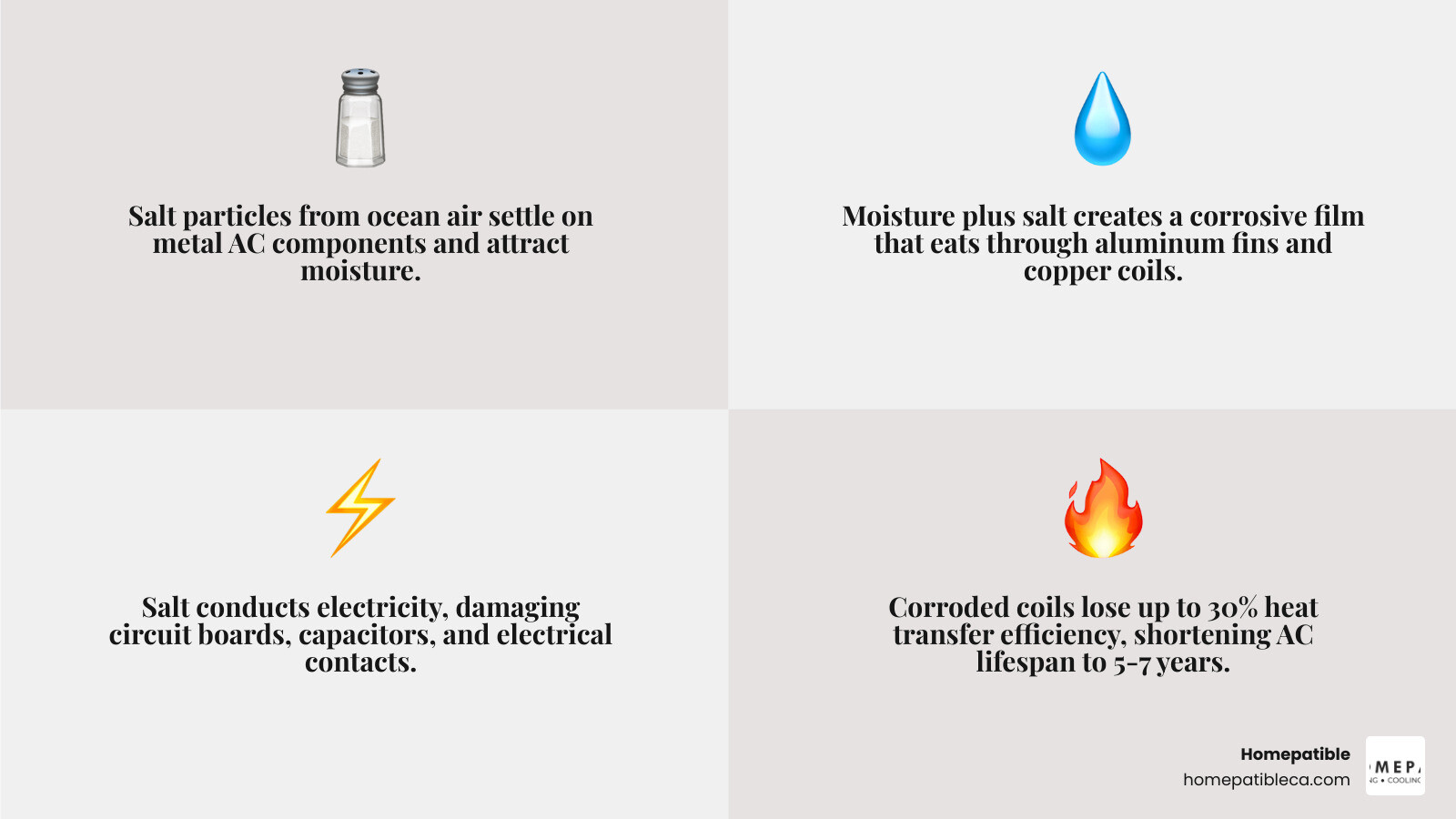
- Salt particles from ocean air settle on metal AC components and attract moisture
- Moisture + salt creates a corrosive film that eats through aluminum fins, copper coils, and steel hardware
- Electrical parts like circuit boards and capacitors are damaged because salt conducts electricity
- Efficiency drops as corroded coils lose up to 30% of their heat transfer ability
- Lifespan shrinks from a typical 10-15 years down to just 5-7 years without proper protection
- Energy bills rise as the system works harder to compensate for corrosion damage
- Homes within 1-5 miles of the shoreline face the highest risk, but salt particles travel farther inland on strong coastal winds
The Central Coast's combination of ocean fog, sea breezes, and year-round mild humidity creates what experts call a "corrosive cocktail" — one that standard AC equipment simply wasn't built to handle. Most homeowners don't notice the damage until it shows up on their energy bill or the system breaks down entirely.
Understanding How Salt Air and Coastal Moisture Stress Your AC Equipment
Living on the Central Coast means enjoying the refreshing sea breeze and that iconic morning fog. However, what feels like a cool relief to us is actually a delivery system for sodium chloride—microscopic salt particles that are incredibly aggressive toward metal.

When ocean mist rolls into neighborhoods in Goleta, Carpinteria, or Morro Bay, it carries these particles directly into the heart of your air conditioner. Once these salt particles settle on your outdoor unit, they don't just sit there. Because salt is "hygroscopic," it literally pulls moisture out of the air. This creates a persistent, wet, salty film that triggers an electrochemical reaction.
This reaction accelerates oxidation at a rate that would be impossible in an inland desert climate. For local businesses, this is even more critical, as Commercial HVAC San Luis Obispo CA systems often have larger surface areas exposed to these wind patterns, leading to faster degradation if not specifically treated for coastal conditions.
The Science of Corrosion: Which Components Fail First?
Your air conditioner is a masterpiece of heat exchange, but that exchange relies on thin, delicate metals. When we look at how salt air and coastal moisture stress your AC equipment, we see a specific "path of destruction" that usually starts on the exterior and works its way into the sensitive internal electronics.
The first thing to go is usually the structural integrity of the aluminum fins. You might notice them becoming brittle or even "turning to dust" when touched. This isn't just a cosmetic issue; it prevents the unit from releasing heat. Once the heat can't escape, the compressor has to work twice as hard, leading to premature mechanical failure. If you are already seeing these signs, you likely need a professional AC Repair Service Santa Barbara CA to assess whether the damage has reached the refrigerant lines.
How salt air and coastal moisture stress your AC equipment's coils and fins
The condenser coils—the "lungs" of your AC—are typically made of copper tubing with aluminum fins pressed against them. This combination of two different metals (copper and aluminum) in a salty, moist environment creates a "galvanic cell." This is essentially a tiny battery that generates a current, which eats away at the softer metal (the aluminum).
This process, known as pitting corrosion, creates microscopic craters in the metal. Eventually, these pits can go deep enough to cause refrigerant leaks. When the fins corrode and flatten, they restrict airflow, forcing the fan motor to spin longer and faster. This is why a regular AC Maintenance Tune-Up Pismo Beach CA is so important; we can catch this pitting before it turns into a total system shutdown.
Electrical damage and mechanical wear
It isn't just the metal "skin" of the AC that suffers. Salt is a highly conductive material. When salt-laden fog gets inside the service panel, it creates a conductive film over circuit boards, contactors, and capacitors.
This film can cause:
- Short circuits: Electricity jumping across paths it shouldn't.
- Arcing: Small sparks that burn out sensitive electrical connections.
- Salt crystallization: As the unit heats up and dries out, salt crystals form inside moving parts like the fan motor bearings, acting like sandpaper and causing mechanical grinding.
Homeowners in coastal areas often experience "mystery" breakdowns where the system keeps tripping the breaker. In many cases, this is due to salt-related electrical leaks. If your unit is acting up, an AC Repair Service Grover Beach CA can help identify if salt buildup is the culprit behind your electrical gremlins.
Warning Signs Your Central Coast System is Struggling
Because we live in such a beautiful environment, it's easy to ignore the outdoor unit until it stops blowing cold air. However, there are several red flags that suggest how salt air and coastal moisture stress your AC equipment is reaching a critical point.
- Visible Rust or "White Dust": If the cabinet looks like it’s rusting or you see a crusty white powder on the fins, corrosion is already well underway.
- Rising Energy Bills: If your April 2026 bill is significantly higher than April 2025 despite similar weather, your system's efficiency is likely dropping due to clogged, corroded coils.
- Uneven Cooling: If some rooms stay warm while others are cold, the system may be struggling to move enough heat out of the house.
- Frequent Circuit Trips: This often indicates that salt-moisture film is causing electrical shorts.
Coastal vs. Inland Performance Comparison
| Feature | Inland (e.g., Cuyama) | Coastal (e.g., Shell Beach) |
|---|---|---|
| Average Lifespan | 12–15 Years | 5–7 Years (unprotected) |
| Maintenance Need | Annual | Bi-Annual (minimum) |
| Corrosion Risk | Low | Extremely High |
| Efficiency Loss | 5% over 5 years | Up to 30% over 5 years |
If you haven't had your system checked recently, scheduling an AC Maintenance Tune-Up Shell Beach CA is the best way to determine where your unit sits on this timeline.
Proactive Steps to Protect Your Coastal Investment
The good news is that you aren't helpless against the ocean. While we can't change the weather in Santa Barbara or San Luis Obispo counties, we can change how we care for the equipment.
How salt air and coastal moisture stress your AC equipment and how rinsing helps
The simplest DIY habit you can adopt is the "Fresh Water Flush." Since salt is water-soluble, rinsing your unit helps remove the surface-level salt before it has a chance to bond with the metal and start the corrosion process.
The Proper Rinsing Technique:
- Turn off the power: Always shut off the AC at the thermostat and the outdoor disconnect box first.
- Use low pressure: Never use a power washer! High pressure will bend the delicate aluminum fins, which is just as bad as corrosion. A gentle spray from a garden hose is perfect.
- Inside-Out: If possible, spray through the top to push salt and debris out through the sides.
- Frequency: We recommend doing this once a month, or even every two weeks if you live within a mile of the beach.
This simple habit is a great bridge between your professional AC Maintenance Tune-Up Santa Barbara CA visits.
Professional solutions and coastal-rated upgrades
For those living in high-impact areas like Avila Beach or Montecito, standard equipment might not be enough. When it's time for an upgrade, we look for "Coastal-Rated" units. These systems are built differently from the ground up.
- Anti-Corrosion Coatings: Professional-grade epoxy or polymer coatings (like BLYGOLD or similar treatments) can be applied to the coils. These act as a barrier, preventing salt from ever touching the metal.
- Stainless Steel Fasteners: Standard screws rust quickly. Coastal units use stainless steel or ceramic-coated hardware to prevent the cabinet from falling apart.
- Enclosed Motors: Protecting the fan motor from direct salt spray can add years to the system's life.
If your current system is already showing significant "flaking" or "shedding" of the fins, it might be more cost-effective to look into an AC Installation Replacement Grover Beach CA rather than pouring money into a failing, inefficient unit.
Frequently Asked Questions about Coastal AC Stress
How far inland does salt air affect my air conditioner?
While the most severe damage happens within the first mile of the Pacific, salt air doesn't stop at the beach. Depending on wind patterns and elevation, microscopic salt particles can travel 5 to 10 miles inland. If you can smell the ocean from your front porch, your AC is at risk. For businesses located slightly inland, such as in parts of Pismo, Commercial HVAC Pismo Beach CA systems still require specialized coastal inspections to prevent long-term decay.
How much faster do AC units degrade near the ocean?
Research shows that neglecting coastal-specific maintenance can lead to 25-40% faster equipment degradation. In a "normal" environment, you might get 15 years out of a unit. Along the Central Coast, that can drop to just 5-7 years if salt is allowed to sit on the coils. This essentially means you are paying double for your cooling over the long term. A quick AC Repair Service Pismo Beach CA can often extend a unit's life if the salt buildup is caught early enough.
When is it time to replace a salt-damaged system?
We generally recommend the "50% Rule." If the cost of repairing a salt-damaged unit (like replacing a corroded coil) is more than half the cost of a new system, replacement is usually the smarter financial move. This is especially true if your energy bills have climbed by 30% or more, as a new, efficient unit will pay for itself in energy savings. For a full assessment of your system's health, contact us for an AC Installation Replacement Santa Barbara CA consultation.
Conclusion
Living on the Central Coast is a dream, but the salt air can make it a nightmare for your air conditioner. By understanding how salt air and coastal moisture stress your AC equipment, you can take the necessary steps to protect your home and your wallet. Whether it's a simple monthly rinse or a professional anti-corrosion treatment, being proactive is the key to coastal comfort.
At Homepatible, we are your local experts in coastal home systems. Serving Santa Barbara and San Luis Obispo Counties, our licensed technicians understand the unique challenges of our local climate. From 24/7 emergency repairs to smart home integrations that help you monitor your system’s efficiency, we are here to make your home smarter, safer, and more resilient.
Don't let the salt win. Protect your coastal home with expert air conditioning services today and ensure your comfort for years to come.
Ready to take the next step?
Our certified technicians are ready to help with all your home service needs. Schedule a service today.
Schedule My ServiceRecent Posts
Related Articles
Ready to Get Started?
Whether you need a repair, maintenance, or a new system, our expert team is here to help.