
Chill Out and Save: How Higher SEER2 Ratings Lower Your Energy Bills
Article content and related resources
Discover how higher seer2 ratings lower your energy bills. Save on cooling costs in Santa Barbara with expert tips on SEER2 efficiency.
Why Your Next AC Upgrade Could Be the Smartest Money Move You Make
How higher SEER2 ratings lower your energy bills comes down to one simple idea: the more efficiently your air conditioner converts electricity into cooling, the less you pay each month to stay comfortable.
Here's a quick breakdown of how it works:
- Higher SEER2 = less electricity used to produce the same amount of cooling
- A jump from 14 SEER2 to 18 SEER2 can cut cooling energy use by roughly 20%
- A 20 SEER2 unit uses about 33% less energy than a 14 SEER2 unit
- For a typical 3-ton system running 1,000 hours a year at average electricity rates, that gap adds up to hundreds of dollars over the life of the unit
- Variable-speed systems at higher SEER2 ratings also run more consistently, avoiding costly energy spikes
If you're a homeowner on the Central Coast — dealing with inland heat in San Luis Obispo or the year-round cooling demands in Santa Barbara — choosing the right SEER2 rating is one of the most direct ways to shrink your utility bills without sacrificing comfort.
SEER2 is the updated efficiency standard the U.S. Department of Energy introduced in January 2023. It replaced the older SEER rating by using more realistic testing conditions that better reflect how your system actually performs inside your home — with real ductwork, real airflow resistance, and real-world static pressure. The result is a number you can actually trust.
In this guide, we'll walk you through exactly how the math works, what ratings make sense for your home, and what else you need to get right to see those savings show up on your bill.
Understanding the Shift: What is SEER2 and Why Does It Matter?
If you’ve lived on the Central Coast for a while, you’ve probably heard the term SEER (Seasonal Energy Efficiency Ratio). Think of it like a car's MPG rating, but for your air conditioner. However, just as a car’s fuel economy changes when you’re driving uphill versus on a flat highway, an AC’s efficiency changes based on the "resistance" it faces in your home.
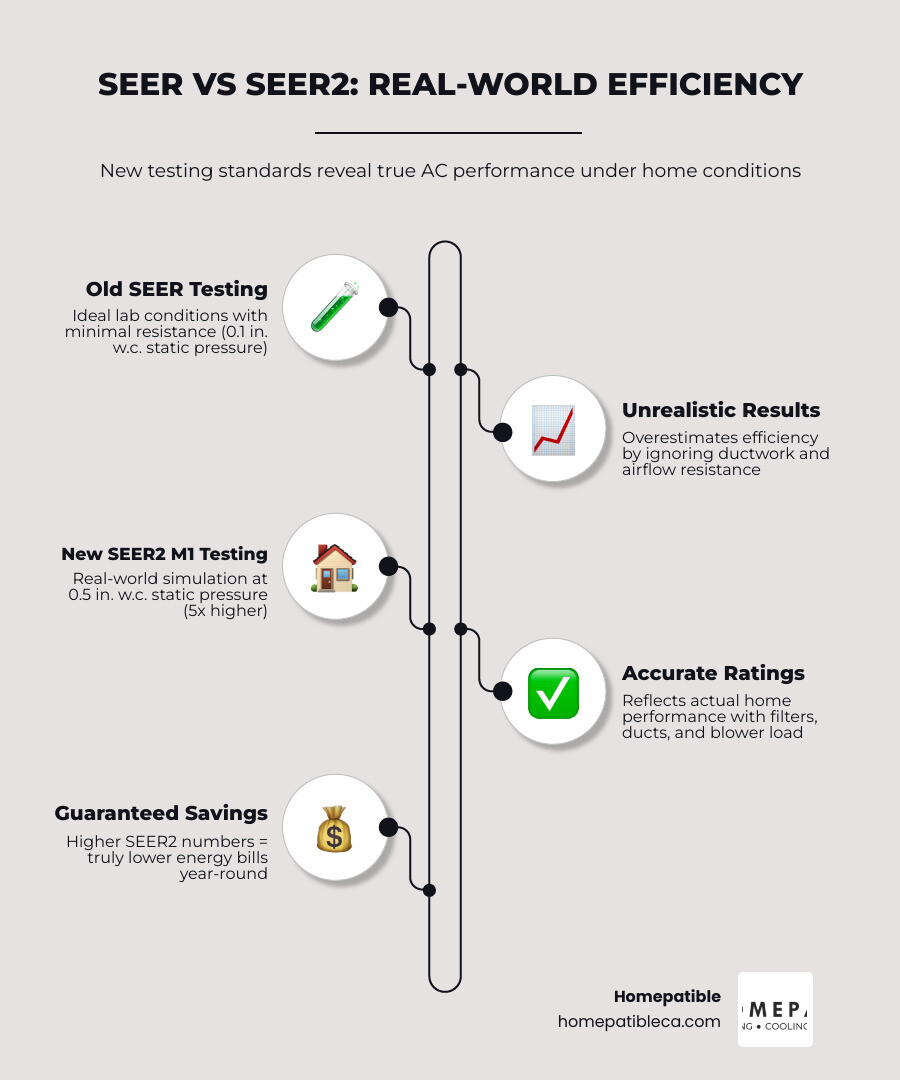
This is where SEER2 comes in. As of 2023, the Department of Energy mandated a new testing procedure called "M1." The old SEER tests were conducted under "ideal" lab conditions with very low external static pressure (0.1 in. w.c.). In the real world, your ductwork, vents, and air filters create much more resistance. SEER2 tests are performed at five times that pressure (0.5 in. w.c.), which more accurately simulates a real-world installation in a home in Santa Maria or Lompoc.
Because the test is harder, the numbers usually look a bit lower. For example, a unit that was rated at 16 SEER might now be labeled as 15.2 SEER2. Don't be fooled—the unit isn't less efficient; the rating is just more honest. Understanding this shift is the first step in seeing how higher SEER2 ratings lower your energy bills. To keep your current system running at its peak until you're ready to upgrade, check out our guide to Stop the Sizzle with These Spring AC Maintenance Tips.
How higher seer2 ratings lower your energy bills through better testing
The accuracy of SEER2 means you can better predict your ROI. By accounting for the blower load and the energy it takes to push air through your specific ductwork, SEER2 provides a performance metric that aligns with your actual utility meter. When we install a high-SEER2 system in a home in Goleta, we know that the simulated external pressure in the test matches the reality of the home's ventilation. This transparency helps homeowners make informed decisions rather than guessing based on lab-perfect scenarios.
Regional requirements for the Central Coast
The U.S. is divided into regions with different minimum standards. Here in California, we fall under the Southwest region. This means that any new split-system central air conditioner installed must meet a minimum SEER2 requirement. Currently, for our region, that minimum is generally 14.3 SEER2 (which is equivalent to the old 15 SEER). If you are looking at heat pumps, the standards are nationwide, but the goal remains the same: ensuring every new system installed from Carpinteria to San Luis Obispo meets a baseline of modern efficiency.
Calculating the Savings: How Higher SEER2 Ratings Lower Your Energy Bills
Let’s get into the "meat" of the matter: the money. The core reason how higher SEER2 ratings lower your energy bills is the reduction in watt-hours consumed.
| SEER2 Rating | Efficiency Gain (vs. 13.4 Baseline) | Potential Annual Savings (Estimated) |
|---|---|---|
| 14.3 SEER2 | 6% | $30 - $50 |
| 16.0 SEER2 | 16% | $80 - $110 |
| 18.0 SEER2 | 26% | $150 - $180 |
| 20.0 SEER2 | 33% | $200+ |
Note: Estimates based on a 3-ton system running 1,000 hours/year at $0.14/kWh. Actual savings in Santa Barbara County may be higher due to local utility rates.
When you move from a standard 14 SEER2 unit to a 20 SEER2 unit, you aren't just getting a "better" machine; you're getting variable-speed technology. While a standard unit is either 100% "on" or 100% "off," a high-SEER2 variable-speed unit can throttle down to 30% capacity. It’s the difference between flooring your car's gas pedal at every green light versus using cruise control. For a deeper dive into the tech behind this, read about The Science of Savings: Improving Efficiency via Smart Integration.
Estimating your home's cooling costs
You can actually do a bit of "back of the napkin" math to see your potential savings. A simple formula to estimate your new bill is: New Bill = Old Bill × (Old SEER / New SEER2). For example, if your summer cooling bill is $200 a month with an old 10 SEER unit, and you upgrade to a 20 SEER2 unit, your bill could drop to roughly $100. That 50% reduction in kilowatt-hours is a game-changer over a 15-year system lifespan.
The impact of variable-speed compressors
Variable-speed compressors are the "secret sauce" of high SEER2 ratings. By operating at lower speeds for longer periods, they maintain a consistent temperature without the massive energy spikes caused by frequently turning on and off. This also leads to superior humidity control—a major plus for our coastal communities like Pismo Beach and Grover Beach, where damp ocean air can make a home feel "muggy" even if the temperature is low.
Maximizing Efficiency Beyond the Rating Label
A high SEER2 rating on the box doesn't guarantee savings if the installation is botched. In fact, a poorly installed 20 SEER2 unit can actually perform worse than a well-installed 14 SEER2 unit. This is why professional sizing and installation are non-negotiable.
We use "Manual J" load calculations to ensure your system isn't too big or too small. An oversized unit will "short-cycle," turning on and off so fast that it never reaches its rated efficiency and fails to remove humidity. Conversely, we check ductwork integrity. If your ducts are leaking air into your attic in Solvang or Buellton, you're literally throwing your SEER2 savings out the window. For residents in the northern part of our service area, we have A Complete Guide to AC System Servicing for Paso Robles Homeowners that covers these essentials.
The role of maintenance in how higher seer2 ratings lower your energy bills
Once your high-efficiency system is in, you have to protect that investment. Dirt is the enemy of efficiency. A clogged filter or a grime-covered outdoor coil forces the motor to work harder, pulling more amps and driving up your bill. Regular "filter hygiene" and annual professional tune-ups ensure that 18 SEER2 unit actually stays an 18. We recommend a seasonal Tune Up to Chill Out with San Luis Obispo AC Maintenance to keep your system's "lungs" clear.
Climate factors in Santa Barbara and San Luis Obispo
Our unique Central Coast climate plays a huge role in your ROI. In coastal areas like Montecito or Summerland, the cooling season might be shorter, but the salt air can lead to corrosion. In contrast, inland areas like Atascadero or Santa Ynez experience intense summer heat where a high SEER2 unit will pay for itself much faster because it runs more often. We always factor in your specific microclimate when recommending a system.
Added Value: Comfort, Incentives, and Environmental Impact
While the primary focus is how higher SEER2 ratings lower your energy bills, the benefits don't stop at your wallet. High-efficiency systems are significantly quieter. Because they often run at lower speeds, you won't hear that "jet engine" roar every time the AC kicks on—a blessing for quiet neighborhoods in Hope Ranch or Nipomo.
Additionally, high-efficiency units use less electricity, which reduces your home's carbon footprint. This is increasingly important as California moves toward more sustainable building standards. For local business owners, understanding these standards is just as vital; see The Business Owner's Guide to HVAC Maintenance Requirements.
Rebates and tax credits for high-efficiency upgrades
The upfront cost of a high-SEER2 system is often offset by significant incentives. Under the Inflation Reduction Act, homeowners can qualify for federal tax credits (often up to $2,000 for qualifying heat pumps). Many local utility providers in San Luis Obispo and Santa Barbara counties also offer rebates for installing ENERGY STAR certified equipment. These incentives can drastically shorten your "payback period," making a premium system much more affordable.
Enhanced indoor comfort and humidity control
Because high-SEER2 units (especially variable-speed models) run for longer cycles at lower speeds, they provide much more stable indoor temperatures. You won't have "hot spots" in the kitchen or "cold zones" in the bedroom. Furthermore, the longer run times allow the system to pull more moisture out of the air, improving your indoor air quality and preventing that "sticky" feeling on humid days in Orcutt or Arroyo Grande.
Frequently Asked Questions about SEER2 Savings
Is a higher SEER2 rating always worth the upfront cost?
It depends on how long you plan to stay in your home and your local climate. If you're in a hot inland area like Paso Robles and plan to stay for 10+ years, a higher SEER2 rating is almost always worth it. If you're in a very mild coastal zone and moving in two years, a mid-range unit might be a better value.
How do I find the SEER2 rating of my current system?
You can usually find the model number on the yellow "EnergyGuide" sticker on your outdoor unit. However, the most accurate way is to look up the AHRI (Air Conditioning, Heating, and Refrigeration Institute) certificate for your specific indoor and outdoor equipment match. Our technicians can verify this for you during a standard service call.
Can poor ductwork negate a high SEER2 rating?
Absolutely. If your ductwork is undersized, leaky, or restricted, it creates high static pressure. This forces the blower motor to consume more energy to move air, which can drop an 18 SEER2 system down to the effective efficiency of a 13 SEER2 unit. We always recommend a duct inspection alongside a system upgrade.
Conclusion
Navigating HVAC efficiency can feel like learning a second language, but the takeaway is clear: how higher SEER2 ratings lower your energy bills is a matter of physics and smart technology. By choosing a system that matches our Central Coast climate and ensuring it is installed by certified experts, you can enjoy a cooler home and a smaller utility bill for years to come.
At Homepatible, we are proud to be the Central Coast’s trusted experts for high-efficiency solutions. Whether you’re in Santa Barbara, San Luis Obispo, or anywhere in between, our licensed Nest Pro Elite technicians are ready to help you integrate the latest in cooling technology with smart home precision.
Ready to see how much you could save? Schedule your high-efficiency air conditioning consultation today and let us help you find the perfect "chill" for your home.
Ready to take the next step?
Our certified technicians are ready to help with all your home service needs. Schedule a service today.
Schedule My ServiceRecent Posts
Related Articles
Ready to Get Started?
Whether you need a repair, maintenance, or a new system, our expert team is here to help.