
Why Your AC is Blowing Warm Air and How to Fix It
Article content and related resources
Discover ac not cooling properly what to check: thermostat, filters, coils & more for quick fixes. Santa Maria AC repair tips!
Is Your AC Running But Not Cooling? Here's What to Check First
If your ac not cooling properly what to check list feels overwhelming, start here. Most AC cooling problems come down to a handful of common issues — and many of them you can spot yourself in minutes.
Quick answer: AC not cooling properly — what to check
- Thermostat settings — Make sure it's set to "Cool" mode, not "Fan" or "Heat," and that the target temperature is below the current room temperature
- Air filter — A clogged filter is the single most common cause of poor cooling; check it first
- Circuit breaker — A tripped breaker can stop the outdoor unit while the indoor fan keeps running
- Outdoor condenser unit — Look for debris, dirt, or overgrown vegetation blocking airflow around the unit
- Vents and registers — Make sure none are closed, blocked by furniture, or obstructed
- Evaporator coil — Check for ice or frost buildup on the indoor unit, which can shut down cooling entirely
- Refrigerant — If everything else checks out, low refrigerant from a leak is a likely culprit and requires a licensed technician
On a sweltering Central Coast afternoon, there's nothing more frustrating than watching your AC run nonstop while your home stays stuffy and warm. The good news: in many cases, the fix is simple — a dirty filter, a wrong thermostat setting, or a blocked condenser unit. But some problems, like refrigerant leaks or compressor failures, need a licensed HVAC professional before they turn into bigger, more expensive repairs. This guide walks you through exactly what to look for, in the right order, so you can stop guessing and start fixing.
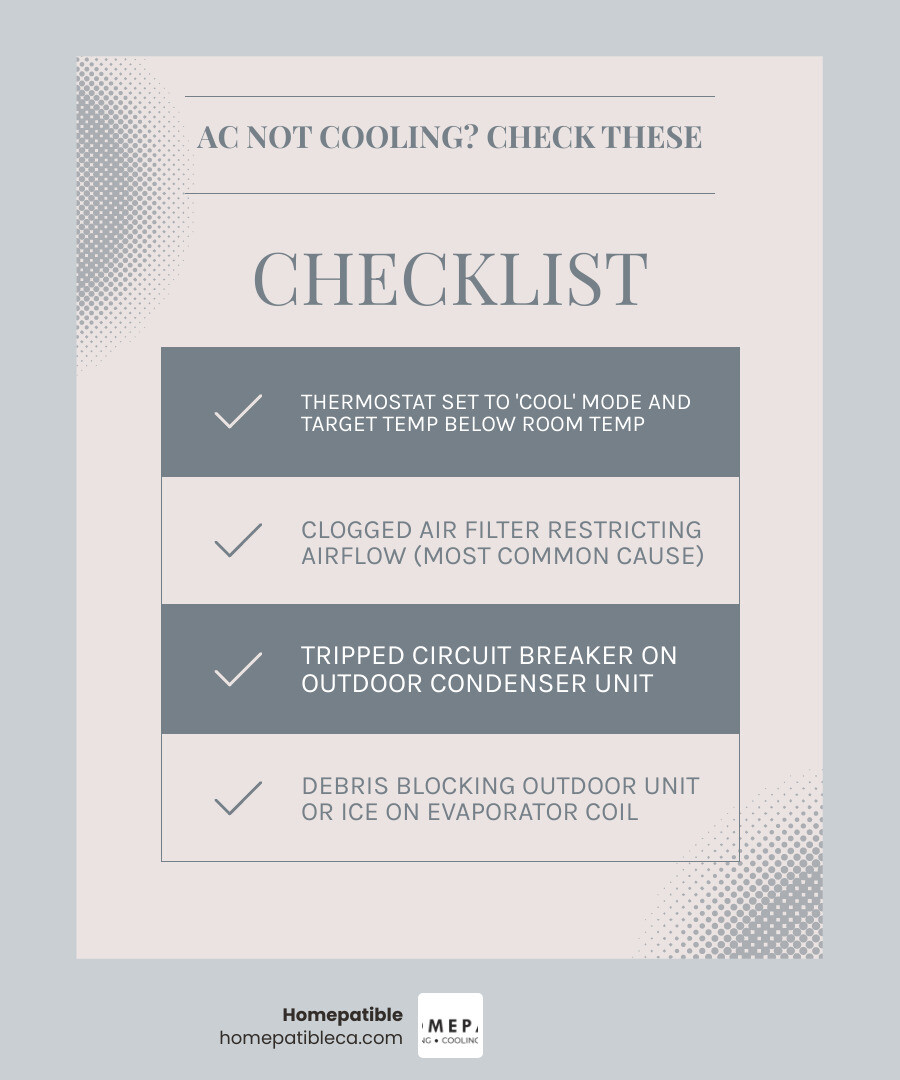
AC Not Cooling Properly: What to Check for Immediate Relief
When your home starts feeling like a sauna in April 2026, the first thing we recommend is a systematic walk-through of your system. Before you assume the worst, many cooling issues are caused by simple interruptions in the "flow" of your system—whether that’s electrical flow, airflow, or the flow of communication from your thermostat.
One common scenario is the "ghost run," where your indoor fan is blowing air through the vents, but the air isn't cold. This often happens because the indoor and outdoor units have different power sources. If the outdoor unit’s breaker trips, the indoor fan will keep spinning, but no heat exchange is happening.
For residents in the northern part of our service area, we often provide AC Repair Service in Santa Maria, CA to address these exact power-supply disconnects that leave homeowners sweating.

AC not cooling properly: what to check on your thermostat
It sounds almost too simple, but the thermostat is the brain of your HVAC system, and even "brains" have bad days. If you find your ac not cooling properly what to check first is the display panel.
- Mode Settings: Ensure the system is set to "Cool." It’s surprisingly easy for a family member or a bump during cleaning to switch the unit to "Heat" or "Fan Only." In "Fan" mode, the system circulates room-temperature air without activating the cooling cycle.
- The "Auto" vs. "On" Fan Setting: If your fan is set to "On," it runs 24/7. This can actually blow warm air into your home when the cooling cycle is resting. Set it to "Auto" so the fan only blows when the air is actually being chilled.
- Batteries: If your thermostat has a blank or fading display, the batteries are likely dying. A weak battery can prevent the thermostat from sending a strong enough signal to the outdoor unit to kick the compressor into gear.
- Calibration: Over time, thermostats can lose their accuracy. If you set it to 72°F but the house feels like 80°F, the sensor might be faulty.
If you’ve checked the settings and the unit still isn't responding, you might need a professional to look at the wiring. We frequently assist with AC Repair Service in Goleta, CA to help homeowners recalibrate or upgrade their "brains" to modern smart systems.
AC not cooling properly: what to check regarding air filters
A dirty air filter is the single most common cause of AC problems—and fortunately, it’s the easiest fix. Think of the air filter as the "lungs" of your system. When it’s clogged with Central Coast dust, pet hair, or pollen, the system has to work twice as hard to pull air through.
When airflow is restricted, several bad things happen:
- Reduced Cooling: Not enough air moves over the cooling coils to lower the temperature of the house.
- Frozen Coils: Without enough warm air passing over them, the evaporator coils get too cold and turn any moisture into ice.
- Short Cycling: The system may overheat and shut itself off prematurely to protect the motor.
We recommend checking your filter every month, especially if you have pets. If you can’t see light through the filter when holding it up to a lamp, it’s time for a change. For those in the Valley, we offer AC Repair Service in Lompoc, CA to help clear out system-wide blockages caused by neglected filters.
Inspecting the Outdoor Condenser and Evaporator Coils
Your air conditioner doesn't actually "create" cold; it removes heat from your home and dumps it outside. This happens via two sets of coils. If either set is dirty or blocked, the heat has nowhere to go, and your AC will blow lukewarm air.
Signs of a frozen evaporator coil and how to thaw it
The evaporator coil is located inside your home (usually in the attic or a closet). Its job is to absorb heat from your indoor air. If you notice frost on the copper refrigerant lines or if the unit is dripping excessive amounts of water, your coil is likely frozen.
How to thaw it safely:
- Turn off the AC: Switch the thermostat to "Off" immediately. Running it while frozen can destroy the compressor.
- Switch the Fan to "On": This runs the indoor blower without the cooling cycle, passing warm air over the ice to melt it.
- Wait: It can take several hours to thaw completely. Do not try to pick the ice off with a tool, as you could puncture the delicate coils.
Once thawed, check your air filter. If the filter is clean and it freezes again, you likely have a refrigerant leak. Our team providing AC Maintenance & Tune-Up in Santa Barbara, CA can help identify the root cause of persistent freezing.
Identifying a blocked or dirty outdoor condenser
The outdoor unit (the condenser) is responsible for releasing the heat collected from your home. Because it lives outside, it’s a magnet for leaves, grass clippings, and dirt. If the "fins" (the metal slats on the sides) are clogged, the heat stays trapped in the refrigerant.
DIY Cleaning Steps:
- Clear the Perimeter: Ensure there is at least two feet of clear space around the unit. Trim back any bushes or tall grass.
- Gently Wash: After turning off the power at the outdoor disconnect switch, use a garden hose on low pressure to rinse away dirt. Never use a pressure washer, as it will bend the fragile fins and ruin the unit.
Regularly scheduled care, such as AC Maintenance & Tune-Up in Orcutt, CA, ensures these outdoor components stay clean and efficient throughout the summer heatwaves. If you notice bent fins, you can use a "fin comb" to straighten them, or call for AC Maintenance & Tune-Up in Atascadero, CA to have a professional handle the delicate work.
Mechanical and System Issues Requiring Professional Attention
While we love empowering homeowners to handle simple checks, some parts of your AC are dangerous or illegal for unlicensed individuals to handle. Refrigerant, for example, requires EPA certification to manage because it is a controlled substance.
| Issue | DIY Check | Professional Fix |
|---|---|---|
| Airflow | Replace dirty filter; open all vents | Duct repair or blower motor replacement |
| Power | Reset tripped circuit breaker once | Replace faulty capacitor or contactor |
| Thermostat | Check batteries and "Cool" mode | Rewiring or sensor replacement |
| Refrigerant | Look for ice or hissing sounds | Leak detection, repair, and recharge |
| Compressor | Check for humming or clicking | Full compressor replacement |
If you’ve tried the basic steps and your home is still warm, it’s time to call in the experts. For those in the South County, we provide reliable AC Repair Service in Nipomo, CA.
Is a low refrigerant level causing my AC not to cool?
A common myth is that AC units "use up" refrigerant like a car uses gas. In reality, your AC is a sealed system. If the refrigerant is low, it means you have a leak.
Signs of a leak include:
- Hissing or bubbling noises near the AC unit.
- Ice buildup on the evaporator coil or the outdoor brass valves.
- Increased indoor humidity (the AC isn't effectively removing moisture).
- Air coming out of the vents is slightly cool but not cold.
Adding more refrigerant without fixing the leak is like trying to fill a bucket with a hole in the bottom. Our technicians providing AC Repair Service in Arroyo Grande, CA use specialized tools to sniff out leaks, seal them, and then recharge the system to factory specifications.
Faulty capacitors and compressor failures
If you hear your outdoor unit making a "click-click-click" or a loud humming sound but the fan isn't spinning, you likely have a failed capacitor. The capacitor is essentially a large battery that gives the motor the "jolt" it needs to start.
The compressor is the heart of the system. If it fails, the refrigerant won't circulate, and no cooling will occur. Compressors are the most expensive part to replace, and in older units (15+ years), a failed compressor often signals that it's time for a new, energy-efficient system. Modern units are 20 to 40 percent more efficient than those made just 15 years ago!
If your system is making strange noises or refusing to start, our AC Repair Service in Pismo Beach, CA can diagnose whether it's a simple electrical component or a major mechanical failure.
Airflow Obstructions: Vents, Ducts, and Filters
Sometimes the AC is creating cold air perfectly, but that air simply isn't reaching your living space. This is usually an airflow issue.
- Blocked Registers: Check every room. Is there a rug over a floor vent? A couch pushed against a wall return? Ensure all registers are open and clear.
- The "Closed Vent" Myth: Many people close vents in unused rooms to "save energy." This is actually a bad idea. It increases the pressure in your ductwork, which can cause leaks or cause the blower motor to burn out. Keep at least 80% of your vents open at all times.
- Leaky Ducts: In many older Central Coast homes, ductwork in the attic or crawlspace can pull apart. This results in you paying to cool your attic while your bedroom stays hot. If you feel very weak airflow coming from your vents, it's a sign of a duct issue.
Maintaining the integrity of your air delivery system is a key part of our AC Maintenance & Tune-Up in Goleta, CA visits, where we inspect the visible ductwork for signs of disconnection or wear.
Frequently Asked Questions about AC Troubleshooting
Should I turn off my AC if it's not cooling properly?
Yes. If your AC is running but the temperature isn't dropping, turn it off at the thermostat. If the issue is a frozen coil, running the compressor will only make the ice block thicker and could lead to permanent compressor damage. If the issue is mechanical, "forcing" the unit to run can turn a small repair into a total system replacement.
How can I reset my AC unit if it's not blowing cold air?
You can perform a "soft reset" by following these steps:
- Turn the AC off at the thermostat.
- Go to your electrical panel and find the circuit breaker for the AC.
- Flip the breaker to the "Off" position, wait 60 seconds, and flip it back to "On."
- Wait 30 minutes. This allows the internal "delay timer" in the AC to reset.
- Set the thermostat back to "Cool."
How often should I perform maintenance to prevent cooling issues?
We recommend an annual professional tune-up every spring. Statistics show that annual service improves efficiency by 5 to 15 percent and significantly reduces the chance of a mid-summer breakdown. Think of it like an oil change for your home’s most expensive appliance.
Conclusion
When you're dealing with an ac not cooling properly what to check first are the basics: the thermostat, the air filter, and the outdoor unit's cleanliness. Taking these DIY steps can often save you time and restore your comfort immediately. However, if the air is still warm or you hear unusual noises, don't wait for the problem to get worse.
At Homepatible, we are proud to serve the entire Central Coast, from the hills of Montecito to the valleys of Santa Maria. Our licensed Nest Pro Elite technicians are experts in both traditional HVAC systems and modern smart home integration. We offer 24/7 emergency service because we know that AC failures don't always happen during business hours.
Whether you need a quick capacitor fix or a full system evaluation, we’re here to help you stay cool. Book your professional AC inspection today and let us get your home’s comfort back on track.
Ready to take the next step?
Our certified technicians are ready to help with all your home service needs. Schedule a service today.
Schedule My ServiceRecent Posts
Related Articles
Ready to Get Started?
Whether you need a repair, maintenance, or a new system, our expert team is here to help.