
When Your DIY Project Is Too Dangerous to Handle
Article content and related resources
Discover if it safe to do your own electrical work in CA. Learn DIY risks, legal rules, safe tasks & when to call pros on Central Coast.
The Real Answer to "Is It Safe to Do Your Own Electrical Work?"
Is it safe to do your own electrical work? The honest answer is: it depends on the task — and the stakes are much higher than most homeowners realize.
Here's a quick breakdown to help you decide:
| Task Type | Safe for DIY? |
|---|---|
| Replacing a light bulb or faceplate | Yes |
| Resetting a tripped breaker | Yes |
| Swapping a light switch or outlet (power off, verified) | With caution |
| Installing GFCI or AFCI outlets | With caution |
| Adding new circuits | No — hire a pro |
| Service panel or breaker upgrades | No — hire a pro |
| 240V appliances, EV chargers, sub-panels | No — hire a pro |
| Outdoor wiring or whole-home rewiring | No — hire a pro |
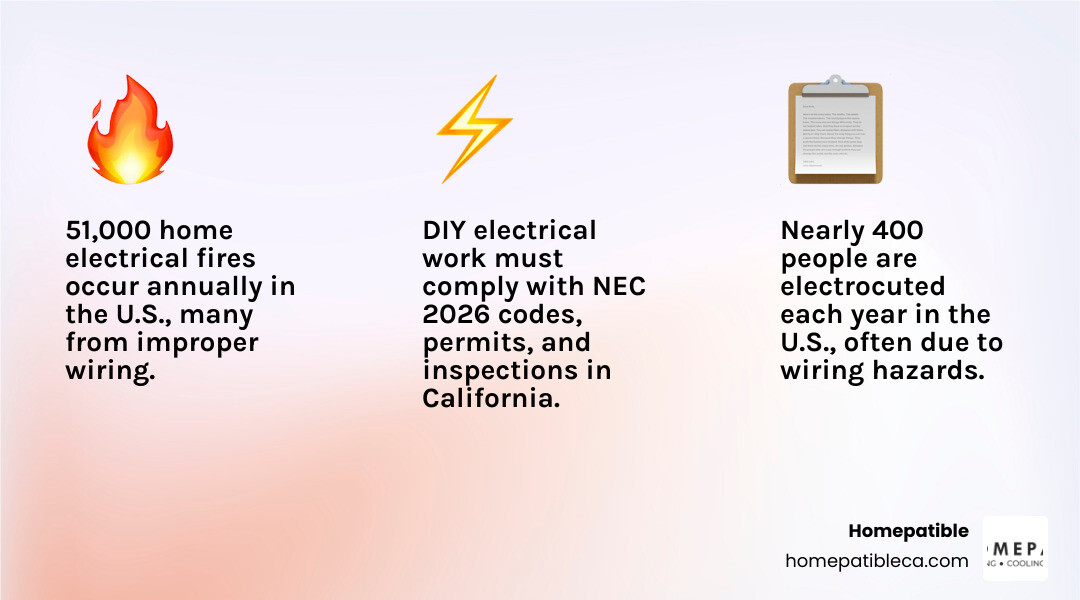
Electricity is one of the few home systems where a small mistake can have life-changing consequences. According to the Electrical Safety Foundation International (ESFI), home electrical fires account for an estimated 51,000 fires each year in the U.S. — many linked directly to improper wiring or amateur repairs. And nearly 400 people are electrocuted in the U.S. annually, with wiring hazards playing a significant role.
For homeowners on California's Central Coast managing busy lives, the temptation to skip the scheduling call and fix something yourself is completely understandable. But knowing exactly where the safe line is — and when to step back — can protect your home, your family, and your insurance coverage.
This guide walks you through what's actually safe, what's not, and what the law says about DIY electrical work in California in 2026.
Understanding the Legalities: Is It Safe to Do Your Own Electrical Work in California?
In April 2026, the legal landscape for home improvement continues to prioritize safety through the National Electrical Code (NEC). Many homeowners ask us if it is even legal to pick up a screwdriver and open an outlet box. In California, the law generally allows "owner-occupants" to perform certain electrical tasks on their primary residence, but this isn't a free-for-all.
The state and local municipalities in Santa Barbara and San Luis Obispo Counties have strict requirements. Even if you are doing the work yourself, you are often legally required to pull a building permit and schedule a formal inspection. This ensures that your work meets the latest safety standards designed to prevent fires and shocks. For those living in rental properties or commercial buildings, DIY electrical work is almost universally prohibited; these tasks must be handled by a licensed professional. If you are unsure about the specific requirements in your neighborhood, our team providing Electrical Services in Buellton can help clarify what requires a permit and what doesn't.
Proving Ownership for DIY Permits
If you decide to apply for a homeowner’s electrical permit, be prepared for some paperwork. Local building departments typically require a deed search or proof of primary residence to ensure you aren't an unlicensed contractor posing as a homeowner.
In some jurisdictions, you may even be required to pass a "homeowner’s electrical exam." Don't worry—it’s not as intense as the professional licensing exam we take, but it is a scaled-down test based on the NEC to prove you understand the basics of grounding, wire sizing, and circuit protection. These rules exist because a mistake in your guest room could theoretically cause a fire that threatens your entire neighborhood.
Why Code Compliance Matters for Your Property
Following the National Electrical Code (NEC) isn't just about avoiding a fine from the city. Code compliance is the "gold standard" for home safety. When we talk about whether is it safe to do your own electrical work, we are really talking about whether that work meets the engineering requirements to handle modern electrical loads.
Non-compliant work can significantly hurt your property value. During a home sale, a professional inspector will often spot "handyman specials"—like wires joined outside of junction boxes or mismatched circuit breakers. These findings can stall a sale or force you to pay for expensive professional corrections at the last minute.
The Real Risks and Consequences of Amateur Wiring
The physical risks of electricity are unforgiving. Unlike a leaky faucet that leaves a puddle, a "leaky" electrical connection creates heat. This heat can lead to arc faults—intense bursts of electricity that can reach temperatures of several thousand degrees. These faults often smolder behind your walls for weeks or months before finally igniting a structure fire.
The statistics are sobering: electrical failure accounted for 89% of electrical fires in residential buildings in recent years. Furthermore, nearly 14% of the 400 annual electrocutions in the U.S. are linked directly to wiring hazards. If your home is older or you suspect the previous owners took shortcuts, you might consider Whole Home Rewiring in Solvang to bring everything up to modern safety benchmarks.
How DIY Mistakes Affect Homeowner's Insurance
One of the most overlooked risks of DIY electrical work is the financial fallout. Most homeowner's insurance policies have clauses requiring that all major systems be maintained according to local codes. If a fire is traced back to an electrical circuit that you installed without a permit or a license, your insurance company may have grounds to deny your claim entirely.
This leaves you responsible for the total cost of repairs and potentially liable for injuries to others. Using a professional helps protect your policy coverage because it provides a paper trail of permitted, inspected, and certified work.
Common DIY Errors That Lead to Hazards
Even well-meaning DIYers often make critical errors. Here are the most frequent mistakes we see in the field:
- Loose Connections: A wire that isn't torqued correctly will arc, creating a fire hazard.
- Wrong Wire Gauge: Using thin 14-gauge wire on a 20-amp breaker is a recipe for disaster. The wire will overheat and melt long before the breaker ever trips.
- Bypassing GFCIs: Skipping Ground Fault Circuit Interrupter outlets in "wet" areas like kitchens or bathrooms removes your primary defense against lethal shocks.
- Overcrowded Junction Boxes: Stuffing too many wires into a small box causes heat buildup and increases the risk of a short circuit.
| Feature | DIY Amateur Work | Professional Standard |
|---|---|---|
| Permit & Inspection | Often skipped, risking legal/insurance issues | Always obtained and verified |
| Wire Sizing | Common to use whatever is "on hand" | Strictly matched to circuit amperage |
| Connections | Hand-tightened, prone to loosening | Torqued to specific manufacturer specs |
| Code Knowledge | Based on YouTube or old books | Based on current 2026 NEC updates |
| Liability | Homeowner takes 100% of the risk | Contractor is licensed and insured |
Identifying Which Tasks Are Safe for Homeowners
While the risks are high, we don't want to scare you away from every project. There is a "meaningful slice" of electrical work that is perfectly reasonable for an attentive homeowner to handle. The key is knowing the boundaries and having the right tools.
Minor Repairs: When Is It Safe to Do Your Own Electrical Work?
Simple cosmetic updates are generally safe. Replacing a cracked faceplate, changing a light bulb, or installing battery-operated under-cabinet lighting are great ways to refresh your home without touching live wires.
If you have a steady hand and a healthy respect for safety, you might also feel comfortable with Outlet Switch Services in Toro Canyon like replacing an existing dimmer switch or a standard outlet. As long as you are replacing "like-for-like" and the power is completely disconnected, these are manageable tasks.
Essential Precautions for Small DIY Electrical Projects
If you decide to tackle a minor project, you must follow these non-negotiable safety steps:
- De-energize the Circuit: Never rely on a wall switch. Turn off the power at the main breaker panel.
- Verify with a Voltage Tester: Use a non-contact voltage tester to ensure the wires are truly "dead" before you touch them.
- Use PPE: Wear rubber-soled shoes and consider safety goggles to protect against falling debris or sparks.
- Use Insulated Tools: Only use tools with handles rated for electrical work.
For more complex aesthetic upgrades, like Lighting Services in Isla Vista, we often recommend having a pro handle the initial wiring so you can simply enjoy the results.
When to Step Back: Projects That Require a Licensed Professional
There are certain points where "handy" becomes "hazardous." Generally, if a project involves high voltage (240V), new circuits, or the main service panel, it is time to call us. These systems carry enough current to be instantly lethal and require specialized training to balance the electrical load of your home.
High-Voltage Hazards: Why Is It Safe to Do Your Own Electrical Work Only on Low-Voltage Systems?
Low-voltage systems (like landscape lighting or doorbells) are generally safe because they don't carry enough "kick" to cause major harm. However, 240V circuits—the ones that power your AC, dryer, and electric range—are a different story.
With the rise of electric vehicles on the Central Coast, we’ve seen an uptick in DIY EV Charger Installation in Oceano. This is a high-risk project. An EV charger pulls a massive, continuous load for hours at a time. If the wiring isn't perfect, it will fail, potentially causing a fire in your garage.
Complex Installations and System Upgrades
Anything involving your main electrical panel is strictly professional territory. The "bus bars" inside a panel remain live even if you turn off the main breaker. One slip of a screwdriver here can cause a massive arc flash.
If your breakers are frequently tripping or you're adding modern appliances, you likely need Electrical Panel Services in Ballard or specialized Panel Services in Pismo Beach. We can ensure your panel is rated for your home's actual demand, preventing "invisible" hazards like overloaded neutrals.
Frequently Asked Questions about DIY Electrical Safety
We hear many of the same concerns from our neighbors in See Canyon and Solvang. Here are the answers to the most common questions regarding is it safe to do your own electrical work.
Do I need a permit for minor electrical work in 2026?
In most Central Coast jurisdictions, you don't need a permit to replace a light bulb or a faceplate. However, if you are moving an outlet, adding a new fixture, or running new wire through a wall, a permit is almost certainly required. Even for something as simple as Ceiling Fan Installation in Solvang, a permit ensures the mounting box is rated for the weight and vibration of the fan.
Can DIY electrical work void my homeowner's insurance?
Yes. If an investigation finds that a fire was caused by unpermitted or unlicensed electrical work, many insurance carriers will deny the claim. This is why we emphasize professional Electrical Services in See Canyon—it provides the legal and safety documentation you need to stay protected.
What are the most common mistakes homeowners make in DIY wiring?
The biggest mistake is overconfidence. Homeowners often assume that if a light turns on, the job was done correctly. However, a light can work perfectly even if the wire is too small or the connection is loose—until the wire gets hot enough to start a fire. Other common errors include using electrical tape instead of proper wire nuts and failing to ground the system correctly. If you're unsure about work done by a previous owner, our Electrical Services in Toro Canyon include safety inspections to catch these "hidden" dangers.
Conclusion
At Homepatible, we love a good DIY project as much as anyone, but we also value the safety of our Central Coast community. Whether you're in Santa Barbara County or San Luis Obispo County, your home’s electrical system is its most vital—and potentially dangerous—component.
From simple repairs to 24/7 emergency service, our licensed technicians are here to make your home smarter, safer, and more efficient. Don't gamble with your family's safety or your home's insurance coverage. If you’re staring at a tangle of wires and wondering, "is it safe to do your own electrical work?" the safest move is to give us a call.
Ready to take the next step?
Our certified technicians are ready to help with all your home service needs. Schedule a service today.
Schedule My ServiceRecent Posts
Related Articles
Ready to Get Started?
Whether you need a repair, maintenance, or a new system, our expert team is here to help.