
The Ultimate Roadmap to Choosing Your Home Water System
Article content and related resources
Discover which water treatment system is right for your home. Expert guide to RO, softeners, filtration for Santa Barbara water quality.
Is Your Home's Water Actually Safe? What Central Coast Homeowners Need to Know
Which water treatment system is right for your home depends on what's actually in your water — and the answer is different for every household. A pitcher filter might be all you need if chlorine taste is your only concern. But if you're on well water in San Luis Obispo County, or your home has older pipes in Santa Barbara, the stakes are higher and the solution more specific.
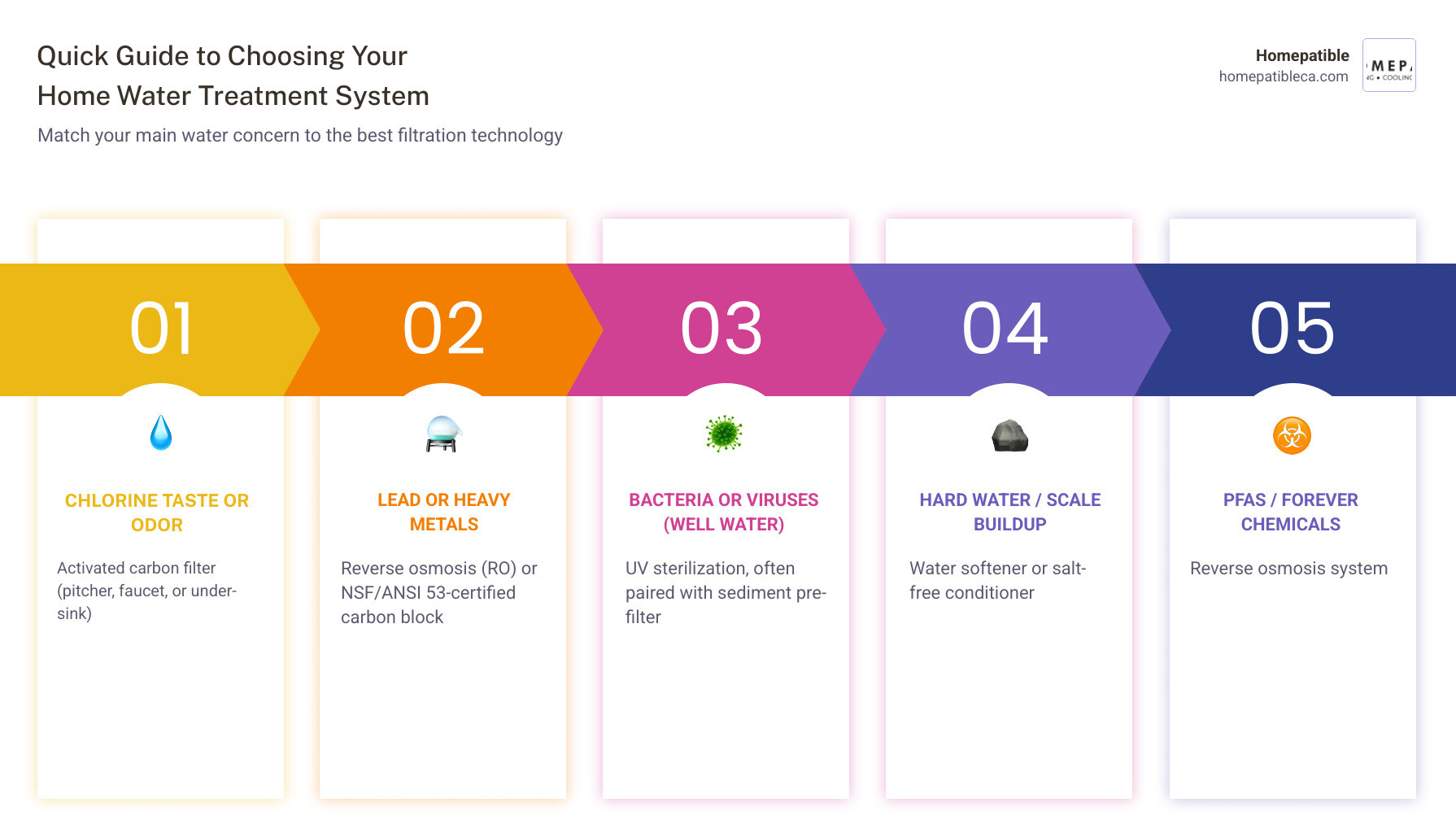
Here's a quick-reference guide to match your situation to the right system:
| Your Main Concern | Best System Type |
|---|---|
| Chlorine taste or odor | Activated carbon filter (pitcher, faucet, or under-sink) |
| Lead or heavy metals | Reverse osmosis (RO) or NSF/ANSI 53-certified carbon block |
| Bacteria or viruses (well water) | UV sterilization, often paired with sediment pre-filter |
| Hard water / scale buildup | Water softener or salt-free conditioner |
| PFAS / forever chemicals | Reverse osmosis system |
| Whole-home protection | Point-of-entry (whole-house) multi-stage system |
| Nitrates (agricultural areas) | Reverse osmosis |
| General taste and safety | Multi-stage under-sink carbon filter |
Here's the uncomfortable truth most filter ads skip: your tap water can meet every federal legal standard and still contain contaminants that exceed health guidelines, according to the Environmental Working Group. "Safe" and "clean" are not the same thing. The CDC estimates that 7.2 million Americans get sick from waterborne diseases each year — and many water quality threats like lead, PFAS, and disinfection byproducts are completely invisible and odorless.
For Central Coast homeowners in Santa Barbara and San Luis Obispo Counties, local concerns include trace PFAS, arsenic, hexavalent chromium, hard groundwater, and — for those on private wells — bacteria and nitrates from agricultural runoff. The right system starts not with a product, but with knowing exactly what you're dealing with.
This guide walks you through every step: how to test your water, how each major treatment technology works, and how to match the right system to your home's specific needs.
How to Identify Your Water Quality Needs in Santa Barbara
Before you browse the aisles for a filter, you need a "diagnosis." Buying a water treatment system without testing your water is like buying a pair of glasses without an eye exam—you might end up with something that doesn't fix the problem or, worse, makes things more complicated.
For those of us living in areas like Santa Barbara or Goleta, the first step is reviewing your annual Consumer Confidence Report (CCR). By law, public water utilities must provide this report every year, detailing exactly what contaminants were detected and whether they meet EPA standards. However, the CCR only tells you the quality of the water at the treatment plant. It doesn't account for what happens as that water travels through miles of aging infrastructure or the specific Water Line Services in Orcutt that connect to your home.
If you live in an older home in places like Montecito or Hope Ranch, lead is a primary concern. Even if the city's water is lead-free, older pipes or lead solder in your home's plumbing can leach this toxic metal into your drinking water. In these cases, a professional lab test is non-negotiable. Unlike DIY home kits, which can be hit-or-miss, a state-certified lab provides a precise breakdown of heavy metals, VOCs, and "forever chemicals" like PFAS.
For our neighbors on private wells in rural parts of the Central Coast, the responsibility for safety falls entirely on the homeowner. Well water should be tested at least once a year for bacteria, nitrates (common in agricultural areas), and minerals that cause hardness. If you notice a "rotten egg" smell or metallic taste, it’s a sign of sulfur or iron—aesthetic issues that can be solved with the right Water Softener Installation in Santa Barbara.
Which water treatment system is right for your home?
Once you have your test results, you can look at the technologies available. No single system removes everything, so many modern setups combine these methods into a multi-stage solution.
| Technology | Best For | Pros | Cons |
|---|---|---|---|
| Activated Carbon | Chlorine, taste, odors, some VOCs | Affordable, easy to maintain | Doesn't remove dissolved solids or bacteria |
| Reverse Osmosis | Lead, PFAS, Arsenic, Nitrates, Fluoride | Most effective for purity | Wastes water; removes beneficial minerals |
| UV Purification | Bacteria, Viruses, Cysts (Giardia) | Chemical-free sterilization | Requires clear water (pre-filtration) to work |
| Ion Exchange | Calcium, Magnesium (Hardness) | Prevents scale; protects appliances | Adds small amounts of sodium to water |
Deciding which water treatment system is right for your home based on source
Your water source dictates your filtration strategy. If you are on city water in Avila Beach, your primary goals are likely removing the "swimming pool" smell of chlorine and filtering out disinfection byproducts. For this, Water Filtration Systems in Avila Beach often focus on high-quality carbon block filters which have a higher surface area than granular carbon.
However, if you are in Santa Ynez or other agricultural hubs, your well water might face threats from nitrates or pesticides. Water Filtration Systems in Santa Ynez frequently require a combination of a sediment pre-filter (to catch dirt and rust), a carbon stage for chemicals, and a UV light to ensure no bacteria or parasites like Cryptosporidium make it into your glass.
For those exploring rainwater harvesting, the focus shifts to catching larger debris and bird-related bacteria. A 5-micron sediment filter followed by UV sterilization is often the gold standard for turning rain into reliable indoor water.
Which water treatment system is right for your home if you have hard water?
The Central Coast is famous for "hard" water—water packed with calcium and magnesium. While not a health risk, hard water is a nightmare for your home's infrastructure. It creates "chalky" scale buildup that chokes your pipes, ruins your water heater's efficiency, and leaves spots on your dishes.
If you find yourself scrubbing white crust off your faucets in Mission Hills, Water Softener Installation in Mission Hills is the most effective fix. These systems use ion exchange to swap "hard" minerals for sodium ions. For those who prefer to avoid salt, salt-free conditioners are an option; they don't remove the minerals but "template" them so they can't stick to your pipes.
In high-end areas like Montecito, where appliances are a major investment, Water Softener Installation in Montecito pays for itself by extending the life of your dishwasher, laundry machine, and tankless water heater.
Comparing Point-of-Use vs. Point-of-Entry Systems
One of the biggest decisions you'll make is where the water gets treated.
Point-of-Use (POU) systems are installed where you actually use the water, typically under the kitchen sink or on the faucet. These are perfect if you only care about the quality of your drinking and cooking water. An under-sink Reverse Osmosis unit is a classic POU example—it provides ultra-pure water at a dedicated tap but doesn't affect your shower or laundry.
Point-of-Entry (POE), or whole-house systems, are installed where the main water line enters your home. This ensures that every drop—from the guest bathroom shower to the backyard hose—is filtered. If you have high levels of chlorine that dry out your skin and hair, or if you're dealing with sediment in Vandenberg Village, Water Filtration Systems in Vandenberg Village that treat the whole house are the way to go.
When choosing a whole-house system, pay attention to the flow rate, measured in Gallons Per Minute (GPM). A standard home with 1–2 bathrooms usually needs 10–15 GPM, while larger homes or those with high-flow showerheads may require 15+ GPM to avoid a drop in water pressure. This is especially important when considering Water Line Services in Shell Beach, where coastal homes often have specific plumbing configurations.
Essential Certifications and Maintenance for Long-Term Performance
A filter is only as good as its certification. When researching which water treatment system is right for your home, look for the NSF/ANSI mark. These aren't just stickers; they are third-party verifications that the system actually does what it claims.
- NSF/ANSI 42: Covers aesthetic effects like chlorine taste and odor.
- NSF/ANSI 53: The "heavy hitter" certification for health-related contaminants like lead, mercury, and VOCs.
- NSF/ANSI 58: Specifically for Reverse Osmosis systems.
- NSF/ANSI 44: For water softeners.
Maintenance is the "secret sauce" of water safety. Even the most expensive system becomes a breeding ground for bacteria if the filters aren't changed. Carbon filters generally need replacing every 6–12 months, while a Reverse Osmosis membrane might last 2–5 years. In places like Hope Ranch, where water quality can vary, Water Filtration Systems in Hope Ranch often include a pressure gauge; when the pressure drops, it's a clear signal that your filter is clogged and needs a swap.
If you've recently had Water Line Services in Buellton, it's a great time to establish a maintenance schedule. We always recommend setting a calendar reminder or joining a maintenance plan to ensure your system remains the "last line of defense" it was designed to be.
Frequently Asked Questions about Home Water Treatment
How do I avoid wasting water with reverse osmosis?
Traditional RO systems are notorious for wasting water—sometimes up to 10 gallons for every 1 gallon of pure water produced. To minimize this, look for WaterSense labeled models, which are certified to waste 2.3 gallons or less. You can also install a permeate pump, which uses the energy of the wastewater to boost the system's efficiency, or choose a "tankless" RO system that filters on demand.
What should immunocompromised individuals consider for water safety?
For those with weakened immune systems, parasites like Cryptosporidium are a serious threat because they are resistant to chlorine. The CDC recommends filters with an absolute pore size of 1 micron or smaller. Note the word "absolute"—a "nominal" 1-micron filter might still let some larger particles through. UV sterilization is another excellent layer of protection for these households.
How often do I need to replace my home water filters?
It varies by usage and water quality, but here are general rules of thumb:
- Sediment Pre-filters: Every 3–6 months (especially on well water).
- Carbon Cartridges: Every 6–12 months.
- RO Membranes: Every 2–5 years.
- UV Lamps: Usually every 12 months, as the light loses its germ-killing intensity even if it’s still glowing.
Conclusion
Choosing the right water treatment system doesn't have to be a guessing game. By starting with a clear understanding of your local water quality in Santa Barbara or San Luis Obispo County, you can target the specific contaminants that matter most to your family’s health and your home's plumbing.
Whether you need a specialized Water Softener Installation in Water Softener Installation in New Cuyama to handle high mineral content or a robust Water Filtration Systems in Vandenberg Space Force Base for peace of mind, professional guidance is key. At Homepatible, our licensed technicians are experts in the unique water challenges of the Central Coast. We don't just install filters; we integrate them into your home’s smart ecosystem, ensuring you have clean, safe water 24/7.
Ready to take the first step toward better water? Schedule your water system assessment today and let us help you find the perfect roadmap for your home.
Ready to take the next step?
Our certified technicians are ready to help with all your home service needs. Schedule a service today.
Schedule My ServiceRecent Posts
Related Articles
Ready to Get Started?
Whether you need a repair, maintenance, or a new system, our expert team is here to help.