
The Ultimate List of California Heat Pump Rebates
Article content and related resources
Discover california energy rebates for hvac upgrades: Stack federal tax credits, HEEHRA & TECH Clean CA incentives for max heat pump savings!
How Much Can You Save with California Energy Rebates for HVAC Upgrades?
California energy rebates for HVAC upgrades can put thousands of dollars back in your pocket - here's a quick look at what's available right now:
| Program | Who Qualifies | Max Rebate |
|---|---|---|
| HEEHRA (federal, via TECH Clean CA) | Income <80% AMI | $8,000 |
| HEEHRA (federal, via TECH Clean CA) | Income 80-150% AMI | $4,000 |
| SMUD (Sacramento area) | Variable-stage heat pump | $3,000 |
| SVCE (Silicon Valley) | Electric appliances incl. heat pump | $8,750 |
| Federal 25C Tax Credit | All income levels | $2,000 |
| Stacked savings (rebates + 25C) | Varies by program | Up to $7,700+ |
Note: HEEHRA single-family rebates are fully reserved statewide as of February 2026. Waitlists are active. Multifamily rebates are still being processed.
Replacing an aging HVAC system is one of the biggest home expenses Central Coast homeowners face. But here's the thing most people don't realize: California has one of the most generous incentive landscapes in the entire country for heat pump upgrades. Between federal tax credits, statewide programs, and local utility rebates, the real out-of-pocket cost can be dramatically lower than the sticker price.
The challenge? These programs have different rules, income thresholds, funding limits, and deadlines - and some are already fully reserved. If you're a homeowner in Santa Barbara or San Luis Obispo County trying to figure out what you actually qualify for, it can feel like a full-time job just to decode it all.
That's exactly what this guide is for. We've pulled together every major California rebate and incentive program for HVAC upgrades in one place, so you can stop guessing and start saving.
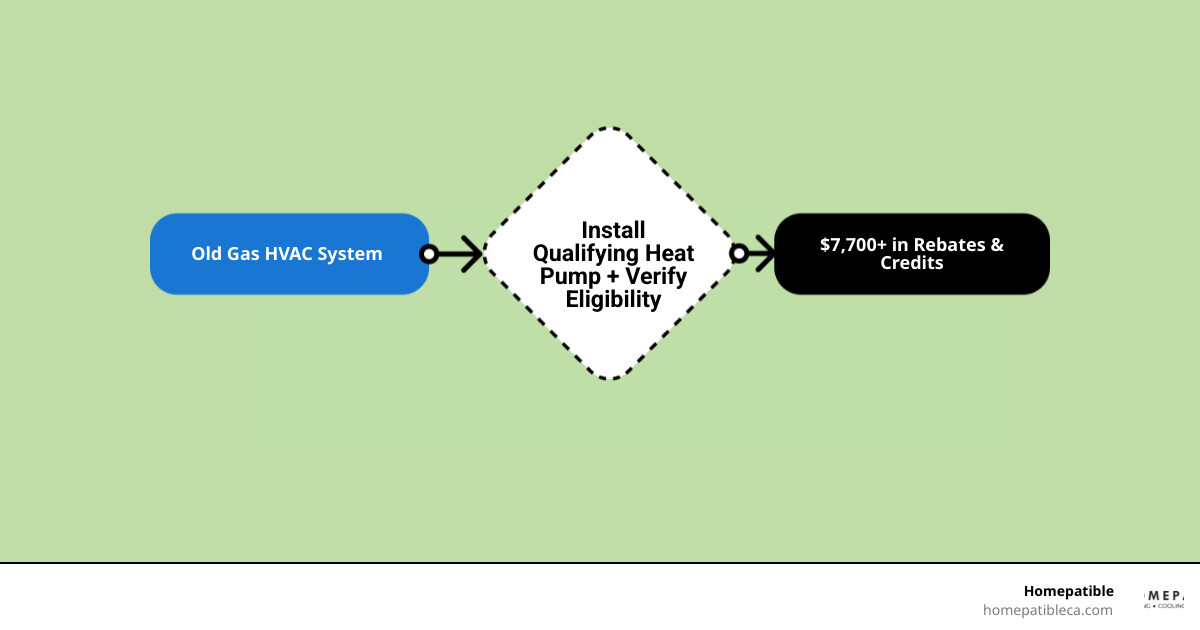
Maximizing Savings with California Energy Rebates for HVAC Upgrades
When we talk about california energy rebates for hvac upgrades, the star of the show is almost always the electric heat pump. Unlike a traditional furnace that creates heat by burning gas, a heat pump moves heat from one place to another. In the winter, it pulls heat from the outside air (yes, even when it's chilly!) and moves it indoors. In the summer, it reverses the process to act as a high-efficiency air conditioner.
To qualify for most of these big-ticket rebates, your new system needs to meet specific efficiency benchmarks. You'll often see terms like SEER2 (Seasonal Energy Efficiency Ratio 2) and HSPF2 (Heating Seasonal Performance Factor 2). Most programs require ENERGY STAR certification to ensure you're actually reducing your carbon footprint and lowering your monthly bills.
One of the best ways to maximize your comfort and your savings is by opting for high-end technology. While single-stage units are the "standard," many rebates offer higher incentives for two-stage compressors or variable-speed motors. These systems don't just turn "on" or "off"; they adjust their output to match your home's needs exactly. This leads to quieter operation, better humidity control, and significantly lower electricity usage.
If you are considering a Heat Pump Installation Replacement, here is a quick look at why multi-stage systems are the preferred choice for rebate programs:
| Feature | Single-Stage Heat Pump | Multi-Stage/Variable Heat Pump |
|---|---|---|
| Energy Use | Higher (blasts at 100% capacity) | Up to 75% less than electric resistance |
| Comfort | Temperature swings | Consistent, steady climate |
| Rebate Eligibility | Often base-level only | Qualifies for maximum "Variable" tiers |
| Noise Level | Loud start/stop cycles | Whisper-quiet operation |
Federal Tax Credits and the Inflation Reduction Act (IRA)
Before we even get to California-specific cash rebates, every homeowner in Santa Barbara and San Luis Obispo should look at the federal 25C Tax Credit. Part of the Inflation Reduction Act, this credit allows you to offset 30% of the total cost of your project, up to a $2,000 annual limit specifically for heat pumps.
The beauty of the 25C credit is its flexibility. Unlike some state programs that are restricted by income, this is available to most taxpayers. It can be applied to Heat Pumps used for space heating and cooling, as well as heat pump water heaters.
But wait, there's more! You can also claim credits for other efficiency essentials. For example, Heat Energy Recovery Ventilators (ERVs) help bring fresh air into your home without losing your heated or cooled air, and they often qualify for a portion of the $1,200 annual limit for general energy efficiency improvements. If you're going "all-in" on green energy, the Residential Clean Energy Credit (25D) provides a 30% credit for solar panels and battery storage with no upper dollar limit.
Pro-Tip: Many of these federal provisions have a current sunset date of December 31, 2032, but the specific 25C thresholds are reviewed annually. It is always best to lock in your upgrade sooner rather than later to ensure you don't miss out on the current 30% offset.
Statewide Programs: HEEHRA and TECH Clean California
California was the first state in the nation to launch the Home Electrification and Appliance Rebates (HEEHRA). Managed by the California Energy Commission (CEC) and distributed through the TECH Clean California initiative, these rebates are designed to make electrification affordable for everyone.
For those looking into a Ductless Installation Replacement, HEEHRA is a game-changer. It offers point-of-sale discounts (which function like instant rebates) to help lower the upfront cost of high-efficiency systems.
The program is split into two main categories:
- Single-Family: Aimed at individual homeowners and renters.
- Multifamily: Aimed at building owners with 5 or more units, focusing on low-to-moderate income properties.
If you live in a home where traditional ductwork isn't feasible, a Ductless mini-split system is often the perfect candidate for these incentives. They are incredibly efficient and allow for "zoning," meaning you only heat or cool the rooms you are actually using.
How to qualify for california energy rebates for hvac upgrades
To qualify for HEEHRA, your eligibility is primarily determined by your Area Median Income (AMI). This is a localized figure that accounts for the fact that living in Santa Barbara costs more than living in other parts of the country.
- Low-Income (<80% AMI): You may qualify for a rebate of up to $8,000, covering up to 100% of the project cost.
- Moderate-Income (80-150% AMI): You may qualify for a rebate of up to $4,000, covering up to 50% of the project cost.
The process requires formal income verification through an official portal. Additionally, the project must be a "retrofit"-meaning you are replacing a non-heat pump system (like a gas furnace or an old AC Installation Replacement unit) with a qualifying electric heat pump. New construction projects typically do not qualify for HEEHRA, as they are already subject to strict Title 24 building codes.
Local Utility Incentives for Santa Barbara and San Luis Obispo Residents
While the big statewide programs get all the headlines, your local utility provider often has "hidden" savings that can be stacked on top. In our neck of the woods, Southern California Edison (SCE) and PG&E are the big players, along with programs like 3C-REN (Central Coast Clean Energy Network).
If you're upgrading your Heating system, check the SCE or PG&E "Marketplace" websites. They frequently offer instant rebates on smart thermostats, which are essential for managing a new heat pump efficiently. Some utilities even offer bill credits if you enroll your smart thermostat in "demand response" programs, where the utility makes tiny adjustments to your temperature during peak grid stress to save energy.
Maintenance is also a key part of the incentive landscape. Programs like Home Performance Plus may offer no-cost assessments, and keeping your system in top shape with a Heat Pump Maintenance Tune Up ensures you continue to meet the efficiency standards required by these rebate programs.
Current funding status of california energy rebates for hvac upgrades
As of April 2026, the demand for california energy rebates for hvac upgrades has been historic. Here is the current status of the major funding buckets:
- HEEHRA Single-Family: As of February 24, 2026, the initial Phase I funding for single-family homes is fully reserved statewide. This means if you haven't already secured a reservation, you will likely be placed on a waitlist.
- HEEHRA Phase II: The California Energy Commission is currently developing Phase II, which is expected to bring fresh funding later in 2026.
- TECH Clean California: While some specific HEEHRA funds are paused, other TECH incentives for Air Conditioning and heat pump upgrades may still be available through specific utility partnerships.
- Contractor Requirements: To access any of these funds when they become available, you must work with a TECH-certified contractor. These pros have undergone specific training to ensure your system is installed to the highest efficiency standards.
If your current system is failing and you need a Heat Pump Repair Service immediately, don't lose hope. Even if a rebate is on a waitlist, the federal 25C tax credit is still wide open and provides a guaranteed 30% offset (up to $2,000) for your 2026 tax return.
Frequently Asked Questions about California HVAC Incentives
Are state rebates stackable with federal tax credits?
Yes! This is the "Golden Rule" of home electrification. You can generally combine a statewide rebate (like HEEHRA or TECH Clean CA) with the federal 25C tax credit. For example, a moderate-income household might get a $4,000 HEEHRA rebate upfront and then claim a $2,000 tax credit when they file their taxes. This can result in a total project offset of $6,000 or more. However, you cannot "double-dip" by using two different federal rebate programs for the exact same piece of equipment.
When planning a Heat Pumps Installation Replacement, we always recommend sitting down with your contractor to map out every possible incentive to ensure you aren't leaving money on the table.
What documentation is required for a successful rebate application?
The paperwork is often the most daunting part, but a good contractor will handle most of it for you. Generally, you will need:
- Proof of Income: (For HEEHRA) Verified via the official portal.
- Building Permits: Most rebates require proof that the job was done legally and inspected by the city or county.
- HERS Verification: A third-party "Home Energy Rating System" rater may need to test your ductwork for leaks.
- Proof of Purchase: Detailed invoices showing the model and serial numbers of the ENERGY STAR equipment.
- Contractor Certification: Proof that your installer is TECH-certified and HEEHRA-trained.
Regular maintenance, such as a Ductless Maintenance Tune Up, isn't usually required for the initial rebate, but keeping your service records can help if you ever need to claim a warranty or a secondary efficiency incentive.
How do I avoid HVAC rebate scams?
Sadly, big government programs often attract scammers. To protect yourself:
- Never share financial statements: Legitimate HEEHRA income verification is done through a secure state portal that gives you a "verification code." You share that code with your contractor-not your tax returns or bank statements.
- Verify your contractor: Only work with companies listed on the "Switch Is On" Contractor Finder. If they aren't TECH-certified, they can't get you the rebate.
- No "Retroactive" Rebates: HEEHRA requires a reservation before the work starts. If a contractor tells you they can get you the rebate for a system you installed last year, they are likely being dishonest.
- Official Portals Only: Always start your journey at official sites like techcleanca.com or energy.ca.gov.
Whether you are looking for a Furnace Installation Replacement or a total heat pump conversion, staying vigilant ensures your "savings" don't turn into a headache.
Conclusion
Navigating california energy rebates for hvac upgrades can be complex, but the rewards are well worth the effort. By switching to a high-efficiency heat pump, you aren't just saving money-you're investing in a more comfortable, quieter, and more sustainable home for your family.
At Homepatible, we are proud to serve the Central Coast community, from the hills of Montecito to the neighborhoods of San Luis Obispo. As licensed Nest Pro Elite technicians, we specialize in bridging the gap between traditional HVAC expertise and modern smart home efficiency. Whether you're in Santa Barbara County or San Luis Obispo County, we're here to help you maximize your comfort and your rebates.
Ready to start your upgrade? Here are your next steps:
- Check your AMI: Visit the official HEEHRA portal to see which income tier you fall into.
- Find a TECH-certified pro: Ensure your contractor is authorized to reserve your rebate.
- Get a Home Audit: Identify if you need electrical panel upgrades or insulation to support your new system.
- Reserve your spot: If funding is limited, get on the waitlist as soon as possible.
- Schedule a consultation: Let us help you design a system that fits your home and your budget.
Explore our full range of energy-efficient home services and let's make your home the most comfortable spot on the Central Coast!
Ready to take the next step?
Our certified technicians are ready to help with all your home service needs. Schedule a service today.
Schedule My ServiceRecent Posts
Related Articles
Ready to Get Started?
Whether you need a repair, maintenance, or a new system, our expert team is here to help.