
The Secret Life of Your Indoor and Outdoor AC Units
Article content and related resources
Unlock comfort by understanding the parts of your AC system. Explore indoor/outdoor units, maintenance, and common issues for peak performance.
Why Understanding the Parts of Your AC System Keeps Your Home Running Smoothly
Understanding the parts of your AC system is the first step to knowing when something's wrong, catching small problems early, and keeping your home cool and comfortable all summer long — especially on the Central Coast, where warm seasons can stretch well into fall.
Here's a quick look at the main components every homeowner should know:
| AC Component | Location | Primary Job |
|---|---|---|
| Compressor | Outdoor unit | Pressurizes refrigerant to move heat out of your home |
| Condenser Coil & Fan | Outdoor unit | Releases heat from refrigerant into outside air |
| Evaporator Coil | Indoor unit | Absorbs heat and humidity from indoor air |
| Blower Motor / Air Handler | Indoor unit | Circulates cooled air through your home via ductwork |
| Expansion Valve | Indoor unit / lineset | Controls refrigerant flow and triggers the cooling effect |
| Refrigerant Lines | Connects both units | Carries refrigerant between indoor and outdoor components |
| Air Filter | Indoor unit | Traps dust, allergens, and particles before they enter the system |
| Thermostat | Wall-mounted, indoor | Acts as the brain — senses temperature and controls the system |
| Ductwork | Throughout the home | Delivers and returns conditioned air to every room |
| Drain Pan & Drain Line | Indoor unit | Collects and removes moisture pulled from the air |
Think of your AC as two teams working in sync — one inside your home, one outside — connected by refrigerant lines and controlled by your thermostat. When every part is doing its job, the result is cool, comfortable air. When one piece fails, the whole system feels it.
Most homeowners don't think much about their air conditioner until something goes wrong. But here's the thing: a little knowledge goes a long way. Knowing what the compressor does, why a clogged drain line matters, or what a frozen evaporator coil means can help you spot trouble early — before a minor issue turns into a costly repair.
In this guide, we'll walk through every major component of a central AC system, explain how they work together, and help you know what to watch for.
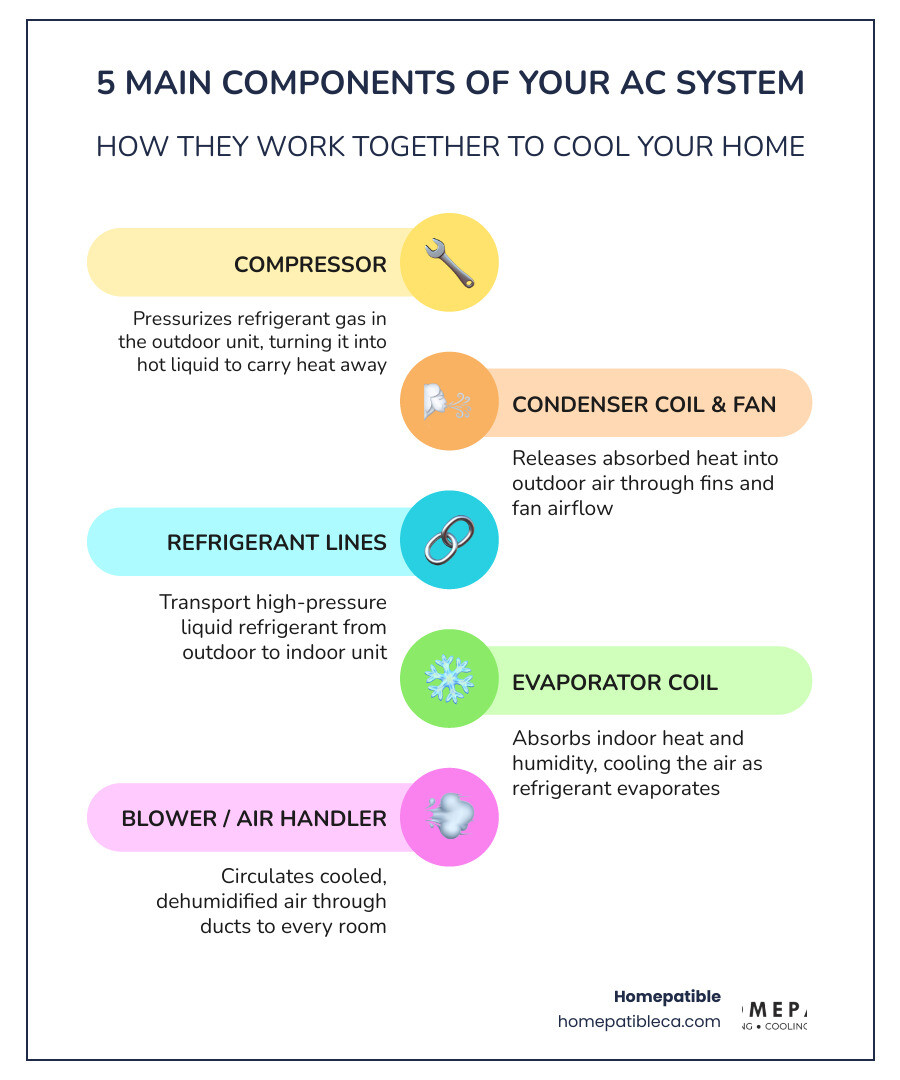
Understanding the Parts of Your AC System: The Outdoor Powerhouse
When you step outside into your yard in Santa Maria or Lompoc, you’ll see the heavy lifter of the cooling process: the outdoor condenser unit. Often housed in a sturdy metal cabinet, this unit is responsible for the "rejection" phase of the cooling cycle. Its primary job is to take the heat that was gathered from inside your home and dump it into the outdoor air.
This "powerhouse" isn't just a fan in a box. It contains several sophisticated components that work under high pressure. If the outdoor unit is struggling due to dirt, debris, or mechanical failure, the rest of the system has to work twice as hard. This often leads to homeowners needing a professional AC Repair Service to restore the balance.

The Compressor: The Heart of Your Cooling System
If the AC system has a circulatory system, the compressor is undoubtedly the heart. Located inside the outdoor unit, this large electric pump is responsible for circulating the refrigerant throughout the entire loop.
The compressor's job is to take low-pressure, cool refrigerant gas and squeeze it into a high-pressure, hot gas. This transformation is vital because it creates the pressure difference needed for the refrigerant to flow. Because it does so much heavy lifting, the compressor is often responsible for up to 70% of your AC's total energy use.
When a compressor starts to fail, you might hear clanking or rattling, or notice your circuit breaker tripping. Keeping this "heart" healthy is the most important part of General Air Conditioning care.
Condenser Coils and Fans: Releasing Heat in the Central Coast Sun
Surrounding the compressor are the condenser coils. These are a series of copper tubes covered in thin aluminum fins. As the hot, pressurized refrigerant gas flows through these coils, a large fan pulls outdoor air across them. This air carries the heat away, allowing the refrigerant to cool down and turn back into a liquid.
In our area, salt air or dust from nearby agriculture can coat these fins, acting like an insulating blanket that traps heat. This is why keeping the area around your outdoor cabinet clear of plants and debris is essential. If the heat can’t escape, your system might overheat, requiring a Commercial HVAC Repair Service or residential intervention to clean the coils and check the fan motor.
The Indoor Cooling Team: Evaporators and Air Handlers
While the outdoor unit is busy getting rid of heat, the indoor unit is hard at work absorbing it. Usually located in an attic, closet, or garage, the indoor assembly (often called an air handler) is where the "magic" of cooling actually happens.
This unit isn't just about temperature; it’s also your home’s primary dehumidifier. As warm air from your house passes over the cold internal components, moisture condenses out of the air—much like water droplets forming on a cold glass of iced tea. This water is collected in a drain pan and sent outside through a condensate line. If you’re upgrading an older home in San Luis Obispo, an AC Installation Replacement often involves modernizing this indoor setup for better moisture control.
The Evaporator Coil: Your Home's Heat Sponge
The evaporator coil is the "cold side" of the system. Think of it as a giant, super-chilled metal sponge. Cold, liquid refrigerant enters these coils, and as the indoor fan blows warm house air over them, the refrigerant "soaks up" the heat.
As the refrigerant absorbs this heat, it evaporates back into a gas (hence the name). This process leaves the air passing through the unit much cooler and drier. If the airflow is restricted by a dirty filter, the coil can actually drop below freezing, causing ice to form on the metal. This "frozen coil" is a common reason for Air Conditioning service calls in the middle of a heatwave.
Blower Motors and Air Handlers: Circulating Comfort
The blower motor is the "lungs" of the system. It’s a powerful fan that draws warm air in through the return vents and pushes the newly cooled air out through the supply ducts.
In modern systems, we often see variable-speed motors. Unlike older single-speed fans that are either "on" or "off," variable-speed motors can ramp up or down to meet the exact cooling needs of your home. This results in quieter operation, better humidity control, and lower energy bills. Whether your system is a standalone unit or integrated with a furnace, the blower is essential for all our home Services.
Connecting the Loop: Refrigerant Lines and Ductwork
The indoor and outdoor units can’t work in isolation; they need a way to communicate and share refrigerant. This is where the "lineset" and ductwork come into play. The lineset consists of two copper tubes (one insulated, one not) that carry the refrigerant back and forth in a continuous loop.
The Expansion Valve: Precision Cooling Control
Before the refrigerant enters the indoor evaporator coil, it must pass through the expansion valve (or metering device). This small but mighty part acts like a nozzle on a garden hose. It creates a bottleneck that forces the high-pressure liquid refrigerant to spray into a low-pressure area.
This sudden drop in pressure causes the temperature of the refrigerant to plummet instantly. Without this precise control, the refrigerant wouldn't be cold enough to absorb heat from your home, and your cooling efficiency would vanish.
Understanding the Parts of Your AC System: Linesets and Air Distribution
Once the air is cooled, it needs a highway to reach your bedrooms and living areas. That highway is your ductwork. Unfortunately, ductwork is often the "leaky" link in the chain. According to industry data, a typical home loses an astonishing 20% to 30% of its conditioned air through small gaps, poor connections, and holes in the ducts.
| Vent Type | Function | Location |
|---|---|---|
| Supply Vents | Blows cold air into the room | Usually on ceilings or high on walls |
| Return Registers | Pulls warm air back to the AC | Often larger, located in hallways or central areas |
Ensuring your ducts are sealed and your lineset insulation is intact is a core part of professional Maintenance.
Maintaining Your System for Peak Performance in Santa Barbara
As we move through April 2026, it’s the perfect time for a spring tune-up. Regular care prevents the most common causes of system failure, such as clogged drains or burned-out capacitors. A professional AC Maintenance Tune-Up ensures that all these moving parts are lubricated, cleaned, and calibrated.
Air Filters and Thermostats: The Brains and Lungs
The air filter is your system’s first line of defense. It protects the sensitive indoor coils from dust and hair while improving your indoor air quality. For those with severe allergies, High-Efficiency Particulate Air (HEPA) filters are a game-changer, as they capture an incredible 99.97% of airborne particles.
The thermostat, meanwhile, is the brain. As licensed Nest Pro Elite technicians, we often recommend smart thermostats for our Central Coast neighbors. These devices learn your schedule and can be adjusted from your phone, ensuring you aren't cooling an empty house in Goleta or Montecito while you’re at work.
Signs of Component Failure and When to Call a Pro
Even with the best care, parts eventually wear out. Knowing the warning signs can save you from a total system breakdown:
- Warm air from vents: Could indicate a refrigerant leak or compressor issue.
- Strange noises: Banging or clanking often points to a failing blower motor or compressor.
- Water pooling: Usually a sign of a clogged condensate drain line.
- Frequent cycling: If the unit turns on and off every few minutes, the thermostat or expansion valve might be failing.
If you notice any of these, it's time to call for an AC Repair Service before the damage spreads to other components.
Frequently Asked Questions about Understanding the Parts of Your AC System
Which AC part is the most expensive to replace?
The compressor is almost always the most expensive single part to replace. Because it requires specialized labor and expensive refrigerant handling, a compressor failure in a unit over 10-12 years old often leads to a cost-benefit analysis where a full system replacement makes more financial sense than a repair.
What is the difference between a furnace and an air handler?
A furnace uses a fuel source (like gas) to create heat, while an air handler is a box that simply moves air. In many Central Coast homes, the AC evaporator coil sits on top of the furnace, using the furnace's blower motor to circulate cool air in the summer. If you have a heat pump, you likely have a dedicated air handler instead.
How often should I change my air filter?
For a standard 1-inch filter, we recommend every 1 to 3 months. However, if you have pets in your Santa Barbara home or live in a dustier area like the Santa Ynez Valley, you should check it monthly. A clogged filter is the #1 cause of airflow restriction and system strain.
Conclusion: Keeping Your Central Coast Home Comfortable
Understanding the parts of your AC system doesn't require an engineering degree, but it does give you the power to manage your home's comfort and efficiency. From the "heart" of the compressor to the "lungs" of the blower motor, every piece of the puzzle must fit perfectly to keep those coastal summer days enjoyable.
At Homepatible, our team of licensed Nest Pro Elite technicians is dedicated to serving Santa Barbara and San Luis Obispo Counties with expertise you can trust. Whether you need a 24/7 emergency repair in Carpinteria or a smart home upgrade in San Luis Obispo, we are here to ensure your Air Conditioning system runs smoothly for years to come. Don't wait for the next heatwave—give your AC the care it deserves today.
Ready to take the next step?
Our certified technicians are ready to help with all your home service needs. Schedule a service today.
Schedule My ServiceRecent Posts
Related Articles
Ready to Get Started?
Whether you need a repair, maintenance, or a new system, our expert team is here to help.