
The Beginner's Guide to Commercial HVAC Systems
Article content and related resources
Master commercial hvac basics for business owners: systems, maintenance, IAQ & efficiency tips for optimal business comfort.
Commercial HVAC Basics for Business Owners: What You Need to Know
Commercial HVAC basics for business owners come down to one core truth: your heating, ventilation, and air conditioning system is one of the most critical - and most overlooked - assets in your building. When it runs well, nobody notices. When it fails, everyone does.
Here is a quick breakdown of what every business owner should understand:
- What it is: A commercial HVAC system controls temperature, humidity, ventilation, and air quality across large or multi-zone commercial spaces
- How it differs from residential: Commercial systems are larger, modular, and built to handle higher occupancy loads, more complex zoning, and stricter code requirements
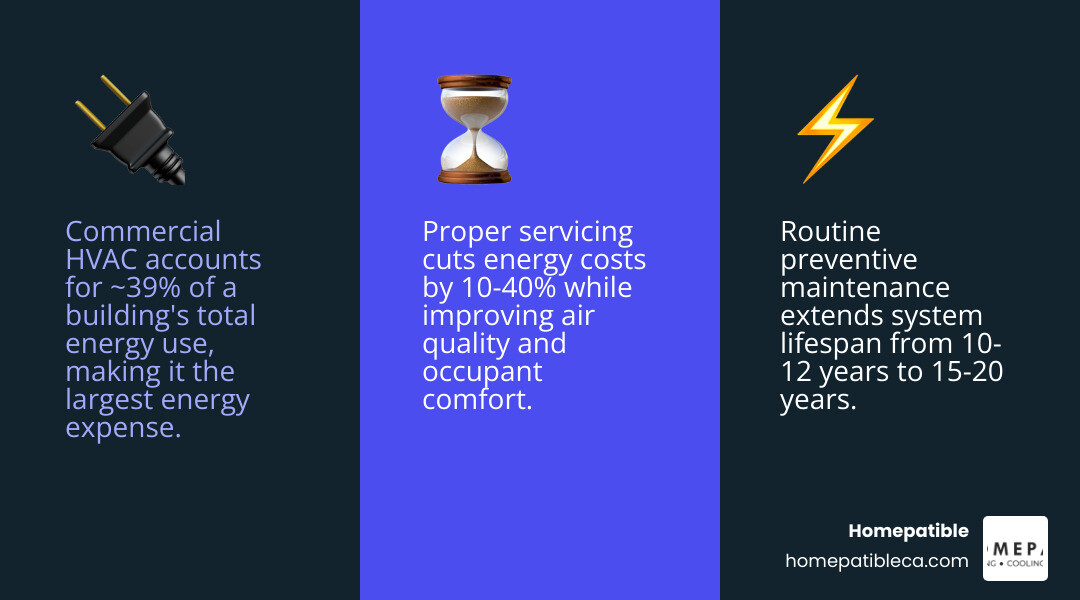
- Why it matters: HVAC accounts for roughly 39% of a facility's total energy use - making it your single biggest energy expense
- What happens without maintenance: Poor upkeep can shorten system life by 8 to 15 years and drive up energy and repair costs significantly
- What good maintenance delivers: Routine servicing can cut energy costs by 10 to 40% and extend system life to 15 to 20 years
- Key system types to know: Rooftop units (RTUs), split systems, VRF systems, and packaged units - each suited to different building sizes and needs
- When to act: At minimum, schedule professional service twice a year - before cooling season and before heating season
As of April 2026, commercial buildings across the U.S. are held to evolving efficiency and air quality standards, and business owners who treat their HVAC proactively stay ahead of both compliance requirements and costly emergency repairs.
This guide walks you through everything - from how these systems work, to what to maintain, to how to get the most out of your investment.
Understanding Commercial HVAC Basics for Business Owners
When we talk about commercial hvac basics for business owners, the first thing to recognize is that these systems are not just "larger versions" of what you have at home. While a residential unit is typically a standalone split system designed to keep a single family comfortable, commercial systems are complex, modular powerhouses designed for high-occupancy environments.
Residential vs. Commercial: The Key Differences
The most significant difference lies in the modular design. In a house, if the AC breaks, the whole house gets hot. In a commercial setting, systems are often modular, meaning components can be added or upgraded as the business grows. Furthermore, commercial units are almost always located on the roof or in a dedicated mechanical room to save ground space and reduce noise for occupants.
Zoning and Occupancy Patterns
Commercial buildings have diverse needs. A server room needs constant cooling, while a retail floor needs variable temperatures based on foot traffic. This requires sophisticated zoning capabilities. Modern systems use sensors to detect occupancy and adjust airflow accordingly, ensuring you aren't wasting energy cooling an empty conference room.
If you are looking to upgrade or install a new system, exploring Commercial HVAC Installation in Santa Ynez is a great place to start understanding how these designs fit your specific square footage.
Standards and Compliance
Commercial systems must adhere to strict ASHRAE standards and local building codes. These regulations govern everything from how much fresh air must be circulated (ventilation requirements) to how condensation is managed (drainage systems). In places like Santa Barbara County, staying compliant isn't just about comfort; it's a legal requirement for business operations.
Core Components and System Types
Understanding the "bones" of your system helps you make better decisions when a technician mentions a specific part. Most commercial setups rely on a combination of these core components:
- Compressors and Condensers: Usually located outside, these handle the heavy lifting of heat exchange.
- Air Handlers: These circulate the air through your ductwork.
- Thermal Expansion Valves: These regulate the flow of refrigerant.
- Economizers: These are the "best-kept secret" of commercial HVAC. They pull in cool outdoor air when the weather is nice, providing "free cooling" and reducing the load on your compressor.
Common Commercial HVAC Basics for Business Owners: System Varieties
Depending on your building's size in areas like Callender or Gaviota, you will likely encounter one of these four types:
- Rooftop Units (RTUs): These are all-in-one "packaged systems." Everything-the compressor, coils, and fan-is in one box on the roof. They are popular for retail and industrial spaces because they save interior space. For those in the coastal regions, Commercial Air Conditioning in Callender often involves these robust units.
- Split Systems: Similar to residential but on a larger scale. They have an indoor unit and an outdoor unit. These are great for smaller offices or restaurants.
- VRF (Variable Refrigerant Flow): These are incredibly efficient, often up to 30% more so than traditional ducted systems. They can heat one room while cooling another simultaneously by moving heat from one zone to another.
- Chillers: Used in very large facilities, chillers use water instead of air to move heat, which is highly efficient for massive square footage.
Whether you need Commercial Heating in Cuyama or cooling in the valley, choosing the right system type is the foundation of your long-term operational costs.
The Critical Role of Preventive Maintenance
We cannot stress this enough: preventive maintenance wins every time. Many business owners fall into the trap of "reactive maintenance"-only calling for help when the system stops working. This is the most expensive way to run a business.
Preventive vs. Reactive: The Numbers
HVAC systems account for roughly 39% of a facility's energy use. A neglected system works harder to achieve the same temperature, driving that percentage even higher. An EPA study found that as little as 0.042 inches of dirt on a condensing coil can drop efficiency by 21%.
| Feature | Preventive Maintenance | Reactive Repair |
|---|---|---|
| Costs | Predictable, budgeted | High, unexpected |
| System Life | 15-20 years | 7-12 years |
| Energy Bills | 10-40% lower | Consistently rising |
| Uptime | High reliability | Frequent emergency shutdowns |
By investing in Commercial HVAC Maintenance in Casmalia, you aren't just paying for a "check-up"-you are buying insurance against a total system collapse during a heatwave.
Essential Commercial HVAC Basics for Business Owners: Maintenance Checklists
A standard professional visit should include:
- Filter Changes: Clogged filters are the #1 cause of system strain. These should be checked monthly and replaced at least quarterly.
- Coil Cleaning: Dirty coils can't exchange heat, forcing the compressor to run longer.
- Refrigerant Levels: Even a small leak can cause the system to freeze up or burn out.
- Thermostat Calibration: Ensuring your sensors are accurate prevents over-cooling.
- Electrical Connections: Tightening connections prevents fire hazards and "ghost" shutdowns.
If you find yourself in a bind, Commercial HVAC Repair in Gaviota is available 24/7, but regular maintenance is the best way to ensure you never have to make that emergency call.
Optimizing Performance and Indoor Air Quality
In 2026, Indoor Air Quality (IAQ) is a major factor in employee productivity and regulatory compliance. Poor IAQ can lead to "Sick Building Syndrome," causing headaches and fatigue among your staff.
The Productivity Link
Studies show that proper ventilation and humidity regulation (keeping levels between 40% and 60%) significantly improve cognitive function. This is where Commercial Indoor Air Quality in Toro Canyon comes into play. By using high-efficiency filters (like HEPA or MERV 13) and CO2 monitoring, we ensure the air stays fresh and oxygenated.
Smart Controls and Integration
The modern way to manage commercial hvac basics for business owners is through smart technology. As Google Nest Pro Elite technicians, we specialize in integrating smart thermostats and building automation systems. These tools allow you to:
- Set temperature setbacks for when the building is unoccupied.
- Monitor system health remotely from your phone.
- Utilize Demand Control Ventilation (DCV), which adjusts fresh air intake based on how many people are actually in the room.
For a deeper dive into how these installations work on the Central Coast, check out our guide on Mastering the Chill: Commercial HVAC Installation in Arroyo Grande.
Frequently Asked Questions
How often should my commercial system be serviced?
At a minimum, you need seasonal tune-ups (twice a year). However, for high-traffic businesses like restaurants or medical clinics, we recommend quarterly visits. Monthly filter checks are something your facility staff can handle, but a professional should inspect the internal components semi-annually.
What are the signs of a failing commercial HVAC unit?
Keep an ear out for unusual noises like banging or squealing. Other red flags include short cycling (the unit turning on and off rapidly), inconsistent temperatures between rooms, and a sudden spike in energy bills. If your system is over 15 years old, it may be time to consider a replacement rather than a costly repair.
How do smart controls improve business efficiency?
Smart controls eliminate human error. They can automatically enter "eco-mode" after business hours and provide precision zoning. This ensures you aren't cooling the warehouse to the same level as the executive offices, saving you a fortune over the course of a year.
Conclusion
Navigating commercial hvac basics for business owners doesn't have to be overwhelming. Whether you are operating in Santa Barbara County or San Luis Obispo County, your HVAC system is the heartbeat of your business infrastructure. By focusing on preventive care, choosing the right system type, and embracing smart technology, you can ensure your facility remains comfortable, compliant, and cost-effective.
At Homepatible, our licensed Nest Pro Elite technicians are ready to help you optimize your business environment with 24/7 emergency service and transparent pricing. From Commercial HVAC Installation in Montecito to routine maintenance across the Central Coast, we are your local experts.
Ready to take control of your building's comfort? Schedule Professional Commercial HVAC Services with us today and let's make your business smarter and more efficient.
Ready to take the next step?
Our certified technicians are ready to help with all your home service needs. Schedule a service today.
Schedule My ServiceRecent Posts
Related Articles
Ready to Get Started?
Whether you need a repair, maintenance, or a new system, our expert team is here to help.