
Stop the Scale and the Smell by Choosing the Right System
Article content and related resources
Discover water softener vs water filtration system comparison for Central Coast homes. Stop scale, remove contaminants—get expert advice now!
Is Your Water Hard, Contaminated, or Both? A Water Softener vs Water Filtration System Comparison
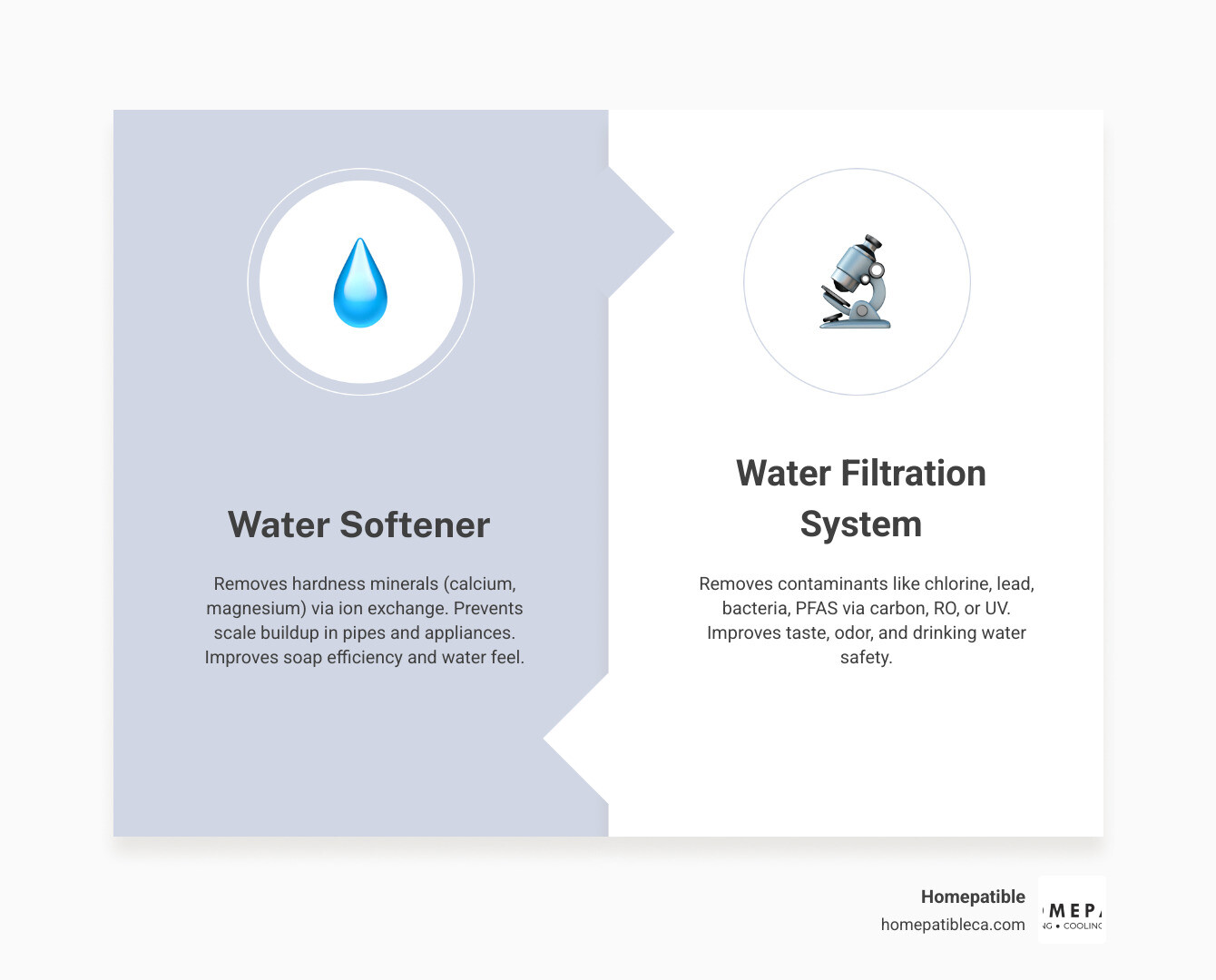
A water softener vs water filtration system comparison comes down to one core difference: softeners remove hardness minerals like calcium and magnesium, while filtration systems remove contaminants like chlorine, lead, bacteria, and PFAS. They solve different problems — and most Central Coast homes need to understand which issue they're actually dealing with before buying anything.
Here's a quick breakdown:
| Feature | Water Softener | Water Filtration System |
|---|---|---|
| Primary purpose | Removes hardness minerals (calcium, magnesium) | Removes contaminants (chlorine, lead, bacteria, PFAS) |
| Technology | Ion exchange (salt-based) or conditioning (salt-free) | Carbon, reverse osmosis, UV, sediment, or iron filters |
| Fixes scale buildup | Yes | No |
| Fixes taste and odor | Partially | Yes |
| Removes bacteria | No | Yes (UV or RO systems) |
| Removes lead or PFAS | No | Yes (certified filters) |
| Best for | Hard water damage to pipes, appliances, skin | Health and safety concerns in drinking water |
| Do most homes need it? | Yes, especially on the Central Coast | Often yes, especially with well water or older pipes |
If you have white crust around your faucets and spotty dishes, you likely have hard water — a softener helps. If your water smells like chlorine, tastes metallic, or has tested positive for contaminants, a filtration system is what you need. Many homes need both.
About 85% of U.S. homes have moderately hard to very hard water, and the Central Coast of California is no exception. But hardness isn't the only concern. Municipal water is often treated with chlorine, older homes may have lead plumbing, and well water can carry iron, bacteria, or hydrogen sulfide. Getting the wrong system — or only one when you need both — means spending money without solving your actual water problem.
This guide breaks down exactly how each system works, what it does and doesn't remove, and how to choose the right setup for your Santa Barbara or San Luis Obispo County home.
Understanding the Water Softener vs Water Filtration System Comparison
When we look at a water softener vs water filtration system comparison in April 2026, we see two technologies that are often confused but serve distinct roles. Think of it this way: a water softener is like a "plumbing bodyguard," protecting your pipes and appliances from mineral damage. A water filtration system is more like a "health shield," focusing on the safety and purity of the water you actually consume.
The primary difference lies in the system scope. A Water Filtration System is designed to reduce total dissolved solids (TDS), chemicals, and biological hazards. Softeners, on the other hand, specifically target "hardness" minerals. While some advanced filtration systems like Reverse Osmosis (RO) can technically reduce hardness, they aren't efficient enough to handle the high mineral loads found in Santa Barbara and San Luis Obispo County groundwater without the help of a dedicated softener.
Defining Water Softening Technology
Water softening is a specific chemical process known as ion exchange. Inside a softener tank are millions of tiny plastic resin beads. These beads are "charged" with sodium or potassium ions. As hard water flows through the tank, the calcium and magnesium ions (the "hardness" culprits) stick to the beads, which then release a tiny amount of sodium in exchange. This effectively swaps the scale-causing minerals for soft sodium ions.
Defining Water Filtration Technology
Water filtration is a broader category. It uses various media—most commonly activated carbon—to trap impurities. While softeners use chemistry to swap ions, filters use physical barriers or adsorption.
- Carbon Media: Excellent for removing chlorine, VOCs, and improving taste.
- Sediment Removal: Uses physical screens to catch sand, silt, and rust.
- Micron Ratings: Filters are rated by the size of particles they can catch; the lower the micron rating, the smaller the contaminants it can stop.
Hard Water Challenges in Santa Barbara and San Luis Obispo Counties
In our region, water hardness is a significant issue. Groundwater often percolates through limestone and other mineral-rich rock, picking up high concentrations of calcium and magnesium. Generally, water exceeding 7 GPG (grains per gallon) is considered "hard." Many areas in the Central Coast see levels far higher than this.
| Symptom | Likely Cause | Solution |
|---|---|---|
| White crust on faucets | Hard Water (Calcium) | Water Softener |
| Dry, itchy skin after shower | Hard Water | Water Softener |
| "Swimming pool" smell | Chlorine | Carbon Filter |
| Rotten egg smell | Hydrogen Sulfide | Iron/Sulfur Filter |
| Metallic taste | Iron or Lead | RO or Specialized Filter |
If left untreated, hard water causes massive limescale buildup inside your water heater, reducing its efficiency by up to 48%. It also leads to plumbing corrosion and shortened appliance lifespans. For homeowners in the city, Water Softener Installation in Santa Barbara is often the first line of defense against these "silent" plumbing killers.
How a Water Softener Works to Stop Scale
A standard softener consists of a resin tank and a brine tank. Periodically, the system enters a "regeneration cycle" where it flushes the resin beads with a heavy saltwater solution from the brine tank to "recharge" them with sodium.
- Brine Tank: Holds the salt (or potassium) pellets.
- Valve Lifespan: A high-quality control valve can last 20+ years with proper care.
- Regeneration: Most modern systems are "metered," meaning they only regenerate based on actual water usage, saving you salt and water. For residents in the northern part of our service area, Water Softener Installation in San Luis Obispo ensures your system is sized correctly for your specific GPG levels.
Identifying the Best Water Softener vs Water Filtration System for Scale
If your primary goal is stopping scale, a salt-based cation exchange system is the "gold standard." However, some homeowners prefer salt-free options.
- Salt-Based: Physically removes the minerals. Best for very hard water.
- Template-Assisted Crystallization (TAC): A salt-free "conditioner" that changes the shape of minerals so they don't stick to pipes. It doesn't "soften" the water (you won't get that slippery feel), but it protects appliances.
- Flow Rates: For a standard 1-3 bathroom home, you typically need a flow rate of 8-12 gallons per minute (GPM) to ensure you don't lose water pressure when the dishwasher and shower are running at the same time.
Beyond Softening: What a Water Filtration System Removes
While softeners handle the minerals, they won't touch the "smell" or the safety concerns. This is where filtration takes over. If you've noticed a "rotten egg" smell or orange stains in your tub, you likely need a specialized Water Softener Installation in Arroyo Grande that includes an iron filter.
Modern filtration systems target:
- Chlorine & Chloramines: Used by municipalities for disinfection but can irritate skin and smell like a pool.
- Lead & Heavy Metals: Often introduced by older plumbing.
- PFAS & VOCs: "Forever chemicals" and industrial runoff that are increasingly a concern for health.
- UV Disinfection: Uses ultraviolet light to kill 99.99% of bacteria and viruses without chemicals.
Comparing Water Softener vs Water Filtration System Contaminant Profiles
It is a common misconception that softeners "clean" the water. They don't. A softener will not remove bacteria, lead, or pesticides. Conversely, a standard carbon filter will not remove hardness minerals.
- Reverse Osmosis (RO): This is the powerhouse. It uses a semi-permeable membrane to remove up to 99% of total dissolved solids. It is often installed under the kitchen sink to provide pure drinking water.
- Manganese & Hydrogen Sulfide: These require specialized media filters, often used in Water Softener Installation in Santa Margarita for homes on private wells.
Specialized Filters for Central Coast Well Water
Well water presents unique challenges. We often see high levels of iron (up to 30 ppm), manganese, and sediment.
- Sediment Traps: The first line of defense to stop sand from clogging your valves.
- Acid Neutralizers: If your water has a low pH, it will eat through copper pipes. Neutralizers add a small amount of hardness back into the water to balance the pH, which is why a softener is usually installed after a neutralizer.
- Iron Oxidation: Uses air or chemicals to turn dissolved iron into a solid that can be filtered out.
Choosing the Right Solution: Softener, Filter, or Both?
The only way to know for sure is to start with professional water testing. We look at pH, hardness, iron, and TDS. For municipal customers, we also review the latest city water reports.
If you are seeing scale and tasting chemicals, a "combo unit" or a stacked system is often the best choice. These units save space by putting carbon media and softening resin in the same tank. For families in the Santa Ynez Valley, Water Softener Installation in Buellton often involves these space-saving hybrid systems.
The Ideal Installation Order for a Water Softener vs Water Filtration System
The order in which you install your equipment matters. If you put them in the wrong order, you can ruin expensive components.
- Sediment Filter: Catches the "big stuff" first.
- Acid Neutralizer/Iron Filter: Addresses pH and heavy metals.
- Carbon Filter: Removes chlorine before the water hits the softener (chlorine can degrade softener resin).
- Water Softener: Removes the hardness.
- UV Light: The final "kill stage" for bacteria.
- Reverse Osmosis: Point-of-use at the kitchen tap for drinking.
Residents looking for Water Softener Installation in Goleta should ensure their plumber follows this "treatment train" logic to maximize the lifespan of the media.
Salt-Free Conditioners vs. Traditional Softeners
For those on sodium-restricted diets or those who want a more eco-friendly "no-drain" solution, salt-free conditioners are a great alternative. They don't use electricity or waste water during regeneration. While they don't provide the "luxury" feel of soft water (better lathering, softer hair), they are highly effective at scale prevention.
Maintenance and Long-Term System Performance
Neither system is "set it and forget it."
- Water Softeners: Typically last 10-15 years. The resin itself can last 15-20 years if protected from chlorine. You'll need to refill the salt every 6-8 weeks.
- Water Filters: Whole-home carbon media usually lasts 5-10 years. RO cartridges need changing every 6-12 months.
- Annual Inspections: We recommend a yearly check-up to ensure valves are cycling correctly and there are no leaks.
For those in coastal areas, Water Softener Installation in Pismo Beach requires extra attention to salt levels, as humidity can sometimes lead to "salt bridges" in the tank.
Troubleshooting Common Water Treatment Issues
- Salt Bridges: A hard crust forms in the brine tank, preventing the salt from dissolving.
- Pressure Drops: Usually a sign that a sediment filter or RO membrane is clogged.
- Fouled Resin: Happens when iron or chlorine coats the softener beads, making them unable to swap ions. This is a common issue we see during Water Softener Installation in Santa Maria if an iron filter wasn't installed upstream.
Frequently Asked Questions about Water Treatment
Can a water softener remove lead or bacteria?
No. A water softener is designed only for mineral removal. To remove lead, you need a certified carbon filter or RO system. To kill bacteria, you need a UV disinfection system or a high-quality RO membrane.
Do I need a water filter if I already have a softener?
In many Central Coast homes, yes. A softener makes the water "feel" better and protects pipes, but a filter makes it "taste" better and ensures it is safe from chemicals like chlorine or PFAS.
How do I know if my Central Coast home has hard water?
Look for white spots on glassware, stiff laundry, or a "film" on your skin after showering. You can also request a professional test from us to get an exact GPG reading.
Conclusion
Choosing between a water softener vs water filtration system comparison doesn't have to be a headache. Whether you're in Santa Barbara or San Luis Obispo County, the right system depends entirely on your water's unique chemistry. At Homepatible, our licensed experts specialize in diagnosing these issues and installing tailored solutions that protect both your home and your health.
From 24/7 emergency plumbing repairs to smart home integration with your Google Nest ecosystem, we provide the Central Coast with reliable, transparently priced services. Don't let hard water ruin your appliances or contaminants affect your family’s well-being. Schedule your professional water system consultation with Homepatible today and start enjoying the clean, soft water you deserve.
Ready to take the next step?
Our certified technicians are ready to help with all your home service needs. Schedule a service today.
Schedule My ServiceRecent Posts
Related Articles
Ready to Get Started?
Whether you need a repair, maintenance, or a new system, our expert team is here to help.