
Sticky Situations and How to Tell if Your AC is Failing the Humidity Test
Article content and related resources
Discover how proper ac sizing controls both temperature and humidity. Avoid oversized AC pitfalls, master Manual J calculations for coastal comfort.
Why How Proper AC Sizing Controls Both Temperature and Humidity Is the Key to Real Home Comfort
How proper ac sizing controls both temperature and humidity comes down to one simple principle: your AC needs to run long enough to do both jobs. Here's the short version:
- A correctly sized AC runs in longer, steady cycles that cool the air and pull moisture out of it
- An oversized AC cools too fast, shuts off early, and leaves humidity behind — even when the thermostat reads a comfortable temperature
- An undersized AC runs constantly but may never bring humidity down to a comfortable level
- The sweet spot is an AC sized to your home's actual load — accounting for square footage, insulation, windows, sun exposure, and local climate
The result of getting it right? Indoor relative humidity stays in the 30–50% range the EPA recommends, your home feels genuinely comfortable, and your system runs efficiently.
That said, most homeowners don't think about humidity until something feels off. You set the thermostat to 72°F, the system kicks on, and the house still feels sticky and cave-like. Sound familiar? That's almost never a thermostat problem — it's a sizing problem.
Here on the Central Coast, this matters more than most people realize. Santa Barbara and San Luis Obispo homeowners deal with a unique mix of mild temperatures and marine-influenced moisture, especially in spring and early summer. The marine layer that rolls in off the Pacific can keep outdoor humidity elevated even when it's not hot outside. That means your AC has to work as a dehumidifier just as much as a cooler — and if it's the wrong size, it simply won't do that job well.
The uncomfortable truth? HVAC equipment is still routinely installed at capacities 50 to 200% greater than what a home actually needs. That means a huge number of homes are running oversized systems right now — systems that hit the temperature target but fail the humidity test every single day.
In this guide, we'll break down exactly why sizing is everything when it comes to indoor comfort, what goes wrong when it's off, and what to look for in a system that handles both temperature and humidity the right way.
The Science of Cooling: How Proper AC Sizing Controls Both Temperature and Humidity
To understand how proper ac sizing controls both temperature and humidity, we first need to look at what your air conditioner is actually doing. Most people think of an AC like a giant refrigerator for their house, but it’s more accurate to think of it as a giant sponge.
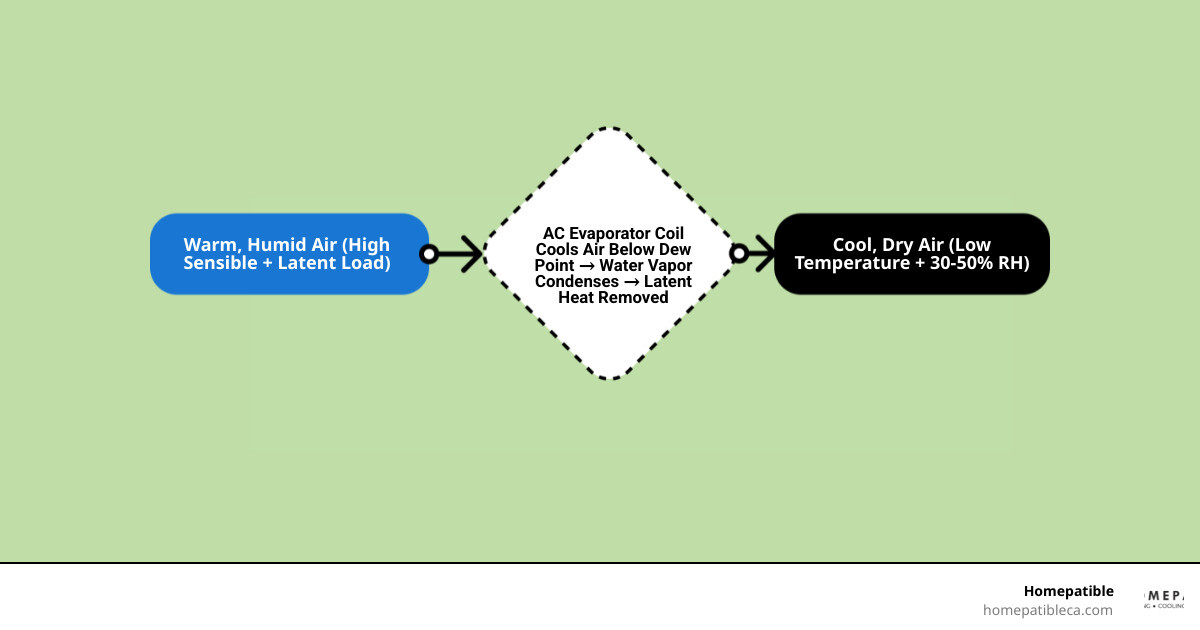
An air conditioner has two distinct jobs, which we call "sensible" and "latent" cooling:
- Sensible Load: This is the heat you can feel. It’s the actual temperature of the air as measured by a thermometer.
- Latent Load: This is the "hidden" heat trapped in water vapor. Removing this moisture is what lowers the humidity.
When your system is running, warm indoor air is blown across a very cold evaporator coil. As the air cools, it reaches its "dew point"—the temperature at which it can no longer hold onto its moisture. That moisture condenses into liquid water on the coil, much like beads of sweat on a cold soda can. This water then drips into a pan and exits your home through a condensate drain.
If the system is sized correctly, it stays on long enough for this condensation process to fully "wring out" the air. If the cycle is too short, the air gets cold, but the moisture stays floating in the room. For more on the fundamentals of your system, check out Don't Sweat It: A Complete Guide to Your New AC Setup.

Understanding the Mechanics: How Proper AC Sizing Controls Both Temperature and Humidity
The mechanics of dehumidification require time. It takes approximately 10 to 15 minutes of continuous operation for the evaporator coil to get cold enough and stay cold enough to begin effective moisture removal. During this time, the system is performing "thermal expansion" of the refrigerant and stabilizing airflow velocity.
If a system is too powerful for the space, it reaches the temperature set-point in five minutes and shuts off. The air is now 72°F, but because the coil never had a chance to truly condense the water vapor, the relative humidity remains at 65% or higher. This is why a room can feel "clammy"—it’s cold, but wet.
Why Coastal Homeowners Need to Know How Proper AC Sizing Controls Both Temperature and Humidity
For our neighbors in Santa Barbara and San Luis Obispo, the "marine layer" is a constant factor. In April 2026, as we move into the "May Gray" and "June Gloom" seasons, outdoor humidity often hovers near saturation. Even if the temperature is a mild 68°F outside, the moisture content is high.
In these conditions, a standard AC sizing "rule of thumb" often fails. If you install a unit based solely on how hot it gets in August, it will be vastly oversized for the humid, mild days of spring. This leads to a home that feels like a damp cave. Proper sizing ensures the unit can handle the moisture saturation of the coast without overcooling the house into an icebox. Residents in high-moisture areas should see our guide on AC Installation in Ballard, CA: Your Ticket to a Breeze Easy Summer for localized advice.
The "Bigger is Better" Fallacy: Why Oversized Units Fail the Humidity Test
In the HVAC world, "bigger" is almost never "better." When a contractor installs a 3-ton unit in a home that only requires a 2-ton unit, they are setting the homeowner up for years of "short cycling." Short cycling is when the AC turns on and off frequently because it satisfies the thermostat too quickly.
The consequences of an oversized unit include:
- Clammy Air: The temperature drops, but the moisture remains, leading to that "sticky" feeling.
- Mold and Mildew: High humidity (above 60%) is the primary fuel for mold growth on window sills, in closets, and behind furniture.
- Energy Inefficiency: It takes a lot of power to start a compressor. A system that starts and stops 20 times an hour uses significantly more electricity than one that runs for one long, steady cycle.
- Shortened Lifespan: Constant starting and stopping puts immense wear and tear on the motor and compressor.
Signs your AC is oversized:
- The system reaches the set temperature in less than 10 minutes.
- The indoor humidity stays above 55% even when the AC is running.
- You feel "cold but sticky."
- You notice musty odors or condensation on your windows.
If you're planning a new install in areas like Lompoc, avoid these pitfalls. See our Don't Sweat It: Your Lompoc AC Installation Roadmap for more details.
The Struggle of Undersized Systems in Santa Barbara and San Luis Obispo
While oversizing is the most common mistake, undersizing creates its own set of headaches. An undersized air conditioner is like a small engine trying to pull a massive trailer—it might move, but it’s going to struggle and eventually overheat.
In the Central Coast climate, an undersized system will run continuously during a heatwave. While this actually results in excellent dehumidification (because the coil is always cold), the system will fail to reach the temperature set-point. If it’s 95°F in Santa Maria and your AC can only bring the house down to 82°F, you aren't comfortable.
Continuous operation leads to:
- Accelerated Component Wear: The blower motor and compressor are never allowed to rest.
- High Energy Bills: Even though the unit is smaller, running it 24/7 is incredibly expensive.
- Poor Air Quality: If the system is struggling, it may not be moving air through filters effectively, leading to a buildup of dust and allergens.
Finding the right professional to balance these loads is key. We recommend checking out the Top 10 AC Installers in San Luis Obispo, CA to ensure you’re working with experts who understand local load requirements.
Precision Engineering: The Role of Manual J and Manual S Load Calculations
So, how do we determine the "perfect" size? We use the industry gold standards: ACCA Manual J and Manual S.
In the old days, contractors used "rules of thumb," like "one ton of cooling for every 500 square feet." In April 2026, we know that’s not just outdated—it’s often wrong. A modern home with high-efficiency windows and R-38 insulation in Goleta has a much lower cooling requirement than a 1950s bungalow in San Luis Obispo with the same square footage.
Manual J is a rigorous calculation that considers:
- Solar Orientation: Which way does the house face? (South-facing windows add massive heat).
- Insulation Levels: What is the R-value in the walls and attic?
- Window Types: Are they single-pane or double-pane? Do they have low-E coatings?
- Occupancy: How many people live there?
- Air Leakage: How "tight" is the building envelope?
Once we have the Manual J "load," we use Manual S to select the specific equipment that matches that load.
| Feature | Rule of Thumb | Manual J Calculation |
|---|---|---|
| Accuracy | Low (often 50-100% off) | High (within 5% of actual need) |
| Humidity Control | Poor (usually leads to oversizing) | Excellent (balances latent and sensible) |
| Energy Cost | Higher due to cycling | Optimized for efficiency |
| Equipment Life | Shorter (stress from cycling) | Maximized |
Advanced HVAC Technology for Enhanced Moisture Removal
While proper sizing is the foundation, modern technology has given us even better tools to handle the Central Coast's humidity. If you are looking for the ultimate in comfort, we often recommend "variable-speed" or "multi-stage" systems.
- Variable-Speed Compressors: Unlike standard units that are either 100% "on" or "off," these can run at 30% or 50% capacity. They stay on for much longer, lower-intensity cycles, which is a dream for humidity removal.
- ECM Blowers: These fan motors can adjust their speed. By slowing down the air as it passes over the coil, the moisture has more time to condense and drop out of the air.
- Dehumidify Mode: Many modern systems have a specific setting that prioritizes moisture removal over temperature drops.
- Whole-Home Dehumidifiers: In particularly damp areas or for "tight" homes, we can install a dedicated dehumidifier into your ductwork. This allows you to control humidity independently of the temperature.
- Smart Thermostats: Systems like Google Nest can monitor humidity levels and automatically adjust your AC's runtime to keep you in the "comfort zone."
For residents in areas like Callender, understanding these options is the first step toward a better home environment. Read more at What Every Callender Resident Should Know About Central Air Installation.
Proactive Maintenance for Year-Round Comfort and Air Quality
Even a perfectly sized AC will fail the humidity test if it isn't maintained. Maintenance is what keeps the "sponge" working effectively.
Key maintenance tasks for humidity control include:
- Coil Cleaning: If the evaporator coil is coated in dust, it can’t transfer heat or condense water effectively. Dirty coils are a leading cause of "sticky" indoor air.
- Drain Line Clearing: Algae and sludge can block your condensate drain. If the water can’t leave, it can back up and even humidify the air inside the unit.
- Refrigerant Levels: If your system is low on "charge," the coil won't get cold enough to reach the dew point, meaning it won't remove any moisture.
- Fan Speed Calibration: Sometimes, the "out of the box" fan speed is too high for our coastal climate. We can often calibrate this to improve dehumidification.
For those in Hope Ranch, we’ve put together a localized guide: AC Maintenance in Hope Ranch: Everything You Need to Know.
Frequently Asked Questions about AC Sizing
What is the ideal indoor humidity level for a home?
The EPA advises keeping indoor relative humidity (RH) below 60%, and ideally between 30% and 50%. Staying below 50% is the "magic number" for health; it significantly reduces dust mite populations and prevents most mold species from germinating. On the Central Coast, maintaining 45% RH usually feels much cooler than 55% RH, even at the same temperature.
Can I just add a dehumidifier instead of replacing an oversized AC?
You can, but it’s often a "band-aid" solution. Standalone dehumidifiers actually add a small amount of heat to the room while they work (this is called "reheat"). This increases the "sensible load" on your AC. While a whole-home dehumidifier is an excellent addition for total control, it shouldn't be used to compensate for a vastly oversized AC that is short-cycling and wasting energy.
How long should a properly sized AC run per cycle?
Ideally, on a warm day, your AC should run for at least 15 to 20 minutes per cycle. During the hottest part of a Santa Barbara afternoon, a perfectly sized system might run almost continuously to maintain the set-point. This is actually a sign of a healthy, efficient system. Continuous, steady operation is far better for your energy bill and your comfort than five-minute bursts of icy air.
Conclusion
At the end of the day, how proper ac sizing controls both temperature and humidity is what separates a "cold" house from a "comfortable" home. Don't settle for a system that leaves you feeling clammy and sticky. Whether you are in Santa Maria, Montecito, or Pismo Beach, your home deserves a system that is engineered for our unique coastal environment.
At Homepatible, our team of licensed experts and Nest Pro Elite technicians are specialists in precision load calculations. We don't guess—we measure. From Buellton to Carpinteria, we are here to ensure your AC is sized perfectly for your home's unique needs. We offer 24/7 emergency service and transparent pricing to give you peace of mind all year long.
Ready to stop the "sticky" summers and start breathing easier? Schedule your professional AC assessment with Homepatible today and let us help you find your home's perfect comfort "sweet spot."
Ready to take the next step?
Our certified technicians are ready to help with all your home service needs. Schedule a service today.
Schedule My ServiceRecent Posts
Related Articles
Ready to Get Started?
Whether you need a repair, maintenance, or a new system, our expert team is here to help.