
Salt vs Membranes in the Fight for Pure Water
Article content and related resources
Discover water softener vs reverse osmosis for your home: Compare hard water solutions, contaminant removal & whole-home protection. Find the best fit!
Why Choosing Between a Water Softener vs Reverse Osmosis for Your Home Matters
Water softener vs reverse osmosis for your home is one of the most common water quality questions Central Coast homeowners ask — and for good reason. Hard water is widespread across Santa Barbara and San Luis Obispo Counties, but mineral buildup isn't the only concern. Many households also deal with chlorine taste, dissolved contaminants, or emerging issues like PFAS in their tap water.
Here's the short answer:
| Goal | Best System |
|---|---|
| Stop scale buildup in pipes and appliances | Water Softener |
| Remove contaminants from drinking water | Reverse Osmosis (RO) |
| Treat the whole house | Water Softener |
| Purify water at one tap (kitchen, bathroom) | Reverse Osmosis (RO) |
| Address both hard water and contaminants | Both systems together |
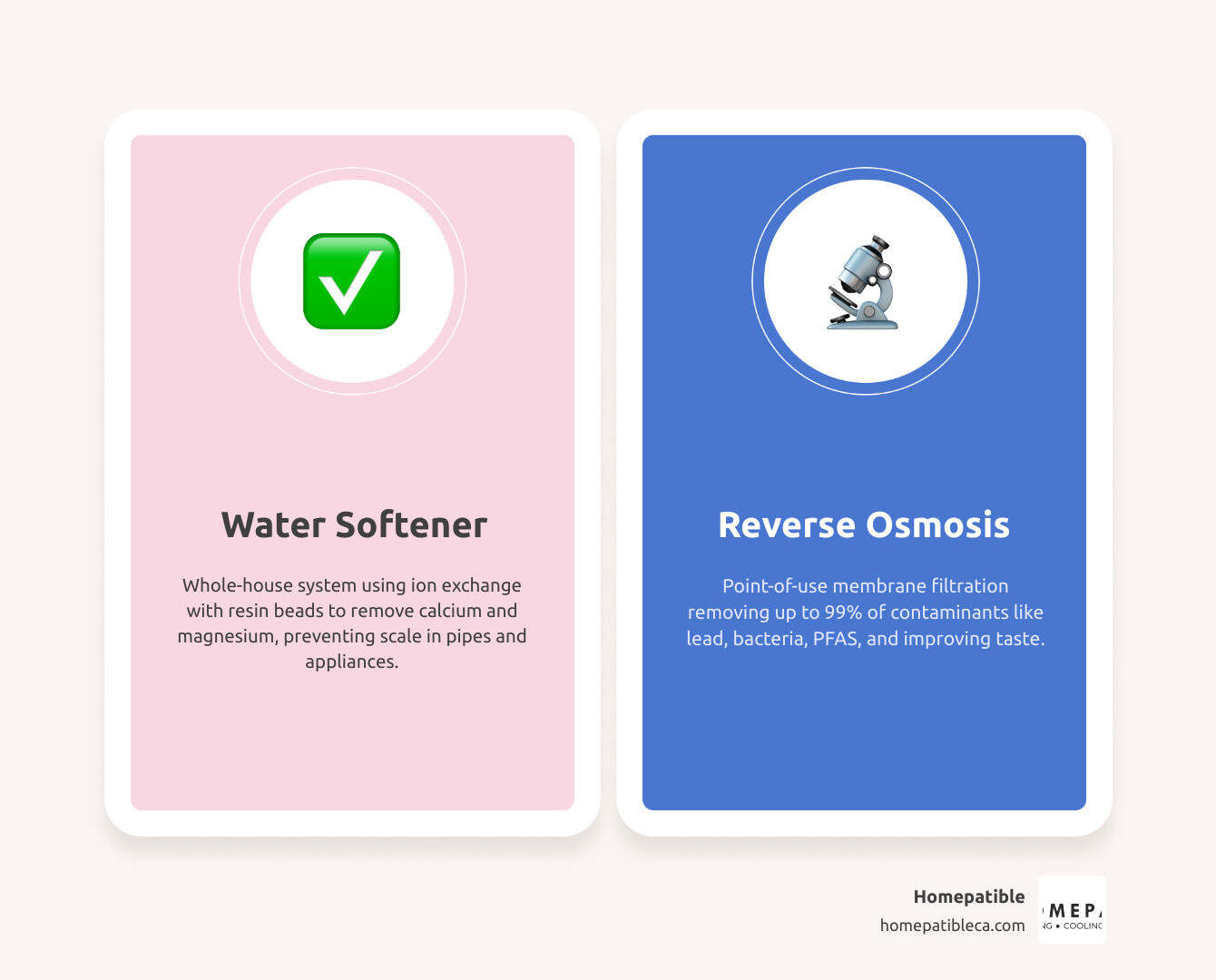
These two systems solve different problems. A water softener uses ion exchange to remove hardness minerals like calcium and magnesium throughout your entire home. A reverse osmosis system uses a semi-permeable membrane to filter out a broad range of contaminants — including lead, bacteria, and PFAS — typically at a single point of use like your kitchen sink.
Neither replaces the other. Many homeowners on the Central Coast benefit most from using both in combination, with the softener protecting the RO membrane and the RO delivering clean, great-tasting drinking water.
Read on to understand exactly how each system works, what they cost to maintain, and how to decide what's right for your home.
Understanding the Main Difference: Water Softener vs Reverse Osmosis for Your Home
When we talk about water softener vs reverse osmosis for your home, we are really talking about two different technologies: ion exchange and membrane filtration. While both aim to improve your water, they "attack" different problems.
A water softener is a "Point of Entry" (POE) system. This means it is installed where your main water line enters the house. It uses resin beads to perform ion exchange, swapping out hardness minerals (calcium and magnesium) for tiny amounts of sodium or potassium. This protects every pipe, faucet, and appliance in your home from the "rock" that hard water leaves behind.
On the other hand, a reverse osmosis (RO) system is typically a "Point of Use" (POU) system. It’s usually tucked under the kitchen sink. It works like a microscopic strainer, forcing water through a semi-permeable membrane that blocks almost everything except the water molecules themselves. If you are looking for Water Filtration Systems in Goleta, you’ll find that RO is the gold standard for drinking water purity.
| Feature | Water Softener | Reverse Osmosis (RO) |
|---|---|---|
| Primary Technology | Ion Exchange (Resin Beads) | Semi-permeable Membrane |
| Main Purpose | Removing Hardness (Scale) | Removing Contaminants (Purity) |
| Installation Point | Whole-House (Main Line) | Point-of-Use (Under Sink) |
| Waste Water | Minimal (during regeneration) | 25-50% during filtration |
| Impact on Appliances | High (Protects them) | Low (Only treats one tap) |
Is a Water Softener vs Reverse Osmosis for Your Home Better for Hard Water?
If your main frustration is white chalky buildup on your showerhead, spots on your wine glasses, or dry, itchy skin after a bath, the water softener is your champion. Hard water is defined by high levels of calcium and magnesium. These minerals don't just sit there; they crystallize when heated, creating "scale."
This scale acts like a layer of insulation inside your water heater, making it work harder and die sooner. By removing these minerals before they enter your plumbing, a softener can significantly extend the lifespan of your appliances. For residents needing Water Softener Installation in Buellton, a softener is the most cost-effective way to preserve the home’s infrastructure. While an RO system can remove some minerals, it isn't designed to handle the heavy mineral loads found in Central Coast groundwater and would quickly clog if used as the primary defense against hardness.
Comparing Contaminant Removal: Water Softener vs Reverse Osmosis for Your Home
While softeners handle the "feel" and "plumbing health" of your water, they are not purifiers. They won't remove lead, arsenic, or chemicals. This is where the reverse osmosis system shines. In water softener vs reverse osmosis for your home, RO is the undisputed heavy hitter for safety.
Modern RO systems are incredibly efficient, capable of removing up to 99.995% of contaminants. This includes:
- PFAS: Often called "forever chemicals," these are a growing concern in many water supplies.
- Lead: Even if your city water is clean, old pipes in your home or neighborhood can leach lead.
- Bacteria and Viruses: RO provides a physical barrier that most microbes cannot pass.
- Chlorine and VOCs: Most RO units include carbon pre-filters to remove the "swimming pool" taste and smell.
If you are exploring Water Filtration Systems in Los Alamos, you’ll find that RO is the best way to ensure your family is drinking the purest water possible, regardless of what's happening in the municipal supply.
Comparing Benefits: Whole-Home Protection vs. Pure Drinking Water
Choosing between these systems often comes down to your priorities: do you want to protect your house, or do you want the best-tasting coffee and safest drinking water?
The Case for the Water Softener A softener treats every drop of water that comes out of every tap. This means:
- Softer Skin and Hair: Without the mineral film, your natural oils can do their job.
- Cleaner Laundry: Your clothes stay brighter and feel softer because soap can actually rinse away.
- Appliance Longevity: Your dishwasher, washing machine, and water heater will thank you.
- Choice of Salt: You can use standard sodium chloride or, for a more eco-friendly option, potassium chloride (which acts as a plant nutrient in graywater).
If you’re looking into Water Softener Installation in Toro Canyon, you’re likely looking to stop the "rock" from ruining your high-end fixtures.
The Case for Reverse Osmosis An RO system focuses on the water you actually put into your body.
- TDS Reduction: It slashes Total Dissolved Solids, resulting in water that tastes "crisp" and "clean."
- Better Cooking: Impurities in water can change the flavor of soups, pasta, and coffee.
- Environmental Impact: Having high-quality water at the tap eliminates the need for plastic bottled water, which is a major win for the Central Coast environment.
For those in the Santa Ynez Valley considering Water Filtration Systems in Ballard, the taste improvement alone is often worth the investment.
The Ultimate Team: Combining Softening and RO Systems
In our expert opinion, the "Water Softener vs Reverse Osmosis" debate shouldn't be an "either/or" choice. They are actually a perfect team. In fact, they work so well together that we often recommend a dual-system approach.
The Installation Order Matters When we install both systems, the order is critical: the water softener must come first. By softening the water at the point of entry, we remove the calcium and magnesium before the water reaches the RO unit. This protects the delicate RO membrane from "scaling up." Without a softener, a hard water supply can cut an RO membrane's life in half. With soft water, that membrane can last up to 5 years.
Efficiency and Waste One common myth is that RO systems are incredibly wasteful. While it’s true that RO systems discard some water (the "concentrate") to wash away impurities—typically 3 to 6 gallons for every gallon of pure water produced—modern systems are much more efficient. Using a permeate pump can reduce this waste significantly.
For homeowners in Orcutt, combining a whole-house softener with an under-sink RO unit provides total protection. You get scale-free showers and bottled-water-quality drinking water.
If you are evaluating Water Filtration Systems in Los Berros, a combined system gives you the best of both worlds: utility and purity.
Frequently Asked Questions
Does reverse osmosis soften water?
This is a tricky one. Technically, yes, an RO system removes the minerals that cause hardness. However, it is not a replacement for a water softener. Because RO systems are typically point-of-use (one tap), they don't protect the rest of your home. Furthermore, using an RO system to soften very hard water is like using a silk handkerchief to scrub a driveway—it will work for a minute, but you’ll ruin the tool. For proper whole-home protection, you need the ion exchange process found in a dedicated softener. If you're in Atascadero, where water can be quite hard, rely on a softener for the heavy lifting.
What maintenance is required for each system?
Both systems are relatively low-maintenance, but they aren't "set it and forget it."
- Water Softeners: You’ll need to add salt (sodium or potassium chloride) to the brine tank every 6–8 weeks. We also recommend a professional inspection once a year to ensure the valve is cycling correctly.
- RO Systems: You’ll need to change the sediment and carbon pre-filters every 6–12 months. The main RO membrane typically lasts 2–5 years, depending on your water quality and whether you have a softener.
For those looking for Water Filtration Systems in Templeton, keeping a regular maintenance schedule ensures your water stays pure and your warranties remain valid.
Should I test my water before choosing?
Absolutely. You wouldn't take medicine without a diagnosis, and you shouldn't buy a water system without a test. A professional water test identifies exactly what is in your water—whether it’s 5 grains of hardness or 25, and whether there are specific contaminants like nitrates or high chlorine. Municipal water reports (like those in Santa Barbara) provide a good baseline, but water can change as it travels through city pipes to your specific home. For well water owners in Hope Ranch, testing is even more critical to check for bacteria and localized mineral issues.
Conclusion
Deciding between a water softener vs reverse osmosis for your home doesn't have to be a headache. If you want to stop scrubbing soap scum and protect your water heater, get a softener. If you want the peace of mind that comes with ultra-pure drinking water, get a reverse osmosis system. If you want a home that runs efficiently and a family that drinks the best water possible, get both.
At Homepatible, our licensed and certified Nest Pro Elite technicians are experts in both traditional plumbing and modern smart home integration. Whether you are in Santa Maria, San Luis Obispo, or anywhere across the Central Coast, we are here to help you find the perfect balance for your home’s water. We offer 24/7 emergency service and transparent, upfront pricing to ensure your home stays comfortable and safe.
Ready to transform your tap water? Schedule your home water filtration consultation with Homepatible today!
Ready to take the next step?
Our certified technicians are ready to help with all your home service needs. Schedule a service today.
Schedule My ServiceRecent Posts
Related Articles
Ready to Get Started?
Whether you need a repair, maintenance, or a new system, our expert team is here to help.