
How to tell if your plumbing issue is a total emergency
Article content and related resources
Learn when a plumbing problem is an emergency: spot burst pipes, sewage backups & leaks. Take immediate action to prevent damage—24/7 Central Coast help!
How to Tell If Your Plumbing Issue Is a Total Emergency
When a plumbing problem is an emergency comes down to three things: is it causing active damage right now, does it pose a health or safety risk, or has it completely cut off an essential service like water or sewage? If the answer to any of those is yes, you need to act immediately.
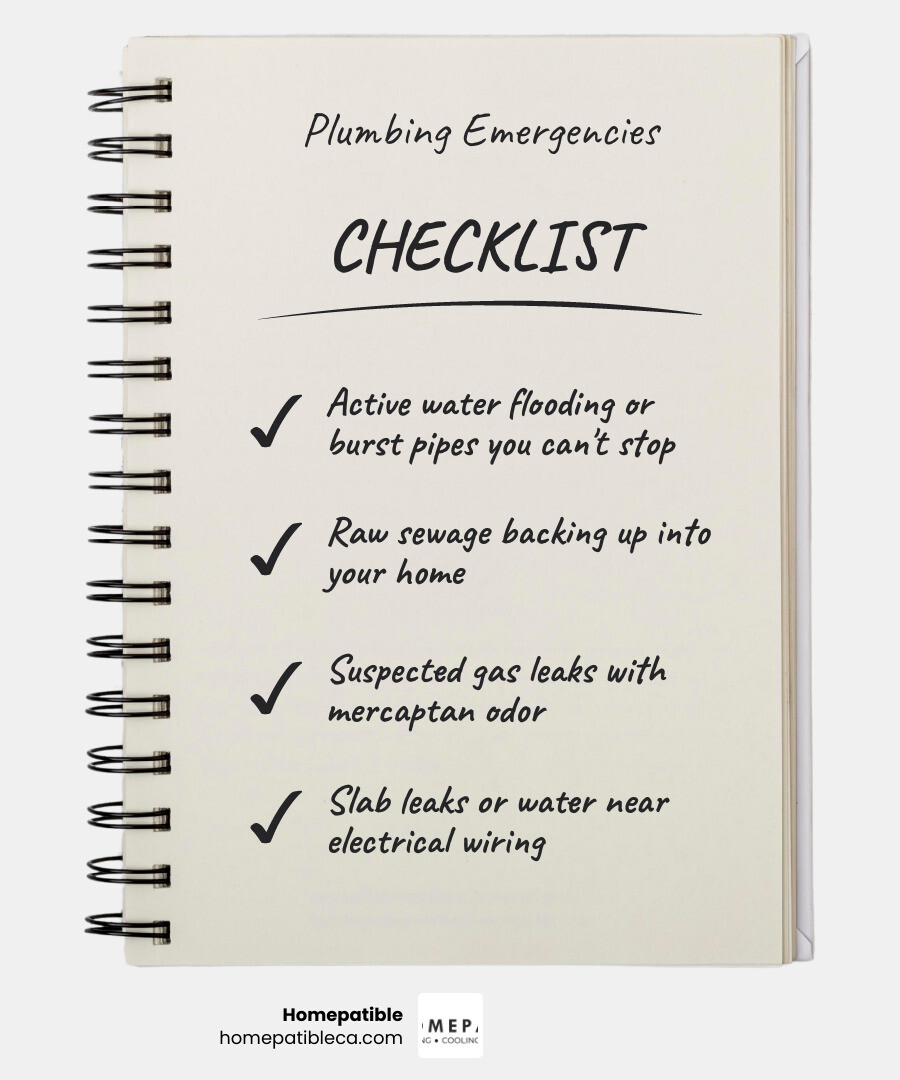
Quick answer — it's a plumbing emergency if you have:
- Active water flooding or a burst pipe you can't stop
- Raw sewage backing up into your home
- Any suspected gas leak
- A complete loss of water supply throughout the house
- A slab leak or water reaching electrical wiring
- Frozen pipes showing signs of cracking or bulging
It can likely wait until business hours if it's:
- A dripping faucet
- A single slow drain (without backup)
- A running toilet that still flushes
- Minor, contained leaks you can catch with a bucket
- Reduced water pressure from one fixture
It's 2:30 in the morning. You hear rushing water. You flip on the light and there's water spreading across your floor. Your heart races — and rightfully so. Some plumbing problems are genuinely dangerous, and every minute of inaction multiplies the damage.
The tricky part is that not every plumbing issue deserves a middle-of-the-night panic call. A dripping faucet is annoying. A burst pipe flooding your walls is a crisis. Knowing the difference can save you thousands of dollars — and protect your family's health and safety.
In this guide, we'll walk you through exactly how to tell the two apart, what to do first, and when to call for 24/7 emergency help.
Defining when a plumbing problem is an emergency
When we talk about a plumbing emergency, we aren't just talking about a nuisance. A true emergency is a situation that threatens the structural integrity of your home, poses a serious biohazard, or puts your family in physical danger. In April 2026, with the high-tech systems many of our Central Coast homes now utilize, a failure in one area can quickly cascade into another.
For instance, a burst pipe can release hundreds of gallons of water in mere minutes. This isn't just a "wet floor" problem; it's a threat to your home's foundation and electrical systems. If water reaches your breaker panel or outlets, you are looking at a fire hazard on top of a flood. Furthermore, situations involving sewage or gas leaks move beyond property damage and straight into the realm of health crises. For residents needing Emergency Plumbing in Vandenberg Space Force Base, understanding these distinctions is the first step toward protecting your property.
Identifying when a plumbing problem is an emergency vs. a minor repair
It helps to think of plumbing issues on a spectrum. On one end, you have the "inconveniences," and on the other, you have the "911 emergencies."
| Feature | Emergency Situation | Non-Emergency Situation |
|---|---|---|
| Water Flow | Gushing, spraying, or uncontrollable flooding | Slow drip or minor seepage into a bucket |
| Health Risk | Raw sewage backup, gas odors, or mold growth | Minor mineral buildup on a faucet |
| Functionality | Total loss of water or all toilets are unusable | One slow-draining sink while others work |
| Structural Impact | Sagging ceilings, bulging walls, or foundation cracks | Dampness under a sink that stays contained |
| Safety | Water near electrical wiring or gas hissing | A toilet that runs occasionally |
If you can shut off the water to a specific fixture (like the valve behind a toilet) and the leaking stops, you have successfully downgraded the emergency to a standard repair. However, if the water keeps coming even after you’ve tried to isolate the source, it’s time to call in the professionals.
Why you shouldn't wait when a plumbing problem is an emergency
Waiting even a few hours can turn a manageable repair into a catastrophic loss. Did you know that mold growth can begin within 24 to 48 hours of water exposure? In our coastal climate, humidity can accelerate this process, leading to respiratory distress for your family.
Beyond the health risks, the financial waste is staggering. Nationwide, household leaks waste about 1 trillion gallons of water annually—enough to supply 11 million homes. When a pipe bursts, you aren't just wasting water; you are actively destroying drywall, insulation, and flooring. If you are facing a crisis and need Emergency Plumbing in Santa Ynez, every hour of delay multiplies the potential for secondary damage like electrical shorts or structural rot.
Critical Situations Requiring 24/7 Service
Some situations simply cannot wait until Monday morning. These are the "drop everything" moments where 24/7 service is non-negotiable. Whether it's a holiday or the middle of the night, these scenarios require an immediate response to keep your home habitable. If you are in the Central Coast region, specifically looking for Emergency Plumbing in Callender, these are the red flags we want you to watch for.
Major water leaks and ruptured lines
A ruptured water line is perhaps the most visible plumbing nightmare. You might see water gushing from a wall, or worse, you might see the evidence before you find the source—like a sagging ceiling. When drywall soaks up enough water, it becomes incredibly heavy and can collapse without warning, potentially injuring anyone below.
Slab leaks are another silent killer of homes. These occur when pipes under your concrete foundation leak. Signs include warm spots on the floor, the sound of running water when nothing is turned on, or a sudden spike in your water utility bill. These require specialized leak detection equipment to fix before they compromise your home's foundation. For those in Emergency Plumbing in Los Berros, we recommend checking your water meter if you suspect a hidden leak; if the dial is spinning while all taps are closed, you have a major problem.
Sewage backups and health biohazards
There is no such thing as a "minor" sewage backup. Sewage is classified as "black water," a Category 3 biohazard. This water is teeming with pathogens like E. coli, Salmonella, and Norovirus. Exposure can lead to severe illness, and the cleanup requires professional-grade disinfection.
Furthermore, sewage backups release methane gas. Not only is this gas unpleasant to smell, but in high concentrations, it can cause respiratory issues and even pose an explosion risk. If you flush your toilet and water starts coming up in your bathtub, or if you smell a persistent "rotten egg" odor from your drains, you likely have a main sewer line blockage. This is an immediate emergency for residents seeking Emergency Plumbing in Templeton.
Immediate Actions to Mitigate Damage
When disaster strikes, the first 10 minutes are the most critical. While you wait for us to arrive, there are several steps you can take to minimize the damage to your property. Think of this as "plumbing first aid." If you are in a remote area like Emergency Plumbing in Gaviota, these steps are even more vital as they buy you time.
Step-by-step emergency response
- Shut Off the Water: This is the single most important step. Every adult in your home should know where the main water shut-off valve is located. Usually, it’s near the water meter or where the main line enters the house. Turn it clockwise to stop the flow.
- Turn Off the Water Heater: If you’ve shut off the main water supply, turn off your water heater as well. If the tank empties while the heating elements are still on (electric) or the burner is active (gas), it can burn out the unit or create a pressure hazard.
- Open the Taps: After the main valve is off, open the lowest faucets in your home to drain the remaining water out of the pipes and away from the leak.
- Contain the Mess: Use buckets, towels, or a wet/dry vac to manage standing water. This helps prevent the water from soaking into the subfloor or spreading to other rooms.
- Document Everything: Before you start cleaning, take photos and videos of the damage. This is essential for your insurance claim. Most homeowners' insurance covers sudden water damage but not the plumbing repair itself—having proof of the "suddenness" is key.
Safety protocols for gas and electrical hazards
If you smell gas (that distinctive sulfur or rotten egg smell), stop everything. Do not turn on a light switch, do not use your phone inside, and do not start your car in the garage. Any spark can trigger an explosion.
- Evacuate immediately: Get everyone, including pets, out of the house.
- Ventilate: If you can do so quickly on your way out, leave the doors open to help the gas disperse.
- Call for help: Once you are a safe distance away, call 911 and your gas utility company.
- Electrical Safety: If water is pooling near outlets or your electrical panel, do not enter the room. If it is safe to reach your breaker box, turn off the power to the affected area to prevent electrocution or fire.
Warning Signs of an Impending Crisis
Plumbing emergencies rarely happen without a "warning shot." By paying attention to the subtle cues your home gives you, you can often catch a problem before it becomes a midnight disaster.
Auditory and olfactory indicators
Your ears and nose are often the first to detect trouble.
- Water Hammer: If you hear a loud banging or thumping sound when you turn off a faucet, that’s "water hammer." It indicates high pressure or loose pipes that can eventually lead to a burst.
- Hissing: A persistent hissing sound behind a wall often means a pinhole leak in a pressurized pipe.
- Gurgling: If your drains gurgle when you use the washing machine or flush the toilet, air is being trapped by a partial blockage. This is the precursor to a full sewage backup.
- Odors: A "rotten egg" smell is a classic sign of a gas leak (mercaptan is added to natural gas for this reason). A musty, earthy smell usually indicates hidden mold from a slow leak, while a sewage smell means a dried-out P-trap or a cracked sewer line.
Visual red flags in Central Coast homes
Living on the Central Coast means dealing with specific environmental factors, like mineral-heavy water or shifting soil.
- Drywall Changes: Look for bulging, bubbling, or discolored patches on walls and ceilings. These are never "just a stain"—they are evidence of active moisture.
- Orange Flames: Your gas stove burners should always burn blue. An orange or yellow flame indicates improper combustion, which could mean a carbon monoxide risk or a faulty gas line.
- Low Water Pressure: If pressure drops suddenly across the whole house, you might have a major leak in your main line or a failing pressure regulator.
- High Water Bills: If your water usage spikes but your habits haven't changed, you have a "silent" leak. Common culprits are leaking toilet flappers or underground pipe cracks.
Frequently Asked Questions about Plumbing Emergencies
Is a single clogged toilet considered an emergency?
Generally, no—provided you have another working bathroom in the house. You can usually manage a single clog with a plunger or an auger. However, if it’s the only toilet in your home, it becomes an emergency because your home is no longer sanitary. Also, if the toilet is actively overflowing and the shut-off valve won't stop it, that is a definite emergency.
What should I do if I smell gas near my water heater?
Treat any gas smell as an emergency. Shut off the gas valve leading to the heater if you can do so safely, then evacuate the home and call 911. Gas leaks near water heaters can be particularly dangerous because the pilot light or electronic ignition can serve as an ignition source for the leaking gas.
Can a slow drain wait until regular business hours?
Yes, a single slow drain is usually an inconvenience rather than an emergency. It indicates a localized clog that hasn't fully blocked the pipe yet. However, don't ignore it! A slow drain is a warning. If multiple drains are slow at the same time, that points to a main sewer line issue, which is an emergency.
Conclusion
Plumbing disasters don't look at the clock—they tend to happen at the most inconvenient times imaginable. Whether you are dealing with a burst pipe in the middle of the night or a suspicious gas smell on a holiday, knowing when a plumbing problem is an emergency is the key to protecting your home and your peace of mind.
At Homepatible, we take the stress out of home maintenance. Our licensed technicians and Nest Pro Elite experts are ready to respond to your needs across Santa Barbara and San Luis Obispo Counties. From high-tech leak detection to 24/7 emergency repairs, we are the Central Coast's trusted source for a safer, more efficient home.
Don't wait for a small drip to become a major flood. More info about our professional home services is just a click away, or give us a call anytime—we're here to help, 24/7.
Ready to take the next step?
Our certified technicians are ready to help with all your home service needs. Schedule a service today.
Schedule My ServiceRecent Posts
Related Articles
Ready to Get Started?
Whether you need a repair, maintenance, or a new system, our expert team is here to help.