
Ductless vs Central AC Cost Breakdown for Savvy Homeowners
Article content and related resources
San Luis Obispo homeowners: Navigate the mini split vs central ac cost comparison. Discover savings on cooling & long-term efficiency.
The Real Mini Split vs Central AC Cost Comparison: What Central Coast Homeowners Need to Know
The mini split vs central ac cost comparison is rarely as simple as comparing two installation quotes. The right answer depends on your home's existing infrastructure, how many rooms you need to cool, and what you plan to spend over the life of the system — not just at installation.
Here's a quick breakdown to orient you before we go deeper:
| Factor | Mini Split (Ductless) | Central AC |
|---|---|---|
| Best for | No ductwork, zoned cooling, additions | Whole-home cooling with existing ducts |
| Upfront cost (single zone) | Lower | Higher (with ducts already in place) |
| Upfront cost (no ducts) | Lower | Much higher (duct installation adds significant cost) |
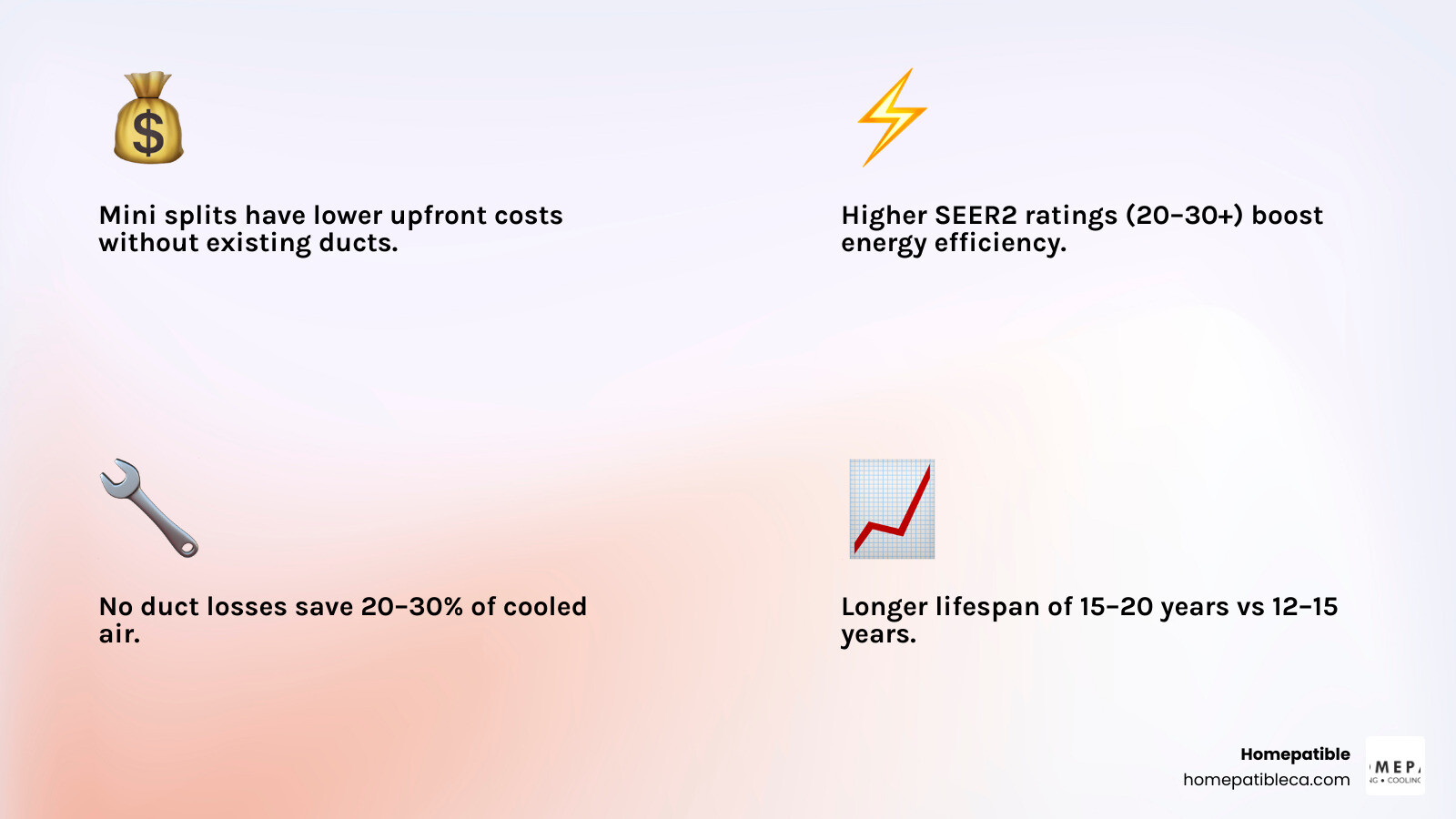
| Energy efficiency | Higher (SEER2 20–30+) | Moderate (SEER2 14–21) |
| Duct energy loss | None | 20–30% of cooled air |
| Lifespan | 15–20 years | 12–15 years |
| Zoning capability | Built-in, room by room | Limited without added hardware |
| Maintenance | Monthly filter cleaning | Quarterly filter + duct cleaning every 5–7 years |
| Best climate fit | Flexible, works year-round as heat pump | Whole-home in moderate climates |
For most Central Coast homeowners in Santa Barbara or San Luis Obispo County, the decision comes down to one question: do you already have ductwork, and is it in good shape?
- If yes, central AC can be the more affordable upfront choice.
- If no, a ductless mini split almost always wins on total cost.
- If you're cooling a single room, addition, or converted garage, a single-zone mini split is typically the smarter investment.
That said, there's more to this decision than a quick table can cover. Operational costs, maintenance requirements, available rebates, and your home's layout all shift the numbers meaningfully — especially in the Central Coast's mild but variable climate.
I’m looking to upgrade my home’s cooling. How do I navigate the mini split vs central ac cost comparison in San Luis Obispo?
When we sit down with homeowners in San Luis Obispo or Santa Maria to discuss a cooling upgrade, the conversation usually starts with the upfront investment. It is a common misconception that one system is "always" cheaper than the other. In reality, the mini split vs central ac cost comparison depends heavily on equipment capacity and the specific configuration of your home.
For a central air conditioning system, the equipment consists of a large outdoor condenser and an indoor evaporator coil, usually paired with a furnace or air handler. The labor requirements for this setup are straightforward if the home already has a functional network of ducts. However, if those ducts are undersized or failing, the labor hours quickly climb as technicians navigate tight attic spaces or crawlspaces to ensure proper airflow.
On the other hand, Ductless Installation/Replacement involves mounting an indoor air handler directly on a wall (or ceiling) and connecting it to an outdoor unit via a small refrigerant line. While the equipment itself can sometimes be more expensive per ton of cooling than a standard central unit, the installation complexity is often lower because we don't have to tear into your walls to run large metal or flex ducts.
The system configuration also plays a major role. A single-zone mini split is a very focused investment, whereas a multi-zone system requires more intricate line-set routing and electrical work to connect three, four, or even five indoor heads to one outdoor compressor. As we move into April 2026, many homeowners are opting for these multi-zone configurations to gain precise control over their home's "micro-climates."
How Existing Infrastructure Impacts Your HVAC Investment
Your home’s current "bones" are the biggest variable in the mini split vs central ac cost comparison. If you live in a historic home in downtown Santa Barbara or a mid-century ranch in Goleta, the structural disruption required to install central air can be a dealbreaker.
Central AC relies entirely on ductwork integrity. If your ducts are over 15 years old, they may have leaks, gaps, or poor insulation. According to industry data, central systems can lose 20% to 30% of their conditioned air through these leaks before it ever reaches your living room. This is essentially money flying out of your pockets and into your attic. If your ducts are salvageable, we often recommend professional Duct Cleaning to ensure your new system isn't blowing dust and allergens through your home, but if the ducts are beyond repair, the retrofitting challenges can be immense.
Adding new ductwork to an existing home often involves lowering ceilings, building "soffits" (boxed-in areas to hide ducts), and losing closet space. This structural disruption adds thousands to the final bill, often making a ductless solution the more fiscally responsible choice.
Is the mini split vs central ac cost comparison better for homes without existing ductwork?
For homes built before central air was standard — common in places like Solvang or Ballard — mini splits are the clear winner. They allow for the preservation of beautiful plaster walls and original architectural details that would otherwise be destroyed by duct installation.
Because they require only a small three-inch hole in the exterior wall for the refrigerant lines, they are the ultimate space-saving solution. Our Ductless Services focus on these older home retrofits where targeted cooling is needed in specific rooms, such as an upstairs master bedroom that always stays five degrees warmer than the rest of the house. By bypassing the need for a whole-home duct overhaul, you can achieve modern comfort without the massive construction project.
Long-Term Operational Efficiency and Monthly Savings
Once the system is installed, the mini split vs central ac cost comparison shifts toward monthly utility bills. This is where modern technology shines. As of April 2026, the efficiency standards for HVAC equipment have reached new heights, and mini splits are leading the charge.
Most ductless systems utilize inverter technology and variable-speed compressors. Unlike a traditional Air Conditioning unit that is either 100% "on" or 100% "off," a variable-speed system can throttle down to run at 20% or 30% capacity. This prevents the energy-heavy "start-stop" cycle and maintains a perfectly steady temperature.
While high-end central AC units can reach SEER2 ratings of around 21, premium mini splits can soar into the 30s. This energy waste reduction is significant. Because there are no ducts, there is 0% energy loss between the unit and the room, compared to the 20-30% loss typical of ducted systems.
How does a mini split vs central ac cost comparison look when reviewing monthly utility bills?
The secret weapon of the Ductless system is zoning. With central AC, you usually have one thermostat. If you want to cool your bedroom at night, you have to cool the kitchen, the guest room, and the laundry room too.
Mini splits allow for independent zoning. You can turn off the units in rooms you aren't using, which can reduce cooling costs by up to 40% compared to an older central system. Furthermore, almost all mini splits are heat pumps. This means they provide highly efficient electric heating during our cool Central Coast winters, often outperforming traditional gas furnaces in terms of cost-per-BTU in our moderate climate.
Total Cost of Ownership: Maintenance and Lifespan
Savvy homeowners look at the "Total Cost of Ownership" (TCO) over a 10-year period. This includes the initial price, the electricity used, and the money spent on repairs and tune-ups.
| Maintenance Task | Central AC (Ducted) | Mini Split (Ductless) |
|---|---|---|
| Filter Cleaning | Replace every 3 months | Clean every 2-4 weeks (DIY) |
| Professional Tune-Up | Once per year | Once per year |
| Duct Cleaning | Every 5-7 years | N/A |
| Condenser Cleaning | Annual | Annual |
| Blower Wheel Cleaning | Occasional | Every 2-3 years |
Mini splits are generally considered to have a longer lifespan, often reaching 20 years with proper care, whereas central AC units often begin to decline after 12 to 15 years. However, mini splits require a bit more "hands-on" attention from the homeowner. Because the air handlers are inside the living space, the filters need to be rinsed off frequently to maintain airflow and prevent mold growth.
Regular Ductless Maintenance/Tune-Up is vital. Our technicians check the condensate drains and refrigerant levels to ensure the system is running at peak efficiency. Should an issue arise, our Ductless Repair Service is available 24/7, which is crucial because these systems rely on complex circuit boards that require expert handling.
Frequently Asked Questions about HVAC Systems
Which system is better for a single room addition or converted garage?
For a single room addition, a guest house in Montecito, or a converted garage in San Luis Obispo, a mini split is almost always the better choice. Extending existing ductwork to a new room often puts a strain on your current central AC, leading to poor performance in the rest of the house. A single-zone mini split provides independent temperature control and supplemental cooling without the need for major construction or a total HVAC system upgrade.
Do modern mini splits provide both heating and cooling in the Central Coast?
Yes! Modern mini splits are "heat pumps," which means they can reverse the cooling process to pull heat from the outside air and move it indoors. They are incredibly efficient at this, providing year-round comfort. They also offer excellent dehumidification, which is a major plus for homes near the coast in Carpinteria or Gaviota where humidity can sometimes make a room feel "stuffy" even if the temperature is low.
Are there incentives available for high-efficiency HVAC upgrades in 2026?
Absolutely. As of April 2026, the federal tax credits under the Inflation Reduction Act (Section 25C) remain a powerful tool for homeowners. You may be eligible for a tax credit of up to 30% of the project cost, capped at $2,000 per year for qualifying heat pump installations. Central AC units that meet high-efficiency Energy Star standards may also qualify for a smaller credit (usually capped at $600). Additionally, many local utility providers in Santa Barbara and San Luis Obispo Counties offer rebates for switching from gas furnaces or old electric baseboard heaters to high-efficiency heat pumps.
Conclusion
At Homepatible, we believe that a smarter home is a more comfortable home. Whether you are leaning toward the whole-home familiarity of central air or the high-efficiency precision of a ductless system, our team is here to help you make the right choice for your specific budget and home layout.
Serving Santa Barbara County and San Luis Obispo County, our licensed Nest Pro Elite technicians specialize in integrating these systems with modern smart home technology. We offer 24/7 emergency response and transparent service, so you never have to worry about hidden fees or being left in the heat.
Ready to see which system wins the mini split vs central ac cost comparison for your home? Contact us today for a consultation and let's make your home more efficient together.
Ready to take the next step?
Our certified technicians are ready to help with all your home service needs. Schedule a service today.
Schedule My ServiceRecent Posts
Related Articles
Ready to Get Started?
Whether you need a repair, maintenance, or a new system, our expert team is here to help.