
Double the Trouble for Contaminants with a Combined System
Article content and related resources
Discover the benefits of combining water softener and filtration for best results. Protect your Central Coast home from hard water and contaminants with expert installation!
Why Combining Water Softener and Filtration for Best Results Matters on the Central Coast
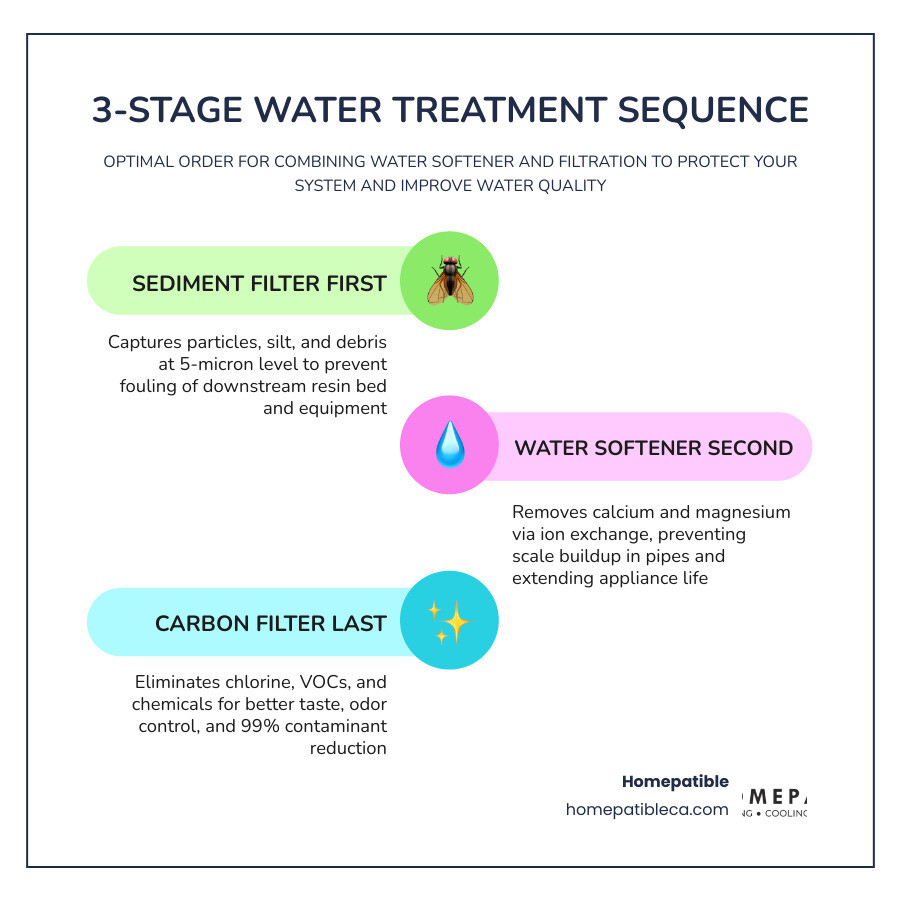
Combining water softener and filtration for best results means installing both systems in the correct sequence so each one handles what it does best — and protects the other from damage.
Here's the quick answer:
- Install a sediment filter first to catch particles and protect your softener's resin bed
- Install the water softener second to remove hardness minerals like calcium and magnesium through ion exchange
- Add carbon filtration last to eliminate chlorine, VOCs, and other chemical contaminants for cleaner-tasting water
Together, these three stages give you comprehensive whole-house water treatment that no single system can match.
If you've noticed scale buildup on your faucets, dry skin after showering, spots on your dishes, or water that just doesn't taste right — you're dealing with two separate problems that require two separate solutions. Hard water minerals and chemical contaminants like chlorine don't respond to the same treatment. A softener alone won't clean up your water's taste or remove chemicals. A filter alone won't stop scale from destroying your water heater and appliances.
This is especially relevant for homeowners across Santa Barbara and San Luis Obispo Counties in 2026. Central Coast water can carry both significant mineral hardness and municipal treatment chemicals — a combination that puts real strain on plumbing, appliances, and the water treatment equipment itself. Getting the system order wrong, or relying on just one device, leaves half your problem unsolved.
The good news: pairing both systems — done correctly — addresses all of it at once.
Understanding the Difference Between Softening and Filtration
To get the best out of your home’s water, we first need to clear up a common misconception: water softeners and water filters are not the same thing. They are teammates, not competitors.
A water softener is a specialist. It uses a process called ion exchange to specifically target "hardness" minerals—primarily calcium and magnesium. Inside the softener tank are millions of tiny resin beads. As hard water passes over them, the beads act like a magnet, swapping the calcium and magnesium ions for harmless sodium or potassium ions. This prevents limescale from ever forming in your pipes or on your heating elements.
A water filtration system, on the other hand, is designed to remove contaminants that affect safety, smell, and taste. Using media like activated carbon, these systems adsorb chemical compounds. They are incredibly effective at reducing chlorine (which municipalities use for disinfection), volatile organic compounds (VOCs), pesticides, and unpleasant odors. While a filter makes your water taste like it came from a premium bottle, it has no mechanism to remove the dissolved minerals that cause scale.
If you have hard water and want it to taste great, you need both. You can learn more about how these work individually on our Water Softener Installation Services page.
Why combining water softener and filtration for best results is the standard for Central Coast homes
Living in areas like Santa Maria, San Luis Obispo, or Santa Barbara means dealing with unique water profiles. Much of our local water is considered "hard" or "very hard," often exceeding 7 to 10 grains per gallon. At the same time, municipal systems often use chlorine or chloramine to keep water safe during transport.
By combining water softener and filtration for best results, you achieve comprehensive treatment. The softener protects your infrastructure—your water heater, dishwasher, and expensive plumbing fixtures—from the "white crusty stuff" (scale) that shortens their lifespan. Simultaneously, the filtration stage ensures that every tap in the house provides water free of chemical tastes and smells. It’s the difference between water that is just "safe" and water that is truly high-quality. Explore our Water Filtration Systems Services to see the options available for your home.
The Step-by-Step Guide to System Sequencing
When we install these systems, the order of operations is everything. If you put the filter in the wrong spot, you might accidentally ruin your softener's expensive resin or find that your water pressure drops to a trickle.
For a point-of-entry installation—where the water first enters your home—we typically set up a professional plumbing manifold. This allows us to install bypass valves, which are crucial for maintenance. If you ever need to change a filter or service the softener, a bypass valve ensures you still have water in the house while the system is being worked on. We’ve performed many of these custom setups, including specialized Water Softener Installation in Montecito.
Step 1: Installing the sediment filter to protect the resin bed
The very first line of defense should always be a sediment filter. Think of this as the "bouncer" for your plumbing. Its job is to catch physical particulates—silt, sand, rust flakes from aging city pipes, and debris.
We recommend a 5-micron rated filter for most homes. By catching these larger particles before they reach the water softener, you prevent "resin fouling." If sand or silt gets into your softener’s resin tank, it can clog the control valve and coat the resin beads, making them unable to swap ions. A simple sediment filter can extend the life of your softener by years. This is a vital first step we always include for Water Softener Installation in Hope Ranch.
Step 2: Positioning the water softener for mineral removal
Once the water is free of physical debris, it moves into the water softener. This is where the heavy lifting of mineral removal happens. Based on your home's specific hardness grains (which we measure during our initial visit), the softener exchanges those pesky calcium and magnesium ions for sodium.
This stage is the primary protector of your home’s energy efficiency. Scale acts as an insulator; if your water heater element is coated in scale, it has to work much harder (and use more energy) to heat the water. Softening the water here ensures your appliances stay in peak condition. We specialize in this type of mineral management, providing expert Water Softener Installation in Santa Margarita.
Step 3: Finalizing with carbon filtration for taste and safety
The final stage is the "polishing" step: carbon filtration. While the water is now soft, it may still contain chlorine or other chemical byproducts from the city’s treatment process.
A high-quality carbon filter can eliminate over 99% of chlorine. Some homeowners worry about lead or VOCs; specific carbon blocks are designed to target these concerns as well. Placing the carbon filter after the softener (or using a dual-tank setup) ensures that the water you drink, cook with, and bathe in is as pure as possible. This is a popular choice for our Water Filtration Systems in Lompoc clients who want that "bottled water" quality from every faucet.
Maximizing Efficiency by combining water softener and filtration for best results
When you pair these systems, the benefits go beyond just cleaner water—you actually start saving money. Statistics show that using a salt-based water softener can reduce detergent and soap use by up to 40%. Because soft water lathers so much better, you don't need nearly as much shampoo, dish soap, or laundry detergent to get things clean.
| Feature | Standalone Filter | Standalone Softener | Combined System |
|---|---|---|---|
| Scale Prevention | No | Yes | Yes |
| Chlorine Removal | Yes | No | Yes |
| Appliance Protection | No | Yes | Yes |
| Taste/Odor Improvement | Yes | No | Yes |
| Soap/Detergent Savings | No | Yes | Yes |
| Resin Bed Protection | No | No | Yes |
Beyond soap, you’ll see gains in energy efficiency. The Department of Energy has noted that hard water can increase water heating costs by 25% or more due to scale buildup. By combining water softener and filtration for best results, you’re making a long-term investment in your home’s efficiency. This is a major reason why we see so many requests for Water Softener Installation in Solvang.
Sizing your combined system for household demand
One of the most common mistakes is buying a system that is too small for the house. If your flow rate (measured in Gallons Per Minute or GPM) is too low, you’ll experience a drop in water pressure the moment someone starts the dishwasher while you're in the shower.
We size systems based on your bathroom count and peak water usage. For example:
- 1-3 Bathrooms: Usually requires a flow rate of at least 9 GPM.
- 4-6 Bathrooms: We recommend 12 GPM or higher.
- 7+ Bathrooms: High-capacity systems of 17-20 GPM are necessary.
Proper sizing ensures that your filtration media has enough "contact time" with the water to actually remove contaminants without slowing down your morning routine. We take these measurements seriously during Water Softener Installation in Shell Beach.
Essential Maintenance for Your Dual Treatment System
A combined system is a powerful tool, but it does require some regular "TLC" to keep running at 100%. We always tell our neighbors in the Central Coast that a little prevention goes a long way.
- Salt Replenishment: Your water softener needs salt to regenerate its resin beads. Depending on your water usage, you’ll likely need to add a bag of salt every 4 to 8 weeks.
- Filter Cartridge Swaps: Sediment filters should generally be replaced every 3 to 6 months. If you notice a drop in water pressure, the sediment filter is likely full and doing its job!
- Carbon Media: Depending on the type of system, carbon media usually lasts between 3 to 5 years (for tank-based systems) or 6 to 12 months (for cartridge-based systems).
- Resin Bed Cleaning: Occasionally, it’s a good idea to use a resin cleaner to remove any iron or mineral buildup that the salt alone can't flush out.
Our technicians often perform these checks during routine visits, such as for Water Softener Installation in Guadalupe.
Common mistakes to avoid when combining water softener and filtration for best results
Even with the best equipment, things can go wrong if the setup is ignored. One major mistake is incorrect sequencing—specifically, placing a carbon filter after a softener on city water. Why is this a mistake? Chlorine is an oxidizer that actually eats away at the softener's resin beads. By placing the carbon filter before the softener, you remove the chlorine first, which can double the lifespan of your resin (from 7 years up to 15+ years).
Another mistake is neglecting pre-filters. A clogged sediment filter is the #1 cause of "low pressure" complaints. Finally, keep an eye on your salt levels; if the tank runs dry, the softener will stop working, and hard water will immediately begin flowing into your pipes again. We help homeowners avoid these pitfalls during Water Softener Installation in Sisquoc.
Frequently Asked Questions about Combined Water Systems
Will filtration systems remove the salt added by a water softener?
This is a very common question! Standard carbon filters and sediment filters do not remove the sodium ions added by a water softener. At a molecular level, sodium ions are too small for these filters to catch.
If you are on a sodium-restricted diet or simply don't like the taste of softened water for drinking, the solution is a Reverse Osmosis (RO) system at the kitchen sink. RO membranes are fine enough to strip away nearly all dissolved solids, including the salt added during the softening process. For many families, the "ultimate" setup is whole-house softening/filtration plus a point-of-use RO system for the best drinking water quality. We’ve set up many of these "triple-threat" systems for Water Softener Installation in Ballard.
How does a sediment filter specifically protect the softener?
Think of your water softener as a high-precision machine. The control valve has small moving parts and seals that can be easily damaged by grit or sand. Furthermore, the resin beads inside the tank are porous. If those pores get filled with silt or rust (debris blockage), the resin loses its ability to soften the water.
The sediment filter acts as a sacrificial barrier. It’s much cheaper to replace a $20 filter cartridge than it is to replace a $500 control valve or $300 worth of resin. This simple addition significantly reduces long-term maintenance costs, which we always emphasize during Water Softener Installation in Los Alamos.
Can I install these systems myself or should I hire a professional?
While some "all-in-one" units are sold at big-box stores as DIY projects, professional installation is almost always the better route for whole-house systems. Plumbing a multi-stage system into your main water line involves cutting pipes, managing pressure dynamics, and ensuring everything is up to local code.
Hiring a licensed professional preserves your equipment warranties and prevents the nightmare of a mid-night leak. Plus, a pro can calibrate the system settings—like the regeneration cycle—to match your actual water hardness, ensuring you don't waste salt or water. This is especially important for compliance and safety in areas like our Water Softener Installation in Isla Vista service area.
Conclusion
Achieving the perfect water for your home doesn't have to be a mystery. By combining water softener and filtration for best results, you tackle the twin problems of mineral hardness and chemical contaminants head-on. Whether you're trying to save your appliances from scale or you're tired of the smell of chlorine in your morning shower, this dual-action approach is the gold standard for modern home comfort.
At Homepatible, our licensed technicians are experts in the unique water challenges facing Santa Barbara and San Luis Obispo Counties. We don't just "hook up a tank"—we analyze your water, size the system to your family's needs, and ensure the sequencing is perfect for long-term reliability. From smart home integration to 24/7 emergency support, we are your Central Coast partners in home health.
If you're ready to transform your water, we're here to help. We provide expert Water Softener Installation in Cuyama and Water Softener Installation in Callender, as well as services across the entire region. Explore our full range of home comfort services today and let us help you make your home safer, softer, and smarter.
Ready to take the next step?
Our certified technicians are ready to help with all your home service needs. Schedule a service today.
Schedule My ServiceRecent Posts
Related Articles
Ready to Get Started?
Whether you need a repair, maintenance, or a new system, our expert team is here to help.