
Don't Let Your Budget Go Down the Drain Comparing Water Systems
Article content and related resources
Compare water softener vs filtration cost comparison: Save on bills, maintenance & appliances. Find the best system for Central Coast homes now!
Is a Water Softener or Filtration System the Smarter Buy for Your Home?
A water softener vs filtration cost comparison is one of the most common questions Central Coast homeowners face when trying to improve their water quality — and getting it wrong can cost you more than you expect over time. These two systems do very different jobs, and the one that makes financial sense for your home depends on what's actually in your water.
Here's a quick breakdown to help you decide at a glance:
| Factor | Water Softener | Water Filtration System |
|---|---|---|
| Primary purpose | Removes hardness minerals (calcium, magnesium) | Removes contaminants (chlorine, lead, PFAS, sediment) |
| Best for | Scale buildup, appliance protection, skin/hair | Drinking water safety, taste, and odor |
| Upfront cost range | Lower to mid-range | Varies widely by system type |
| Ongoing maintenance | Salt refills, resin cleaning | Filter cartridge replacements |
| Lifespan | 10–25 years | 6–15 years depending on type |
| Works best when | Water hardness exceeds 7 GPG | Contaminants are the primary concern |
| Combined system? | Yes — often recommended for complete protection | Yes — softener + filter is the gold standard |
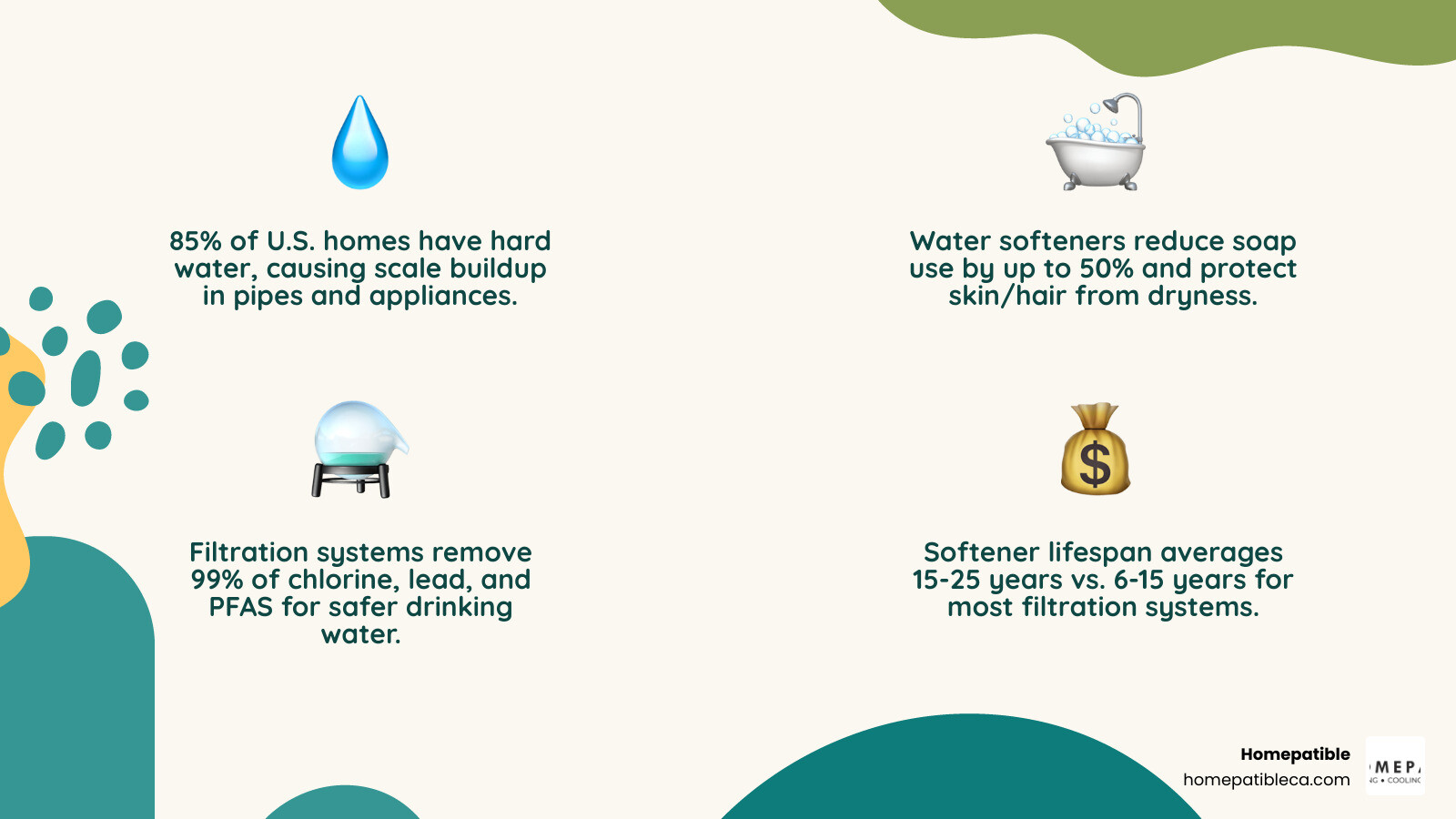
About 85% of U.S. homes deal with hard water, and Santa Barbara and San Luis Obispo Counties are no exception. But hard water and contaminated water are two separate problems — and treating them requires two separate solutions. As Kenton Jones, Certified Water Specialist and VP of Operations at Multipure, put it:
"A home filtration system and water softener can greatly improve the quality and safety of your water at a relatively low cost. Compared with purchasing bottled water for drinking and cooking, replacing expensive appliances, and time spent cleaning showers and bathrooms, water filtration and softening equipment can be very cost-effective."
Many homeowners assume one system covers everything. It doesn't. Buying the wrong one — or skipping one altogether — can leave your appliances, plumbing, and drinking water worse off than you realize.
Analyzing the Water Softener vs Filtration Cost Comparison for Homeowners
When we look at a water softener vs filtration cost comparison, the first thing we notice is that the "cheapest" option isn't always the one with the lowest price tag on the box. The upfront investment for these systems varies based on the technology used and the complexity of the installation. For instance, a basic under-sink filter is a world away from a whole-house reverse osmosis system or a high-efficiency smart softener.
Installation complexity is a major factor in the total initial investment. Water softeners typically require more intensive plumbing work because they need to be integrated into the main water line and require a drain connection for the regeneration process. Filtration systems can range from simple point-of-use units to complex whole-home setups that involve multiple stages of media.
In areas like Montecito, homeowners often prioritize protecting high-end fixtures from scale, while residents looking for water filtration systems in Orcutt might be more focused on removing specific local contaminants. The long-term value of these systems is realized when they are matched correctly to the water profile of your specific neighborhood.
Impact of Water Softener vs Filtration Cost Comparison on Utility Bills
One of the most significant "hidden" benefits of a water softener is its impact on your monthly energy consumption. Hard water is a silent thief; it leaves scale deposits inside your water heater, acting as an insulator that forces the unit to work harder to heat the same amount of water. Research indicates that hard water can reduce water heater efficiency by as much as 48%.
By removing calcium and magnesium, a softener prevents this scale from ever forming. This can lead to a reduction in energy bills of 10% to 30%. When you choose water softener installation in Los Berros, you aren't just buying a kitchen appliance; you're investing in the efficiency of your entire home’s infrastructure. Filtration systems, while excellent for health and taste, generally do not provide this same level of energy-saving ROI because they don't address the mineral content that causes scale.
Evaluating the Water Softener vs Filtration Cost Comparison for Maintenance
Maintenance is where the two systems diverge most sharply. A traditional salt-based water softener requires a steady diet of salt pellets to keep the resin bed functioning. Depending on your water usage and the hardness level, you’ll find yourself refilling the brine tank every six to eight weeks. High-efficiency models can reduce this burden significantly, using up to 40-60% less salt than older, timer-based units.
Filtration systems, on the other hand, rely on filter cartridges or media beds. Point-of-use filters might need a swap every three to six months, while large whole-house carbon tanks might only need a media replacement every few years. If you are looking at water filtration systems in Grover Beach, we recommend factoring in the frequency of these replacements to get a true picture of the annual operating budget.
Long-Term Value: ROI and Appliance Longevity
The real financial story of water treatment unfolds over a decade or more. A high-quality water softener often pays for itself within 3.5 to 7 years through a combination of lower energy bills, reduced plumbing repairs, and massive savings on cleaning supplies. Soft water allows soaps and detergents to lather more effectively, meaning you can use up to 50% less soap to get the same results.
| Benefit | Water Softener | Water Filtration System |
|---|---|---|
| Appliance Lifespan | Extends life by up to 50% | Minimal impact |
| Energy Efficiency | Improves by 10-30% | Neutral |
| Soap/Detergent Use | Reduces by ~50% | Neutral |
| Plumbing Protection | Prevents pinhole leaks/clogs | Prevents chemical corrosion |
| Drinking Quality | Neutral (adds small sodium) | Excellent (removes toxins) |
For many families, especially those opting for water softener installation in Santa Margarita, the reduction in "hard water stress" on the home’s plumbing is the primary driver for the investment.
Salt-Based vs. Salt-Free Softener Effectiveness
It is important to distinguish between traditional salt-based softeners and salt-free "conditioners." Salt-based systems use ion exchange to physically remove minerals. Salt-free systems use Template Assisted Crystallization (TAC) to change the mineral structure so it doesn't stick to pipes.
While salt-free options are often marketed as lower maintenance because they don't require salt refills, they do not actually "soften" the water. You will still have the same mineral content, which means you won't get the same lathering benefits or the "soft" feel on your skin. For serious hard water issues found during a water softener installation in Los Alamos, a salt-based system is usually the more effective choice for protecting the home.
Protecting High-End Appliances
If you have invested in a modern tankless water heater, a high-end dishwasher, or a high-efficiency washing machine, hard water is your biggest enemy. Manufacturers often specify that their warranties may be voided if the unit is operated with water exceeding a certain hardness level without a treatment system.
Hard water can cut an appliance's lifespan by 30% to 50%. By installing a system like those we provide for water softener installation in Santa Maria, you are effectively insuring these expensive investments. A softener keeps the heating elements clear and the internal valves moving freely, ensuring you get the full 15-20 years of service you expect from your appliances.
Choosing the Right System for Your Central Coast Home
The "best" system isn't a matter of opinion; it's a matter of chemistry. We always recommend starting with a comprehensive water test to identify your specific challenges. Are you dealing with 15 grains per gallon (GPG) of hardness, or is your main concern the "rotten egg" smell of sulfur or the chemical taste of chlorine?
In areas like Vandenberg Village, filtration might be the priority for health-conscious families, whereas a water softener installation in New Cuyama might be focused on the heavy mineral loads common in rural groundwater.
When to Install a Combined Softening and Filtration System
For the ultimate home water experience, a combined system is the gold standard. A water softener addresses the "working water" (bathing, laundry, cleaning), while a filtration system — such as a whole-house carbon filter or an under-sink reverse osmosis unit — addresses the "drinking water."
There is a powerful synergy here: a softener actually protects your filtration system. By removing the minerals first, it prevents the filter media from becoming clogged with scale, which can significantly extend the life of your expensive filter cartridges. This is a popular choice for families seeking water filtration systems in Mission Hills who want both great-tasting water and protected plumbing.
Identifying Local Water Challenges
Our local water across the Central Coast varies significantly. Here are some of the common issues we see:
- High Mineral Content: Leading to white scale on faucets and spotty dishes.
- Chlorine/Chloramines: Used by municipalities for disinfection but leaving a harsh taste and odor.
- Sediment: Common in older infrastructure, leading to clogged aerators.
- PFAS/PFOS: "Forever chemicals" that are increasingly a concern in modern water reports.
Whether you are looking at water filtration systems in Santa Barbara or dealing with well water in the outlying areas, understanding these local profiles is the first step toward a cost-effective solution.
Frequently Asked Questions about Water Systems
Which system is better for removing lead and chemicals?
A water filtration system is the only choice for removing lead, chlorine, and chemicals. While a water softener is great for minerals, it is not designed to tackle toxins. For the highest level of health protection, we recommend activated carbon or reverse osmosis filtration.
Does a water softener increase my monthly water usage?
Traditional softeners do use water during their regeneration cycles. However, modern high-efficiency models use up to 30% less water than older units. These smart systems only regenerate when they actually need to, based on your real-time usage, rather than on a set timer.
How often do I need to replace filters or add salt?
For softeners, you should check the salt level monthly and expect to add bags every 6-8 weeks. For filtration systems, point-of-use cartridges usually need replacing every 6 months, while whole-house media tanks can last several years. Many modern systems now feature alerts to let you know exactly when maintenance is required.
Conclusion
Navigating the water softener vs filtration cost comparison doesn't have to be a headache. The key is to stop guessing and start testing. Whether you want to protect your appliances from the ravages of hard water or ensure your family has the cleanest drinking water possible, we are here to help.
At Homepatible, our licensed technicians specialize in the unique water challenges of the Central Coast. We provide transparent pricing, 24/7 emergency service, and the expertise needed to install a system that delivers real long-term value.
Ready to stop scale and start enjoying better water? Schedule your professional water system consultation with us today and let's find the perfect fit for your home and budget.
Ready to take the next step?
Our certified technicians are ready to help with all your home service needs. Schedule a service today.
Schedule My ServiceRecent Posts
Related Articles
Ready to Get Started?
Whether you need a repair, maintenance, or a new system, our expert team is here to help.