
Check It Twice: Your Essential Pre Summer AC Maintenance List
Article content and related resources
Master your pre summer ac inspection checklist: DIY steps for filters, vents, coils & more. Boost efficiency, prevent breakdowns before 2026 summer!
Why Your Pre Summer AC Inspection Checklist Can Make or Break Your Summer Comfort
A pre summer ac inspection checklist is exactly what Central Coast homeowners in Santa Barbara and San Luis Obispo County need before the warm season hits — and here's a quick look at the essential tasks to cover:
Pre Summer AC Inspection Checklist — Quick Reference
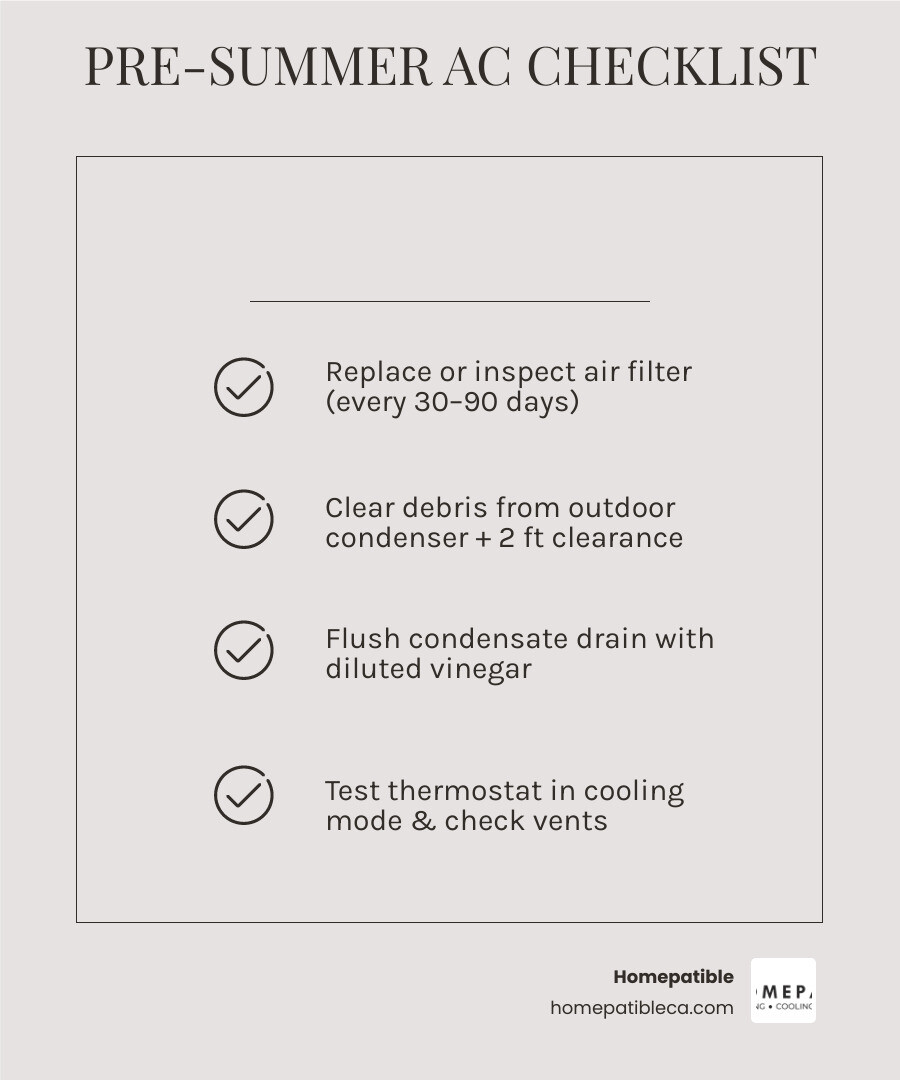
- Replace or inspect the air filter (every 30–90 days during cooling season)
- Clear debris from the outdoor condenser unit and maintain 2 feet of clearance
- Flush the condensate drain line with diluted white vinegar
- Test the thermostat in cooling mode and replace batteries if needed
- Check that all supply and return vents are open and unobstructed
- Inspect accessible ductwork for visible gaps or disconnections
- Listen for unusual noises on first startup
- Schedule a professional tune-up for refrigerant, electrical, and coil checks
Most air conditioners don't fail because they're old or poorly made. They fail because small, preventable problems go unnoticed through the off-season — a clogged filter here, a blocked drain there — and then the first genuinely hot day pushes a stressed system past its limit.
On the Central Coast, that risk is real. While Santa Barbara and SLO County don't face the same brutal heat as inland California, summer still brings stretches of warm, dry days when a working AC is far from optional. And with technicians often booked two to four weeks out by late May, waiting until something goes wrong is a costly strategy.
The good news: a straightforward pre-summer inspection can dramatically reduce the chances of a breakdown. Research consistently shows that preventive maintenance can cut the risk of HVAC failures by as much as 95%, lower utility bills by 10–30%, and extend your system's lifespan by up to 40%. That's a strong return for a couple of hours of attention each spring.
Whether you're handling what you can yourself or getting a licensed technician to handle the technical side, this checklist covers everything you need to head into the 2026 cooling season with confidence.
The Ultimate DIY Pre Summer AC Inspection Checklist
Taking care of your air conditioner doesn't always require a tool belt and a degree in thermodynamics. There are several high-impact tasks you can handle right now to optimize airflow and boost efficiency. In fact, simply changing a dirty air filter can lower your AC’s energy consumption by 5% to 15%. When you consider the cumulative cooling costs of a Central Coast summer, those savings add up quickly.
Starting your pre summer ac inspection checklist with basic airflow optimization ensures that your system doesn't have to "choke" for air. If you're in a coastal area like Santa Barbara, salt air and humidity can also play a role in how your unit performs, making these early checks even more vital. For homeowners in the city, AC Maintenance Tune-Up Santa Barbara CA is a great way to supplement your DIY efforts with professional precision.
Step-by-Step Filter and Vent Maintenance
The air filter is the lungs of your HVAC system. Over the winter, it likely collected dust, pet dander, and allergens. When this filter becomes clogged, the blower motor has to work twice as hard to pull air through, which can lead to frozen evaporator coils or even a total motor failure.
- Check the MERV Rating: For most residential systems, a MERV rating between 8 and 11 is the "sweet spot." It filters out most common pollutants without putting excessive strain on the system. Be wary of high-MERV filters (13+) unless your system is specifically designed for them, as they can restrict airflow.
- Inspect for Dust Accumulation: Hold your filter up to a bright light. If you can't see the light through the mesh, it’s time for a change.
- Clear Supply Registers and Return Vents: Walk through your home and ensure that no furniture, rugs, or curtains are blocking your vents. We often see homes in Montecito where beautiful interior design accidentally smothers the AC vents, leading to hot spots and uneven cooling.
Clearing the Outdoor Condenser Unit
Your outdoor unit is responsible for releasing the heat collected from inside your home. If it’s buried under leaves or surrounded by overgrown shrubs, that heat has nowhere to go.
- Remove Debris: Clear away any dried leaves, pine needles, or trash that has accumulated around the base.
- Maintain 2-Foot Clearance: Ensure there is at least a two-foot perimeter of clear space around the unit. This allows for proper heat exchange and prevents the compressor from overheating.
- Straighten the Fins: The thin metal "fins" on the condenser can easily get bent. You can use a "fin comb" to gently straighten them, which restores proper airflow.
- Gentle Rinsing: With the power off, use a garden hose (never a pressure washer!) to gently rinse away dust and pollen from the coils. This is especially helpful for units in Goleta or Summerland where coastal breezes can deposit salt and grit on the equipment.
Finally, don't forget the condensate drain line. This is the PVC pipe that carries moisture away from your indoor unit. Pouring a cup of distilled white vinegar down the line helps kill algae and mold that could otherwise cause a backup and lead to water damage in your home.
Maximizing Efficiency with Smart Controls and Duct Care
As we move into the 2026 season, technology is playing a bigger role than ever in home comfort. If you are still using a manual thermostat, you might be leaving money on the table. Upgrading to a smart system, like Google Nest, allows you to program cooling schedules that align with your lifestyle, ensuring you aren't cooling an empty house while you're out enjoying the beaches of San Luis Obispo.
Testing Your Thermostat for the 2026 Season
Before the first heatwave, you need to know if your "brain" (the thermostat) is talking correctly to the "body" (the AC).
- Calibration Check: Place a separate thermometer next to your thermostat. If the readings differ by more than two degrees, your thermostat may need recalibration or replacement.
- Battery Refresh: If your thermostat uses batteries, swap them out now. A low battery can cause the system to cycle erratically or fail to turn on entirely.
- Test Cooling Mode: Set the thermostat to "Cool" and drop the temperature five degrees below the current room temp. You should hear the indoor blower kick on, followed shortly by the outdoor compressor.
- Temperature Differential: After about 15 minutes of running, the air coming out of the vents should be 14°F to 22°F cooler than the air going into the return vent. If the gap is smaller, you likely have a refrigerant or airflow issue that needs professional attention in Carpinteria.
Why Your Pre Summer AC Inspection Checklist Includes Ductwork
Ductwork is the most overlooked part of the HVAC system because it’s usually hidden in attics or crawlspaces. However, the average forced-air system loses 20% to 30% of its conditioned air to leaks and poorly connected ducts.
When air leaks out of your ducts, you’re paying to cool your attic instead of your living room. This creates "static pressure" issues that strain the blower motor and reduce indoor air quality by pulling in dust and insulation fibers from unconditioned spaces. If you notice uneven cooling in your home in Isla Vista, a ductwork inspection should be at the top of your list.
Professional Tune-Up: Beyond the DIY Scope
While DIY tasks are great for maintenance, certain parts of a pre summer ac inspection checklist require specialized tools and EPA certification. Handling refrigerant, for example, is not only dangerous but also highly regulated. Refrigerant doesn't "run out" like gas in a car; it stays in a closed loop. If your levels are low, it means you have a leak that needs to be sealed.
A professional tune-up in Solvang or Buellton includes several critical technical checks that keep your system safe and efficient.
Critical Components in a Professional Pre Summer AC Inspection Checklist
Our licensed technicians look at the components you can’t see or safely test yourself:
- Electrical Connections: We tighten all connections and measure voltage and current on motors. Loose connections are a leading cause of part failure and can even pose a fire risk.
- Capacitor Testing: The capacitor is like a battery that gives your motor the "kick" it needs to start. These often fail during the first heatwave of the year. Testing them early allows for a proactive replacement that costs much less than an emergency repair call.
- Evaporator Coil Cleaning: The indoor coil can become caked with microscopic dust that passes through the filter. This grime acts as an insulator, preventing the coil from absorbing heat and potentially causing the system to freeze up.
- Lubrication: We lubricate all moving parts to reduce friction. Less friction means less energy used and a longer life for your blower and fan motors in Hope Ranch.
Identifying Warning Signs During Your Pre Summer AC Inspection Checklist
Even during a routine check, you should keep your ears and nose open for "red flags":
- Unusual Noises: Grinding, squealing, or banging sounds usually indicate a belt has slipped or a bearing is failing.
- Burning Smells: This could indicate electrical components overheating or a thick layer of dust burning off a heater element.
- Frequent Cycling: If your AC turns on and off every few minutes (short-cycling), it’s a sign of an oversized unit, a thermostat issue, or a dying compressor.
- Warm Air: If the air coming from the vents isn't cold, don't keep running the system. This can cause permanent damage to the compressor. If you're in Toro Canyon and experience this, shut the system down and call for service immediately.
Frequently Asked Questions about AC Maintenance
| Task | DIY-Friendly? | Professional Recommended? | Frequency |
|---|---|---|---|
| Filter Replacement | Yes | No | Every 30-90 days |
| Outdoor Unit Cleaning | Yes | Yes (for deep clean) | Annually |
| Drain Line Flush | Yes | No | Monthly in summer |
| Refrigerant Check | No | Yes | Annually |
| Electrical Testing | No | Yes | Annually |
| Thermostat Testing | Yes | Yes (for calibration) | Every 6 months |
How often should I change my AC filter during a Central Coast summer?
Most homeowners should check their filter every 30 days. If you have pets that shed or live in a particularly dusty area, you may need to replace it monthly. During the milder months of a 2026 spring, you might get away with every 90 days, but once the cooling season is in full swing, airflow efficiency is your top priority.
What are the signs that my AC needs immediate repair?
Immediate help is needed if you see ice formation on the copper refrigerant lines, water leaking from the indoor unit (indicating a clogged drain or frozen coil), or if the system keeps tripping your circuit breaker. High utility bills that can't be explained by a change in weather are also a major sign that your system is struggling and needs a professional eye.
Can I clean my own AC coils?
You can gently rinse the outdoor condenser coils with a hose. However, the indoor evaporator coils are much more delicate and harder to access. Using the wrong chemicals or too much pressure can flatten the fins and ruin the coil. We recommend leaving indoor coil cleaning to the pros to avoid accidental damage.
Conclusion
Preparing for the 2026 summer doesn't have to be a headache. By following this pre summer ac inspection checklist, you're taking the most important step toward a stress-free, cool, and energy-efficient season. From the simple act of changing a filter to the technical precision of a professional tune-up, every bit of maintenance pays off in lower bills and a longer-lasting system.
At Homepatible, we are proud to serve our neighbors across Santa Barbara and San Luis Obispo Counties. As licensed technicians and Nest Pro Elite partners, we bring the best of modern smart home technology and traditional HVAC expertise to your doorstep. Whether you're in Santa Maria, Goleta, or any of our 40+ service communities, we are here 24/7 for your emergency needs and routine care.
Don't wait for the first 90-degree day to find out your AC isn't up to the task. Schedule your maintenance today and stay cool all summer long!
Ready to take the next step?
Our certified technicians are ready to help with all your home service needs. Schedule a service today.
Schedule My ServiceRecent Posts
Related Articles
Ready to Get Started?
Whether you need a repair, maintenance, or a new system, our expert team is here to help.