
Central AC vs Mini Splits: Which One Wins the Cold War?
Article content and related resources
Discover central ac vs ductless mini split comparison for Central Coast homes. Compare efficiency, installation & costs to pick the best cooling winner!
The Cooling System Dilemma Every Central Coast Homeowner Faces
A central ac vs ductless mini split comparison is one of the most common questions homeowners across Santa Barbara and San Luis Obispo Counties ask when it's time to upgrade or replace their home cooling system — and for good reason. The answer affects your energy bills, your comfort, and how much disruption you'll deal with during installation.
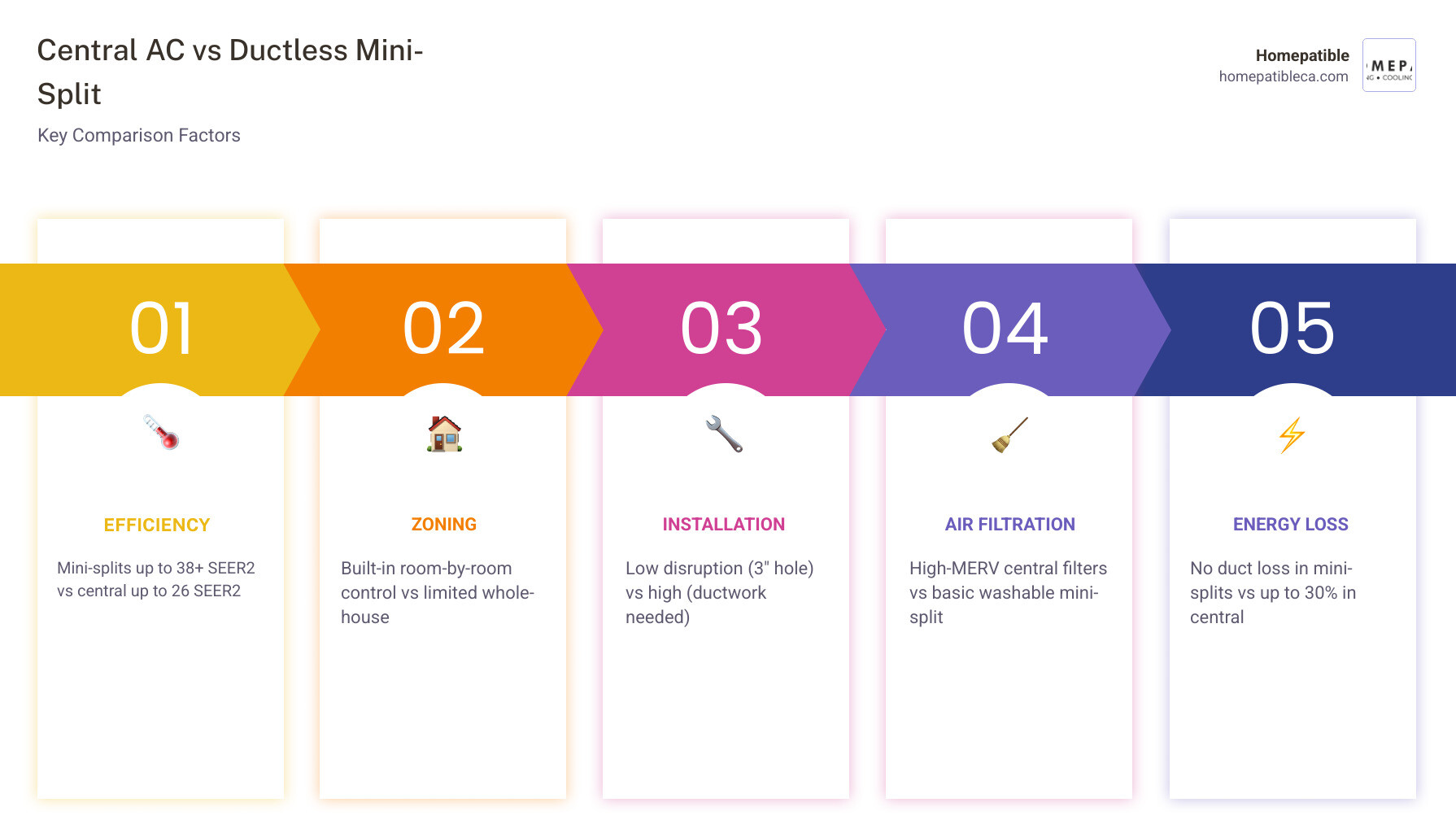
Here's a quick breakdown to help you decide:
| Factor | Central AC | Ductless Mini-Split |
|---|---|---|
| Best for | Homes with existing ductwork | Homes without ducts, additions, older homes |
| Efficiency (SEER2) | Up to 26 SEER2 | Up to 38+ SEER2 |
| Zoning | Limited (requires add-ons) | Built-in, room-by-room control |
| Installation disruption | Higher (ductwork required if none exists) | Low (3-inch wall penetration) |
| Air filtration | Superior (high-MERV filters) | Basic (washable filters) |
| Aesthetics | Hidden vents, cleaner look | Visible wall units |
| Lifespan | 15-20 years | 15-20+ years |
| Duct energy loss | Up to 25-30% | None |
The honest answer? Neither system is universally better. The right choice depends on your home's existing infrastructure, how you use your space, and your long-term comfort goals.
On the Central Coast, that decision gets even more nuanced. Santa Barbara and San Luis Obispo homes range from historic craftsman bungalows with no ductwork to newer builds already wired for central air. Coastal fog, inland heat spikes, and mild winters all shape how hard your system works — and which one delivers the best return on your investment.
This guide walks you through every major factor, side by side, so you can make a confident, informed choice for your home.
Understanding the Mechanics: Central AC vs Ductless Mini Split Comparison
When we look at a central ac vs ductless mini split comparison, we have to start with the "how." Both systems use the same basic physics: they use refrigerant to absorb heat from inside your home and dump it outside. However, the way they move that cool air around your living room in Goleta or your bedroom in Pismo Beach is completely different.
Central air conditioning is what most of us grew up with. It's a "forced air" system. There is one large indoor unit (an air handler or furnace with an evaporator coil) and one large outdoor condenser. The indoor unit blasts chilled air through a network of hidden ducts and out through vents in your floors, walls, or ceilings. It's an all-or-nothing approach; one thermostat usually controls the temperature for the whole house.
Ductless mini-splits, on the other hand, skip the middleman (the ducts). An outdoor compressor connects to one or more indoor air handlers via thin refrigerant lines. These air handlers are mounted directly on the wall or ceiling of the room they are cooling. Because there are no ducts, there is no energy lost as the air travels through the attic or crawlspace.
Modern systems in 2026 have come a long way. Most high-end units now use inverter technology. Think of a standard AC like a light switch — it's either 100% on or 100% off. Inverter-driven, variable-speed compressors are more like a dimmer switch. They can ramp up or down to meet the exact cooling demand of the room, which prevents those annoying temperature swings and saves a massive amount of electricity.
If you’re curious about how these compact units handle the heat, check out our deep dive on Ductless AC installation in San Luis Obispo: small units, big chill.
Energy Efficiency and Performance in the Central Coast Climate
Efficiency is where the central ac vs ductless mini split comparison gets really interesting. In the HVAC world, we measure efficiency using SEER2 (Seasonal Energy Efficiency Ratio). As of April 2026, the standards have become quite strict, but ductless systems are still the reigning champions.
While a high-efficiency central AC might reach a respectable 26 SEER2, some ultra-efficient ductless mini-splits are now hitting 38 or even 42 SEER2. But the numbers on the box don't tell the whole story.
The "hidden" efficiency killer in central systems is duct leakage. Research shows that typical duct systems lose about 25% to 30% of their cooling energy through leaks, poor insulation, or thermal bypass. Imagine buying a gallon of milk in Santa Maria, but 30% of it leaks out of the bag before you get home. That’s essentially what happens with leaky ducts in a hot attic.
Ductless systems deliver 100% of the cooling directly into the room. This can reduce cooling costs by 30% in homes that previously lacked ductwork or had failing systems. Furthermore, most mini-splits are actually heat pumps. This means they can reverse the process in the winter, providing incredibly efficient heating for those chilly nights in Buellton or Solvang without needing a separate furnace.
To keep either system running at peak efficiency, regular care is non-negotiable. You can Tune-up to chill out with San Luis Obispo AC maintenance to ensure your SEER2 ratings stay as high as the day the unit was installed.
Why a central ac vs ductless mini split comparison favors zoning
One of the biggest complaints we hear from families in Montecito or Orcutt is the "thermostat war." One person is freezing in the kitchen while another is sweating in the upstairs office.
This is where ductless mini-splits shine. Because each indoor unit has its own thermostat, you get built-in zoning. You can set the guest room to 78 degrees while keeping the master bedroom at a crisp 68. This isn't just about comfort; it's a massive energy saver. Why pay to cool an empty living room at 2:00 AM?
Central AC can be zoned, but it requires a complex system of motorized dampers inside the ducts and multiple thermostats. It's often an expensive add-on and rarely as precise as a ductless setup. Ductless systems also frequently use occupancy sensors to detect when a room is empty, automatically shifting into an eco-mode to prevent energy waste.
Maximizing efficiency with smart home integration
In 2026, your AC shouldn't just be "set and forget." As licensed Nest Pro Elite technicians, we’ve seen how smart home integration can transform a central ac vs ductless mini split comparison.
Whether you choose central or ductless, pairing your system with Google Nest Pro technology allows for:
- Adaptive Learning: Your system learns your schedule and adjusts temperatures automatically.
- Remote Monitoring: Did you leave the AC blasting in your Carpinteria beach house? Turn it off from your phone in Santa Barbara.
- Energy Usage Reports: See exactly how much power you’re using and get tips on how to save.
- Geofencing: Your home can start cooling down the moment your phone enters the neighborhood.
Installation Considerations for Santa Barbara and San Luis Obispo Homes
The "best" system often comes down to the "bones" of your home. If you live in a newer home in Vandenberg Village or Mission Hills that already has high-quality ductwork, replacing a dead central AC unit with a new, high-efficiency central model is often the path of least resistance.
However, if you’re looking at a home addition, a converted garage in Lompoc, or an attic workshop in Arroyo Grande, running new ductwork is often a nightmare. It involves tearing into walls, dropping ceilings, and losing precious closet space. For these scenarios, ductless is the clear winner. Installation only requires a small three-inch hole in the exterior wall for the refrigerant and power lines.
If you’re planning a project in the Lompoc area, you’ll want to look at Don't sweat it: your Lompoc AC installation roadmap. For those further north, we have a local's guide to getting new AC in Arroyo Grande that covers the specific needs of South SLO County homes.
Choosing the right path: central ac vs ductless mini split comparison for older homes
Our local area is famous for beautiful historic homes. Whether it’s a Victorian in Santa Maria or a mid-century gem in San Luis Obispo, these houses often have plaster walls and zero crawlspace.
Installing central air in these homes can be structurally invasive and aesthetically jarring. A central ac vs ductless mini split comparison for a historic home usually ends with ductless. We can install "slim duct" units that hide in the ceiling or floor-mounted units that look like traditional radiators, preserving the home's character while providing 21st-century comfort.
Residents in the North County can find more local insights in our guide on 5 reasons why you will love AC install in Paso Robles.
Air Quality, Maintenance, and Long-Term Reliability
Indoor air quality (IAQ) is a top priority for Central Coast residents, especially during fire season or high-pollen springs.
Central AC systems generally offer superior air filtration. Because they use a powerful central blower, they can push air through thick, high-MERV filters that trap smoke, pet dander, and microscopic allergens. If you have severe allergies, a central system with an integrated whole-home air purifier is hard to beat.
Ductless units have filters, but they are smaller and primarily designed to protect the unit's internal components. They are usually washable, meaning you’ll need to rinse them out every 2–4 weeks. While they do help with IAQ, they aren't quite as robust as a central system's filtration.
Maintenance is a bit of a wash. Central systems need their ducts cleaned every few years and the outdoor unit serviced annually. Ductless systems require you to stay on top of those washable filters, and the indoor heads need a deep professional cleaning every year or two to prevent mold buildup.
Both systems typically last 15 to 20 years if cared for properly. If you’re trying to keep your current system alive on a tight budget, check out The best AC repair services in San Luis Obispo on a budget. If you're ready for someone to help you navigate the sea of installers, we have a guide to air conditioner installers near San Luis Obispo that can help.
Frequently Asked Questions about Home Cooling Systems
Choosing between these two is a big decision. Here are the most common questions we hear while out in the field in places like Ballard and Los Olivos.
Which system is quieter for a home office or bedroom?
Ductless mini-splits are the undisputed kings of quiet. The indoor units operate at decibel levels between 19 and 26 dB — that is literally softer than a whisper. Central AC isn't exactly "loud," but you will always hear the "whoosh" of air moving through the vents and the sound of the ductwork expanding and contracting. For a home office where you're on Zoom calls all day, ductless is the way to go.
Can I use both systems together in a hybrid setup?
Absolutely! This is actually a very popular choice in Santa Barbara. You might have a central AC system that handles the main floor perfectly but leaves the upstairs master suite or the new sunroom sweltering. Adding a single-zone ductless mini-split to that "problem room" gives you the best of both worlds without the cost of a full system overhaul.
What are the typical maintenance requirements for each?
- Central AC: Change the disposable filter every 1–3 months, keep the outdoor unit clear of debris (leaves/grass), and have a professional tune-up once a year.
- Ductless Mini-Split: Wash the indoor filters every 2–4 weeks, ensure the outdoor unit has at least two feet of clearance, and schedule a professional deep clean of the indoor coils annually.
Don't forget that the Inflation Reduction Act of 2022 is still providing significant federal tax credits (up to $2,000 for qualifying heat pumps) in 2026. Many local utility companies on the Central Coast also offer rebates for switching to high-efficiency electric cooling.
Conclusion: Making the Best Choice for Your Central Coast Home
At the end of the day, a central ac vs ductless mini split comparison isn't about finding the "best" technology — it's about finding the best fit for your lifestyle and your home.
Whether you're looking for the discrete, whole-house coverage of central air or the hyper-efficient, zoned comfort of a ductless mini-split, our team is here to help. We live and work right here in Santa Barbara and San Luis Obispo Counties, serving neighbors from Carpinteria to San Simeon.
As licensed Nest Pro Elite technicians, we specialize in making homes smarter, safer, and more efficient. We offer 24/7 emergency service and transparent pricing, so you never have to worry about hidden fees or middle-of-the-night meltdowns.
Ready to end the "Cold War" in your home and find the perfect cooling solution? More info about HVAC services is just a click away, or give us a call to schedule your comfort assessment today.
Ready to take the next step?
Our certified technicians are ready to help with all your home service needs. Schedule a service today.
Schedule My ServiceRecent Posts
Related Articles
Ready to Get Started?
Whether you need a repair, maintenance, or a new system, our expert team is here to help.